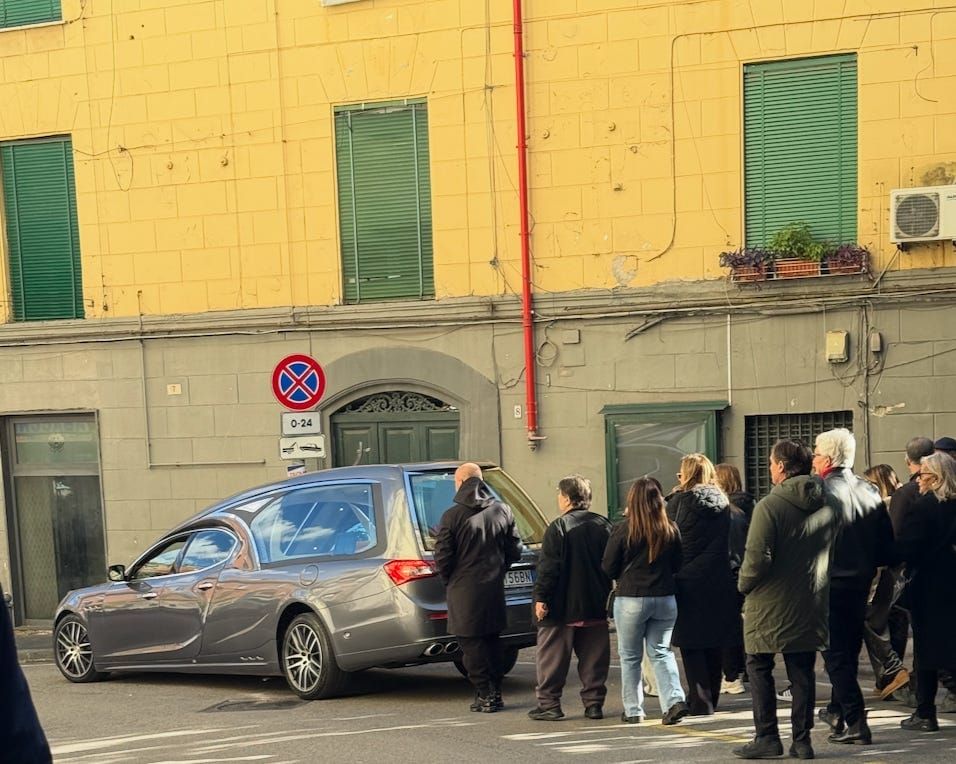
In Naples I saw my first Maserati hearse. It was making its way slowly down a narrow cobbled street, mourners following slowly, solemnly in procession.
I am always ready to be a respectful cortege onlooker. For one thing there’s the jolt, the reminder, as you’re going about your ordinary day: it comes to us all.
For another you don’t want to be the person who can’t manage to show a bit of respect and decency.
But in Naples I saw for the first time in my life a Maserati hearse and I forgot myself. I went for my phone. A Maserati!
A few minutes later when Karren and I were talking about what we’d just seen, I said, I mean, how fast do you need a hearse to go?
It had been Karren who had seen what I was about to do and quietly asked if I thought that was such a good idea.
We stood and watched as they slowly made their way down the hill. When they were at a decent distance and had their backs to us, she said, Maybe now.
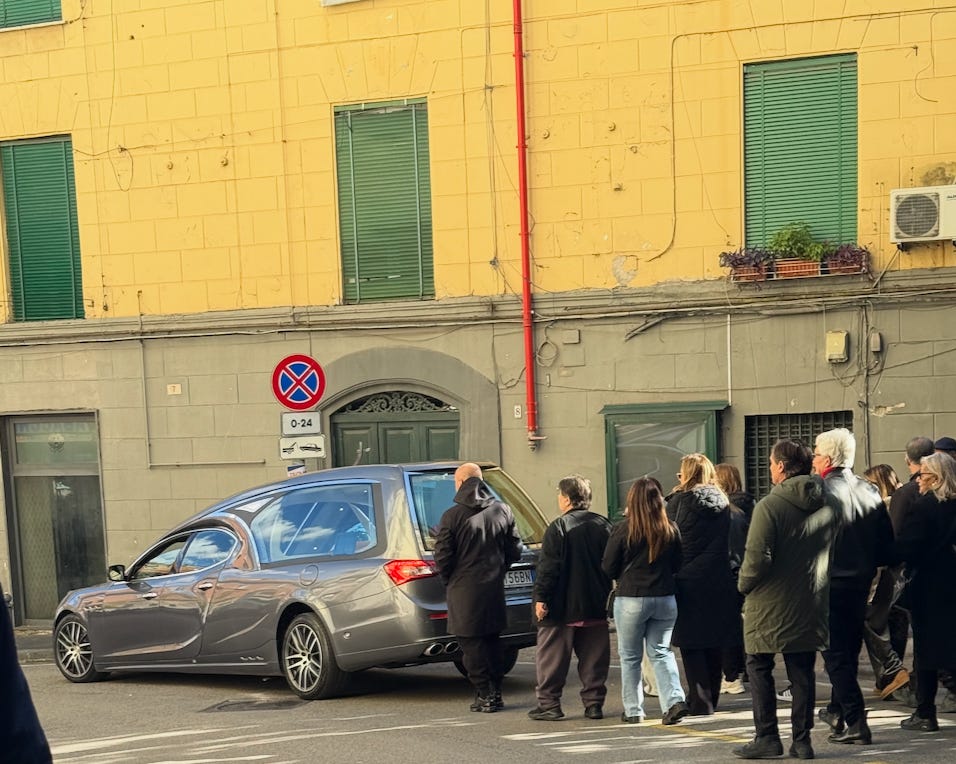
A Maserati hearse! Talk about fancy. But who am I to judge what people might do for a loved one. Nothing was too good for her, she was a saint etc.
There is a line, in your mind and you keep to your side of it.
We were enthralled by the excavations at Herculaneum and Pompeii and I photographed here and everywhere. But when you come to a scene of huddled remains down at the water’s edge in boatsheds where they took shelter and their posture of fear and distress has been frozen in time, the snapping stops. You apprehend what this was and you are stilled.
At the Mauthausen camp last year, I took a photo from the hill as we parked our bikes and it was the only one I took.
It matters, respect for the dead. We are rightly angered when people show disregard. But also: it’s asking comparatively little of us to take a moment, to say nothing. It’s easy to get people to agree on respect for the dead. It can be a whole lot harder to get it for the living; a whole lot harder for those judged to be less worthy, less deserving, less human.
This is not to say that this is new or even that we have not been much worse at it at many points in the long trudge of civilisation.
But it felt as though we had been pointing ourselves in better directions in recent decades, even in the face of rednecked and belligerent objection.
Where we are now, in terms of race, in terms of sex, in terms of identity, in terms of respect for minorities of all kinds, is looking altogether less hopeful than it had been.
There can be few people with less respect for others than the pig in the White House, and the protofascists who are helping him to fashion such work as the National Security Strategy document instructing Europe to stop immigration from Asia, Africa, and the Caribbean lest the Great Replacement fears of white nationalists come to pass. The great danger to the world in their eyes is not China, not Russia, but people of colour moving to Europe. Message not clear enough? Let him add that Somali Americans are garbage.
It’s easy to see this guy and his appalling administration as far worse and wrong than anything we’re saying or doing in our little hobbit hollow. But the way people talk about the bloody Treaty, and bloody Māori, and bloody bludgers and bloody pronouns and bloody trans people and all the rest of it runs on a continuum.
Dignity and respect isn’t just about please and thank you, it holds us together. When someone treats you with dignity, they’re saying: you matter here, you belong.
More mortality, more respect for the dead. Down in the Naples catacombs of San Gennaro and San Gaudioso, where they ask that you not take photos, you come to the end of the tour and they explain to you how these tours have only been going for the past twenty years or so. They describe the inspired idea some people had to open them up to visitors, to give young people of the community the chance to be guides and bring some good to a neighbourhood hampered by crime and economic decline. The young guides speak with passion about what it has done for the sense of community.
Dignity is making a place for everyone. Everywhere you go in Europe, you’re never far from a reminder of how deadly it can turn when humanity loses its sense of that. But there are also always reminders that we know how to be better.