
A thought I can often have as I walk past yachts like this is: The pristine unsullied gleam on those things is unreal.

Another thought I can often have is: It cannot be good, what’s happening with wealth in the world. It feels so wrong.
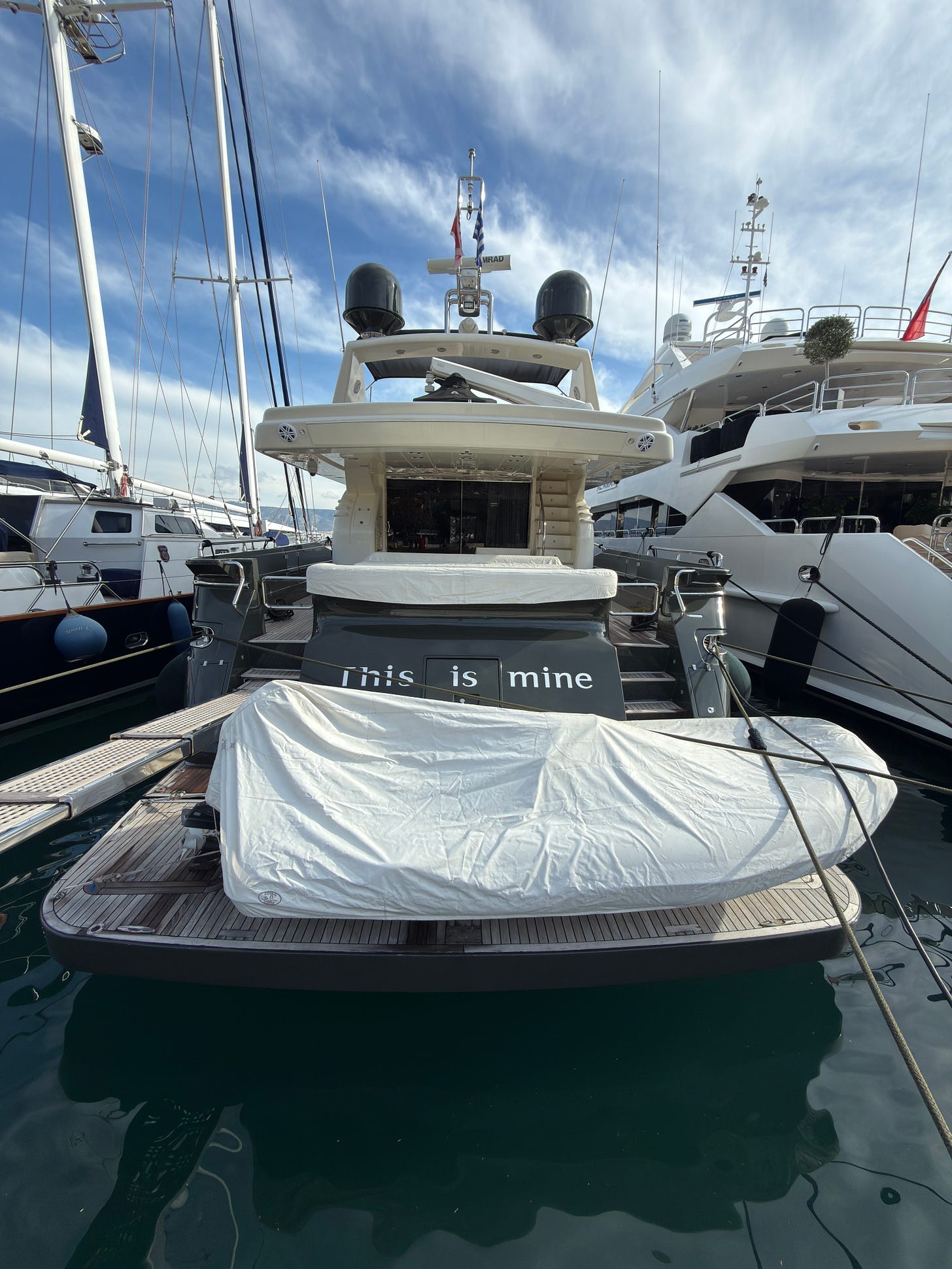
You could be in Auckland. You could be in Bermuda. You could be on the Riviera. The yachts are in all the nice places.
In this case it happens to be Athens, a marvellous place but not by any means rolling in wealth, especially not after a debt crisis and data that says as many as a third of homeowners are behind on their mortgage.
Lovely people they are, who surely deserve every good fortune, but you know that most of them will only ever be walking past these places pushing a stroller under a sunny blue sky.
Perhaps that should be enough for any of us: the prospect of a nice walk under a sunny blue sky, and if we try really hard, maybe one day owning such a boat as this. Live and let live, in other words. Let highly motivated people be as voracious in their consumption as they wish, as avaricious as it suits them to be. Let inequality be the great incentive for the rest of us to try harder.
This is no doubt how our prime minister sees it. Celebrate the wealth and the wealth creators, think like winners, and all the rest of it.
We have for very good reason this year worried more and more about the billionaires and the hold they have taken of our media and communications and levers of political power, and the algorithms that pit us against one another and the AI fantasies that stand to dispossess us, and I am for sure greatly worried about it. But when I walk past the super yachts, I think about the broader ecosystem that’s done so much to spawn it all.
We could use The One Percent, that somewhat captures it, but it feels as though what’s happened actually reaches a bit farther and wider than that. What we’ve ended up with is a very comfortable class, the kind that for instance was happily pronouncing its belief that New Zealand should stop putting up its feet for such long summer holidays, oblivious to the reality that many of New Zealand’s least well-paid workers are already counted out of that calculation and will be expected to be bringing the drinks and ringing up the purchases at the Boxing Day sales.
Many people have been feeling a little bit stunned each time they go to the supermarket, and any time they go out to eat if, in fact, they still do. But in the comfortable class, life glides on.
There has always been rich and poor, and very often in history the gulf has been huge. But for a nice long while in the postwar era we had something pretty good going. Where we are now represents quite a drift from that.
How did we let it happen? Making a fetish of inadequate taxation has played a large part, the cult of individualism and market forces too.
And there’s also this. The story has been told with many different numbers, but the essential point is always abundantly clear. Let’s run one set of numbers to get to that point.
In America in 1965, CEOs earned 21 times more than the average worker; by 2023, this ratio had escalated to 290 times.
We echoed that in New Zealand: in 1997, average CEO pay was 11 times higher than the average worker salary. In 2019, it had climbed to 18 times higher—and as high as 88 times.
Your mileage may vary, but let’s not get lost locating the exact number. The broad point is abundantly clear: the ratio has greatly, greatly increased.
What happened? For one thing, once you make pay public, you have the makings of a self-serving arms race. In 1970, Forbes magazine published a scorecard of the highest-paid CEOs, and in doing so they set off a raft of fresh negotiations as other CEOs decided they deserved to be paid more. To quote one acerbic academic: Most companies wanted to be in the top compensation quartile—a mathematical impossibility, precipitating an unstoppable upwards spiral.
The headhunters who get paid on commission thought this was really good for business, thus dragging along broader executive pay with it and minting an entirely new gilded class of people. This self-serving deluded racket went everywhere. Everyone with a vested interest climbed on board.
In this way we managed to create a two-track system that saw ordinary workers purchasing power compressively declining while the best-paid did ever better. What were once viable dreams like buying a house and going on holiday steadily dwindled for many. But for the more fortunate, the car kept picking up speed and turned into a luxury import.
The more you pay such people, the more they believe in their own bullshit, and the greater the certitude they bring to their pronouncements. Such people love to tell you that a CEO is absolutely worth several million dollars a year in pay; an article of faith among true believers.
They can even make it sound quite persuasive; one might almost manage to believe it were it not for the last two years watching Christopher Luxon in painful close-up action.
You’d think that people being paid millions might be bolder and more daring and take advantage of the opportunity to look out over the horizon, but they can be surprisingly lacking in this way.
The Prime Minister is a dire case in point.
He was too busy this year to ever talk to Jack Tame and get into any serious discussion about the country he leads and where he might like to lead it. However he was prepared this week to sit down with RNZ to answer the question: Merry Christmas Prime Minister. You have twenty minutes to make uncontested assertions in defence of your woeful stewardship of the country. Your time starts now.
What he offered was exactly what you might expect from a plodding CEO trying to defend a lacklustre share price, promising everything will be better next quarter.
The reality is we hit quarter two with Trump’s liberation day and that caused a huge loss of confidence. Through that winter period in New Zealand it was incredibly difficult because the reaction to the Q2 contraction in the economy, as a function of the chaos and the uncertainty around the tariff policy, caused a huge amount of negative sentiment for people.
Nope. Nice try, buddy, but our real problem is being a narrow, comparatively low-skilled 20th-century economy and you’re doing squat about that. And no, a line like our opportunity is to get inflation down, interest rates down, get the economy growing, create opportunity for jobs doesn’t count. That’s so generic you might as well put a Pams label on it and call it hand soap.
He’s a dullard, a next quarter performer. Cannot wait to see him go so we can restart the engines.
Robert Reich was so right when he said: Concentrated wealth is a policy choice. Inequality is a policy choice.
The system needs to change, fundamentally. We need to reclaim a collective spirit. We need better policies. We need sustainable ones. And we need better people making them.