And other canards that legrope us
Public transport: what a ghastly way to go!
My very first ride ended in misery. I was 5, getting off the school bus, just a step down into the gravel outside school, but somehow I got it wrong and ended up slipping into a deep wet muddy ditch.
Still at the same school, on the way home from a big trip, on the steep downhill from Taihape to Mangaweka, the bus lost clutch or brakes or some combination of that. We stayed upright and no harm done, but scary all the same.
The following year, on another school bus, a car pulled out in front of us and we smashed into it and ended up bouncing overland for a few hundred yards. Also no harm done, but also pretty perturbing.
On that same school bus, a few years later, a thoroughgoing asshole by the name of Jeff got on one morning with a smirk at his mates and a knowing look at me, and the reason for this turned out to be that he’d gone to the trouble of making some muffins loaded with chilli powder and intended to get them stuffed into my mouth. We ended up rolling around the floor of the bus, one smirking and one wild with rage, until the driver stopped the bus and broke it up.
It was around this time I started using my ten-speed to do the ten-mile trip up and down Kimbolton Road, and fuck me if Jeff the asshole didn’t switch to chucking rocks at me out the window as they went past. He kept this up until the day I hammered on their front door and shouted the odds at him until his father came to see what was going on. After that there were no more missiles.
This was when I first learned how hostile people in vehicles can be to people on bikes, and I remain painfully aware but also not at all put off.
Likewise I am not in the least dissuaded from taking public transport because things can go wrong.
Which brings us on to this week’s most excellent Labour Party policy, which doesn’t really apply to me at all, but I love it anyway.
To recap, it’s a cap. The most you’ll pay on your public transport fares is twenty dollars a week if you’re up in Auckland, Wellington or Christchurch, and ten dollars everywhere else. It’s a bloody good proposition, is what it is: I can get everywhere I need to go for a maximum of twenty dollars a week. Work, school, the doctor, your friend’s place, a job interview, wherever you’re headed. You pay up to twenty dollars, and after that, for the rest of the week, the meter stops. Go where you like.
We understand this principle perfectly well in other parts of life. We love a flat rate, an all-you-can-eat, an annual pass. We don’t need to get out the calculator and add up the costs of running even the cheapest of cars to make the comparison. $20 a week to get around (yes, granted, assuming it’s available to you) is a bloody good proposition.
What’s not to admire? It’s clear and simple and gives a great break to people who could really use it.
What’s not to admire? Just ask the many citizens of this plucky little nation who believe that no one anywhere should ever be getting something that I don’t. These are the people who seem to imagine that tax is simply something you pay in advance for services to be rendered back to you by the useless State.
Sigh. Yes, you’re right: if you don’t use public transport you won’t be getting any free rides. Here’s what you get instead: You get fewer cars in the queue in front of yours, cleaner air in the lungs of your own kids, shops with customers who can actually get to them and businesses that can find the staff to run them.
It makes the place you live in a better place for everyone to live, which is the only return on tax that has ever really mattered.
A good society isn’t a vending machine. You don’t put your coin in and get your exact coin’s worth back out. You all put coins in, and you get something none of you could have bought alone.
Also there’s this: if you’re in Nelson you probably don’t use the Waikato Expressway, and if you’re in Henderson you probably don’t use Transmission Gully much. But where’s the guts-aching about that? We pay for plenty of things we don’t personally use: schools after our kids have left them; hospitals while we’re healthy; frigates pretty much always, because that’s what a country is.
And regarding the roads you do use: Who paid for them? Everyone did, including the people on the bus, who are subsidising your driving rather more heavily than you’ll ever subsidise their fare.
Who’s going to pay for this? Easy: the same people who are being expected to pay tens of billions of dollars for Roads of National Significance that have already had to be massaged to the point of squeaking to yield an acceptable cost-benefit ratio.
This scheme is just puny cents in the dollar compared to that.
Well, what if they’ve underestimated the cost? And it’ll be way more than $65 million? Well sure, it does actually sound light to me. But if so many people might climb aboard that the bill comes in at three or four hundred million what then? Oh no!! The good thing happened more than expected!! I would be delighted.
That would be hundreds of thousands more people getting where they need to go for twenty dollars a week, hundreds of thousands fewer cars in the queue ahead of you. And we could take every cent of it off the roads budget and never notice the difference. It’s loose change down the back of the RONS couch.
Every person on a bus is a person not in a car in front of him. Less congestion, faster freight, cheaper roads to maintain. You can benefit from the infrastructure other people use, even when you never touch it.
What also seems to be at play in this is prejudice: Public transport is for losers.
Well, you know what? The plane that took you to Fiji was public transport. A long aluminium bus with a drinks trolley, several hundred strangers packed in shoulder to shoulder, and you paid through the nose to get on board. A cruise ship is public transport with a buffet and a magician. Nobody calls the Koru Lounge a place for losers.
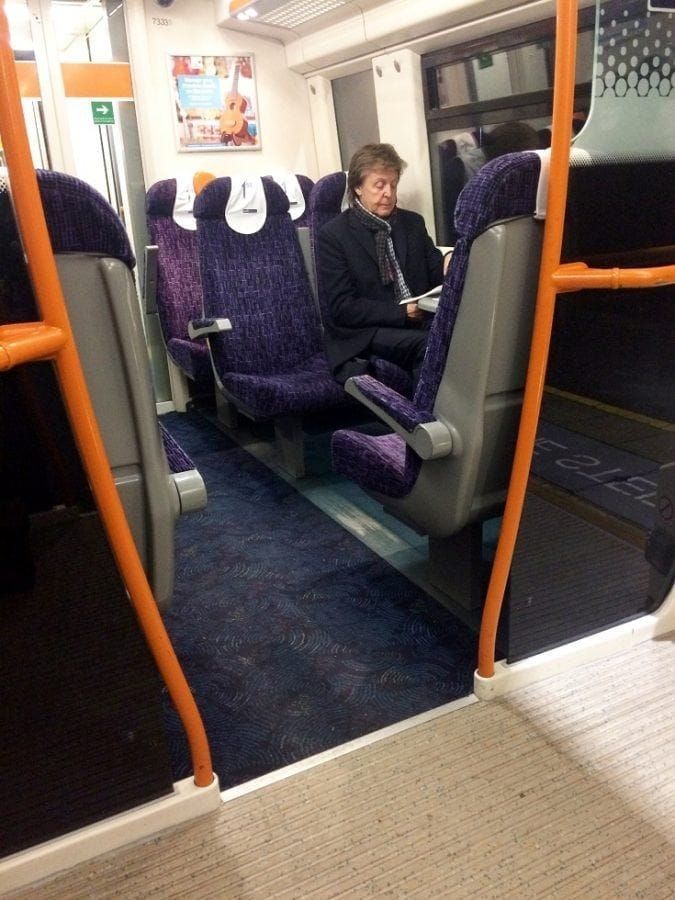
Finally, consider this loser on public transport in London.
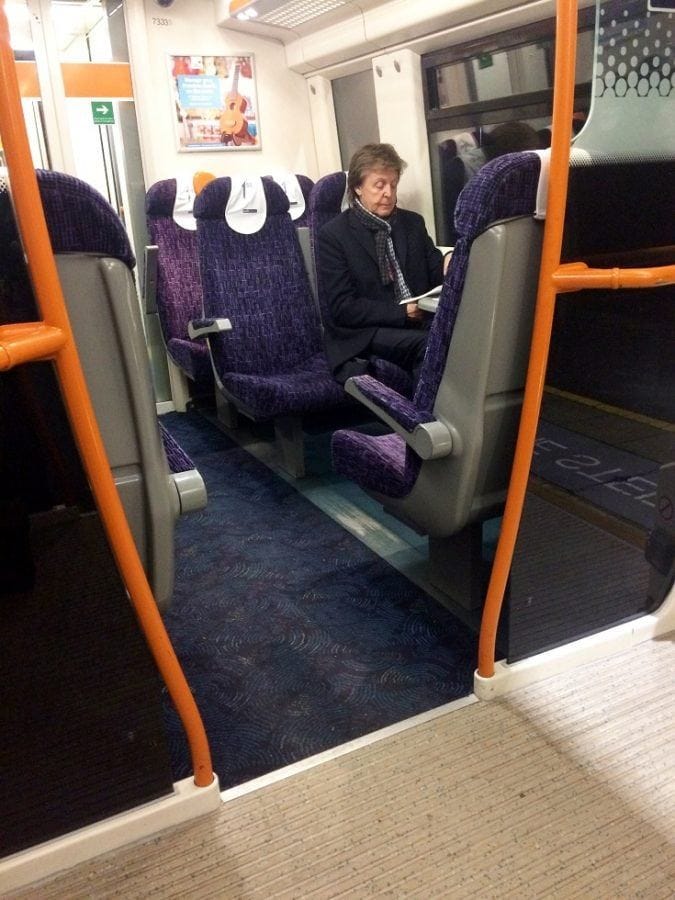
He could buy the train. He takes the train.
Think about how great it can feel in the stand watching your favourite team. All those different people who’d otherwise never meet, all roaring at the same thing.
We get less and less of that. We’ve sorted ourselves into suburbs and feeds and locked cars, each in our own little capsule with the radio agreeing with us.
The bus and the train and the ferry remain a place where the city is simply everyone, together, going somewhere.
In an atomised, siloed world, being handed back to each other like that is worth at least $65 million a year.