My brother said: I’m glad he got to be 100, and I’m also glad he didn’t have to go on to 101.
If grief is the process of coming to terms with losing someone, our grieving for Dad began some years ago.
Frustrating to see his world shrink as memory became dense fog. He had been so clear of thought, so capable in taking the measure of things. But he also took it in his stride, remained genial, cheerful, still knew which social cues to draw on.
His world got smaller, but it also felt to us that it had become warmer.
He had said he’d rather have his throat cut than end up in one of those places, and when the time came, and each time Mum explained again what would be happening in a few days’ time, he would say that he’d hoped he’d die in the home they would now be leaving behind.
But then something unexpected happened. The solitary days they had been leading mostly alone were now replaced by much more sociable ones. The man who’d said he believed he would much enjoy living on a lighthouse was happily going along with Mum to take part in the singalongs, and the games and the outings, and happily walking up to meals in the dining room with the others, and what’s more, after Mum was gone, veritably sought out the activities, happily bantering along with everyone, even if he wasn’t holding on to memories for more than a few minutes.
But you grieved nonetheless, for the knowing that whatever you told him would be gone in a minute, that you could no longer really meaningfully talk about the family in the photos, the lives they were leading. He knew all the right ways to nod or smile or approve, still, as we described who this is in her flat in London, and who this is riding a bike down a cycle path, but it would not take you far, and you would also not be sure he’d even heard what you said.
And you both wished him as many happy days as life might grant him, but you also hoped the fog might not grow much more dense before it was over.
It’s a long way from Auckland to Masterton, and driving is the simplest way to get there. We would make the trip regularly, but you can’t be doing it every week. So there’s a grief and a guilt about that as well, knowing that your brother is calling in to sit and talk, or not, just be with him to provide companionship each day, and your sister is back and forwards across Remutaka to care for him as well.
And you’re greatly reassured to know that the care they give him in the rest home is wonderful. But there’s a guilt about that too, and the grief is there a little in each visit, knowing what’s already gone.
And then you reach the last weeks and days, and as it turns to vigil you reflect on that fuller life you’re grieving, and have some regrets about that too, about what you said or might have failed to say, what you had done or might have failed to do.
On our last visit a couple of weeks ago, he recognised the faces but was struggling to place us. A few days later the turns became more frequent and my brother and sister began taking turns to stay overnight to support him
On Saturday Belinda texted that he was no longer eating or speaking and that they were beginning the morphine. We were back in Masterton that evening.
The long weekend became a vigil where your sense of time largely disappears and your 100-year-old father’s breathing becomes the measure of everything.
He was as frail as you might imagine, but also still so durable, a strong determined heart propelling the lungs that rise and fall with a strength you might not sense you feel his chest rising and falling and it reminded you that this frame knew how to stay aboard a jumping horse, and even now he is holding on tight.
A long vigil, offering him presence and love, because who can say what a person might sense unconscious. And we also, the three of us, talk in a way that feels more perfectly connected, making sense of where we now find ourselves.
A long vigil, a kind of wake, recalling moments.
Belinda asking if I can remember him saying anything at the time about stopping duck shooting because he found it too cruel and recalling how the dams on our farm became something of a sanctuary at open season.
Tim then recalling the time when we had a barley crop in paddocks on both sides of the house, and plump ducks would gorge themselves on one side and waddle across to the other. They needed to be eradicated, but again Dad had felt it wasn’t a fair fight to shoot them walking across the lawn, they needed at least to be urged up into the air and taken down under fire, or something like that.
And so he gave Tim, aged perhaps 8, his first lesson in firing a double barrel shotgun, and Tim unloaded one barrel and just winged one, and so Dad went to despatch the bird. Meanwhile Tim was still fiddling around with the gun, not yet fully comprehending that each barrel had its own trigger, and so then the gun still pointing in the duck’s general direction, and therefore also Dad’s he clicks the second one. Thank God, Tim says, the trigger didn’t work.
That might sound reckless, and it would be misleading. Dad was careful and fastidious in all that he did. But also things were different on farms half a century ago — he had me on the tractor steering it when I was five years old so that he could feed out hay from behind, as we proceeded slowly along the side of a ridge. When Mum arrived with morning tea she was horrified — the second cartridge didn’t fire; Dad would live on to be 100.
Belinda has gone many places, done many things.
She rode through India alone on a bicycle, and this was so unusual she would tend to attract a small swarm of onlookers riding and walking alongside her into town, where word would have arrived of a woman riding alone, and mostly it would mean she would be greeted by the headmaster who insisted she stay with his family for the night. In this way she crossed a subcontinent and had a marvellous time. But she said the most instructive moment of the whole trip was when someone explained to her that the crowds of onlookers were not admiring her spirit: they were full of sympathy, because what kind of family would care so little for their daughter that they would leave her to travel alone through India?
I’m very aware that many people don’t have the fortune we did, to have parents who cared for you as much as ours did, who did as much for you as they did.
The connection I had with Mum was emphatic; I was sometimes less sure what Dad and I had. Meaning: I admired his values, wanted to live up to them, wasn’t always sure I had, wasn't always sure we were on the same page or even in the same book. My way has not been his way: rowdier sometimes, more chaotic, less considered. There were certainly points in my teenage years when he told me he was, to put it mildly, disappointed.
But also, if your father is of a generation that is not especially expressive or given to outpourings of feeling, you may not hear it. So much can be in the look and the unspoken actions; what’s said in the unsaid.
He did appreciate an arch phrase, a knowing line. He loved the columns of Rosemary McLeod in the Listener, he was greatly entertained by the Herald restaurant reviews of Peter Calder, even though he only went out to dinner if you really made him. The food was the least of it. He enjoyed wry observations of people and their foibles, because he was an astute judge of such things himself.
And he knew a sneer when he saw it. There was an expression of sneer in the story the Herald’s Stephen Cook wrote about me when my first book came out —the man who’s written a book telling us what to think about the bloody Māoris and the bloody Treaty — saying until now I’d been making a living doing $20 speeches on the internet. Dad was apparently going to ring up the Herald and ask for the editor. Mum dissuaded him, but there you go, had him in my corner.
Respect mattered to him, dignity mattered to him. He was like a cat in that way, in that it never puts itself in an awkward stance. A good horse rider, a good dancer, a man who never blurted out something stupid, was recognised as someone who was worth listening to when he did decide to speak.
You suspect he had seen more than he shared. Once Mum was about to recount a story of his time in J Force that he’d evidently once shared. He could tell where she was going, just cut her off: we don’t need to be talking about that. It could have been seemliness, or shame, or something else, in any event, it was not going to be shared.
Maybe it’s because of that that one of my fondest memories is one morning in a paddock with a bull calf. Dad went to apply a treatment to the base of its emerging horns, to burn them off. Doubtless this was not a pleasant thing to have done to you, and the calf reacted with extreme prejudice, trying to wrench free, but Dad was not going to let go, and they ended up wrestling on the ground, rolling over and over, and Dad hanging on like it was On The Mat, and hugely amused by the whole thing. It was undignified it was also very funny. I realise as I write this that most of the time when he was working he would have the same set of his face for concentration that I can have, and my sister too. People get the impression we might be furious but in fact it’s just concentration.
A long vigil; reflecting, taking stock of regret. Already too late to talk, but not too late to say things to him, so we do, each of us, as much for us as for him.
How you expect things to go, how they actually go. I wrote a piece once about getting old, about the night he turned 50 and I asked him how it felt to be that age, and he looked out the window and said nothing, and it seemed to me it could be that he might be disappointed to take stock in such a way, he might be disappointed to have so much time elapsed, he might be disappointed to have a teenager who needed to rattle on about this stuff when we could just be getting on with doing the dishes in peace. Much of what I learned from him I learned by example and not in words. Sometimes his silence, or the set of his face, would tell you.
How you expect things to go, how they actually go. Mum told me, when he was maybe in his late seventies, reflecting on it all, he had said, rhetorically maybe: Is that all there is? Discouraging, dismaying to contemplate. Or perhaps more clear-eyed?
Not to make too much of it, but it feels at least a bit that the ending they were not expecting changed that somewhat.
Busy his whole life, fulfilled by the busyness, as a sheep breeder, as a horseman, as a kiwifruit orchardist, as a grandparent, as the tender of the lifestyle block they moved onto with my brother’s family in Carterton, helping with renovations and maintenance, a workshop wherever they moved, always busy, still sometimes going to look for the set of spanners when he was in the rest home. And whatever you were doing, you persisted, you didn’t quit. You gave it your best.
And they would always make the warmest connections with the truest people.
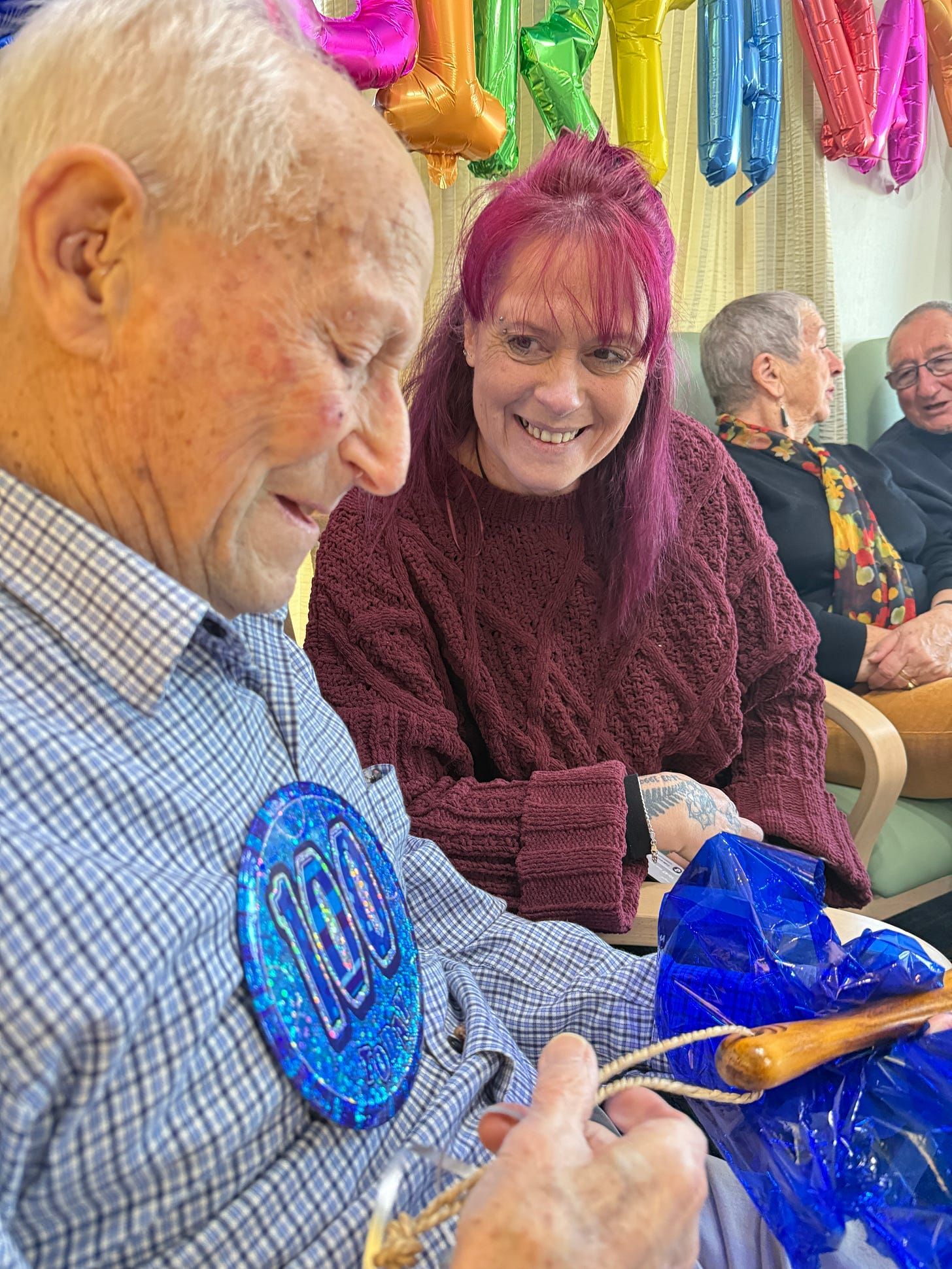
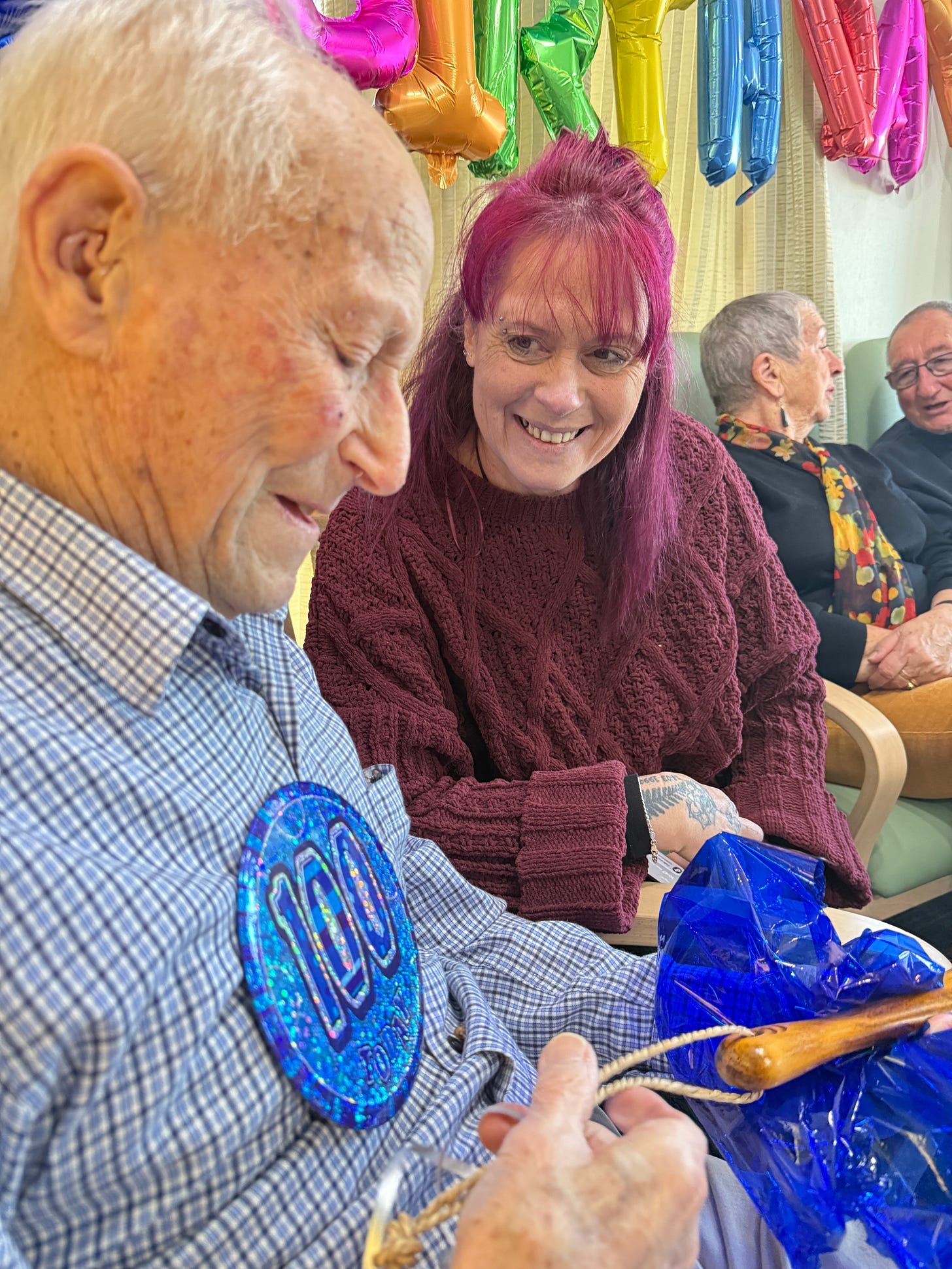
In the home they could enthuse over the art on the arm of one of the carers who was especially fond of them. Mel offered to get Dad transfers to apply to his own one for the 100th birthday, he sported them with delight. She got her uncle to carve him a patu for the occasion, Dad loved it.
She has a fondest memory of helping him into bed one night, and a hug, and Dad singing Show Me The Way To Go Home. She says he made her feel like a granddaughter. She loved to care for him.
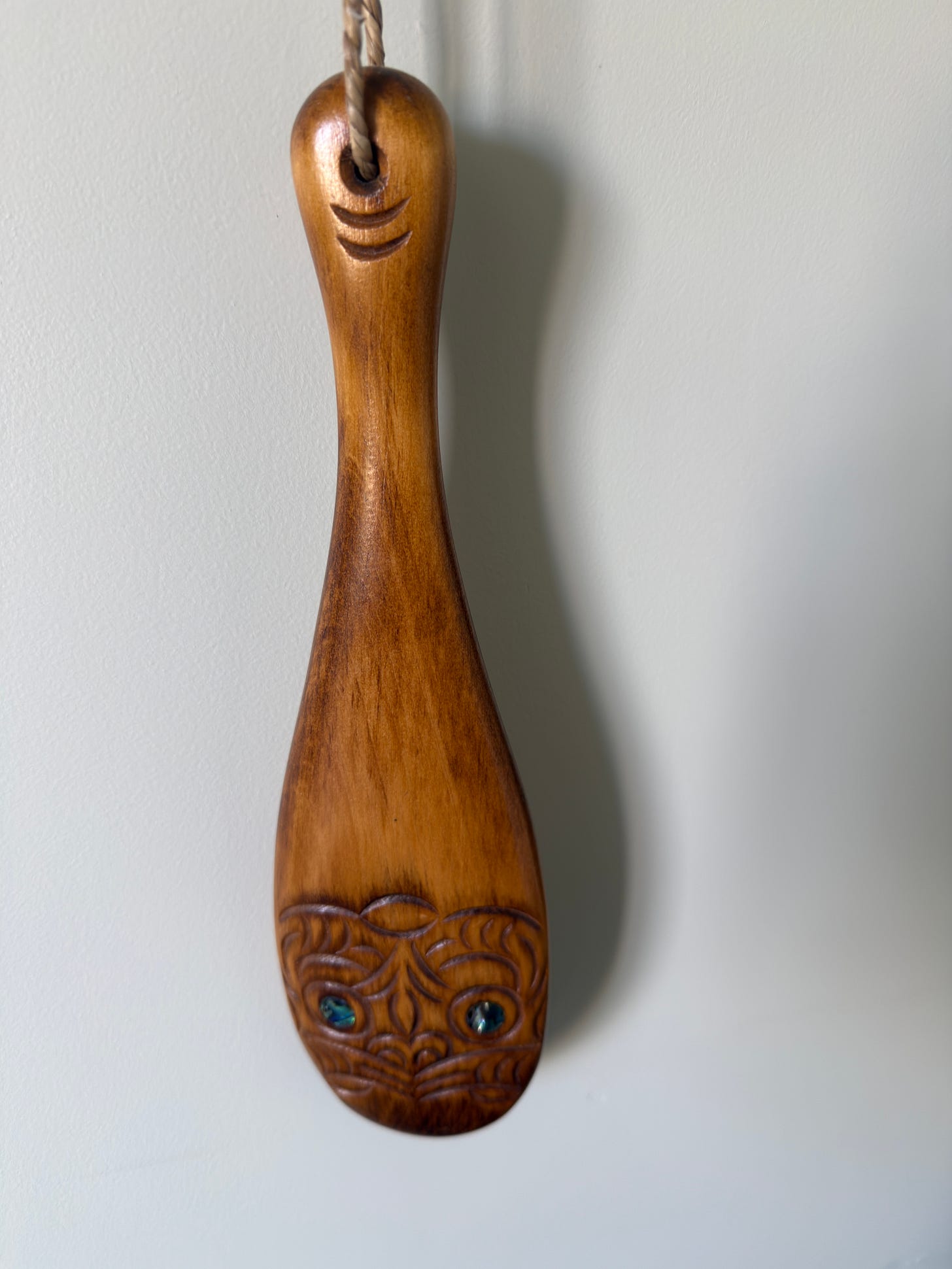
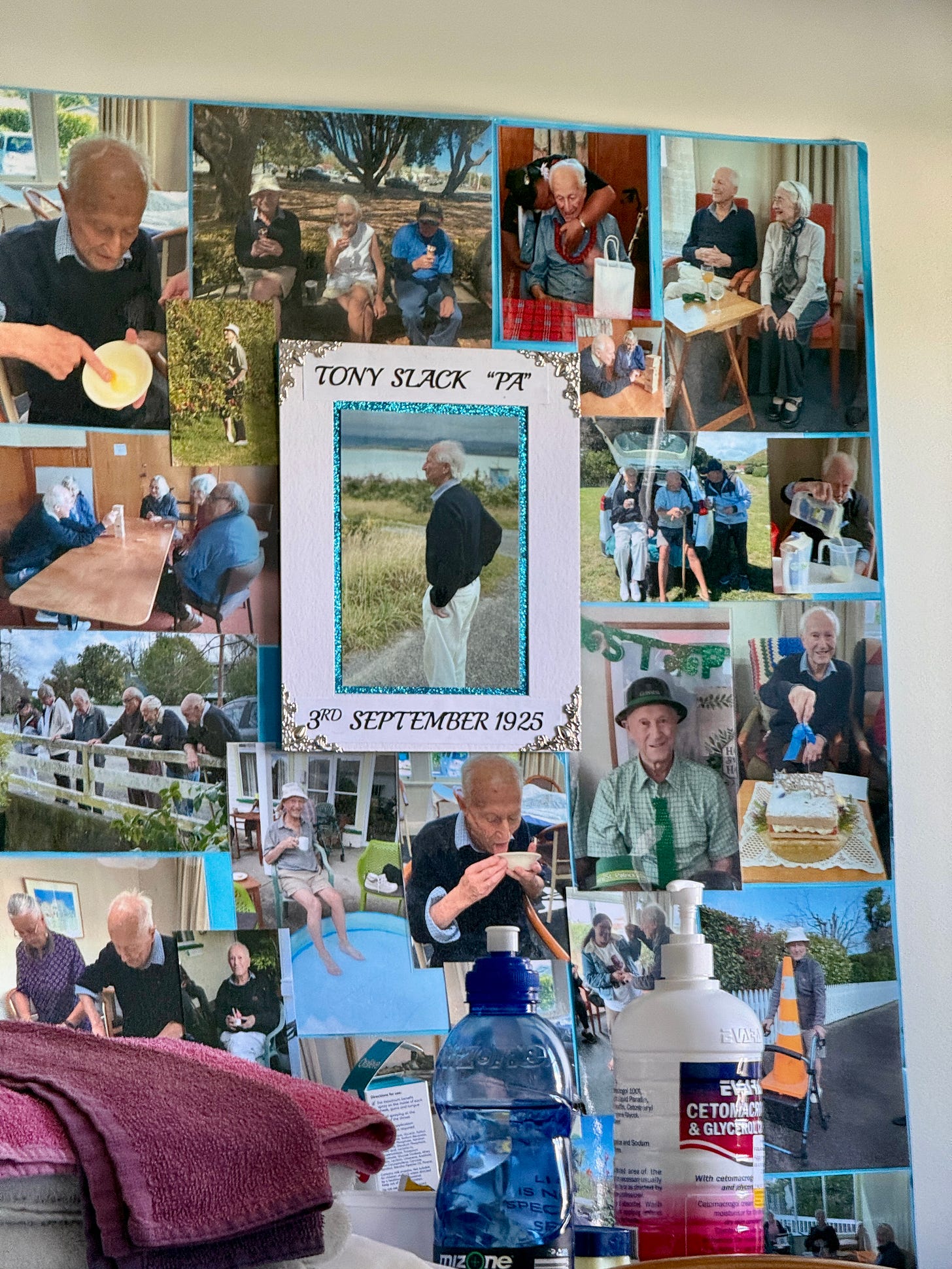
It was not what he had imagined, that last chapter, I think. He enjoyed ending up amongst a crowd, everyone calling him Tony. He enjoyed the cheerful exchanges, everyone appreciated his good humour.
The vigil came to an end on Monday night. The breaths got ever farther apart and finally there were no more.
In one sense it is hard to comprehend how profound a difference it can make as the vitality in a face disappears. But also, amongst the embraces and the tears you are seeing so much remaining character there, the father you loved and admired, the father you wanted to live up to, the father who had made your life for you.
I learned in the end that we could best connect with words on paper. I wrote this for him, almost a decade ago, when it first seemed we were running out of time. Tim told me he had a smile on his face for the rest of the day.
I’m so glad I got to tell him then.