Chapter One
She sees a listing on an online trading site. Reputable seller in Manchester, decent price for a good phone. She makes the trade, sends the money, and waits for Royal Mail to deliver it. Signature required, of course; you want to be careful about these things.
A few days go by. The expected day of arrival comes and goes. She emails the seller, she messages Royal Mail. There seems to be some mystery: it should have arrived by now. She waits some more, she messages some more.
Then, while the messages are going back and forth, a different one arrives.
Under the letterhead of Haringey Council and Kingdom Services, it informs her:
Police and Criminal Evidence Act 1984 — Interview under Caution. Environmental Protection Act 1990 s33, s34, s87, s46, s47. Premises/Location: Seven Sisters Road, N15.
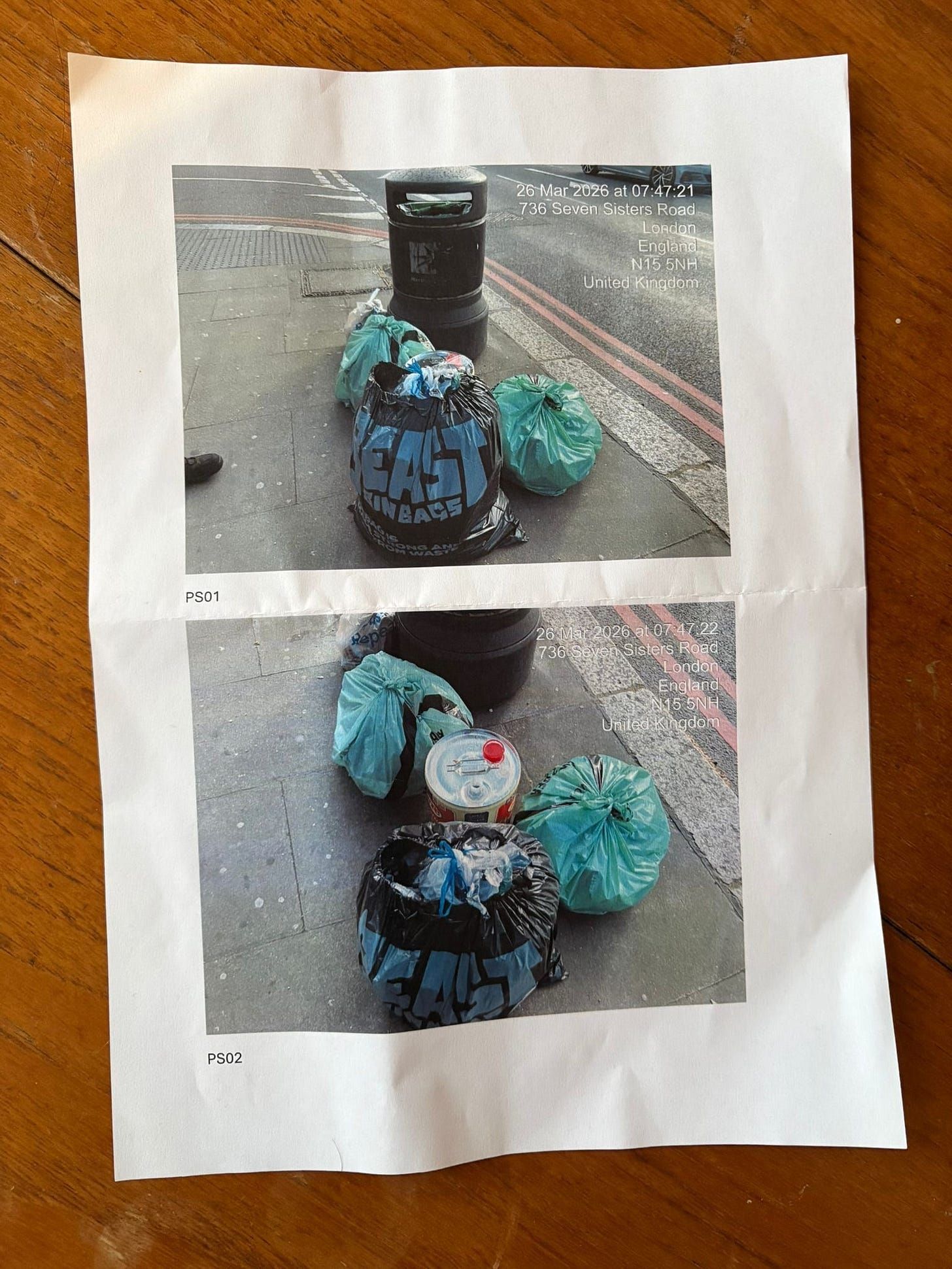
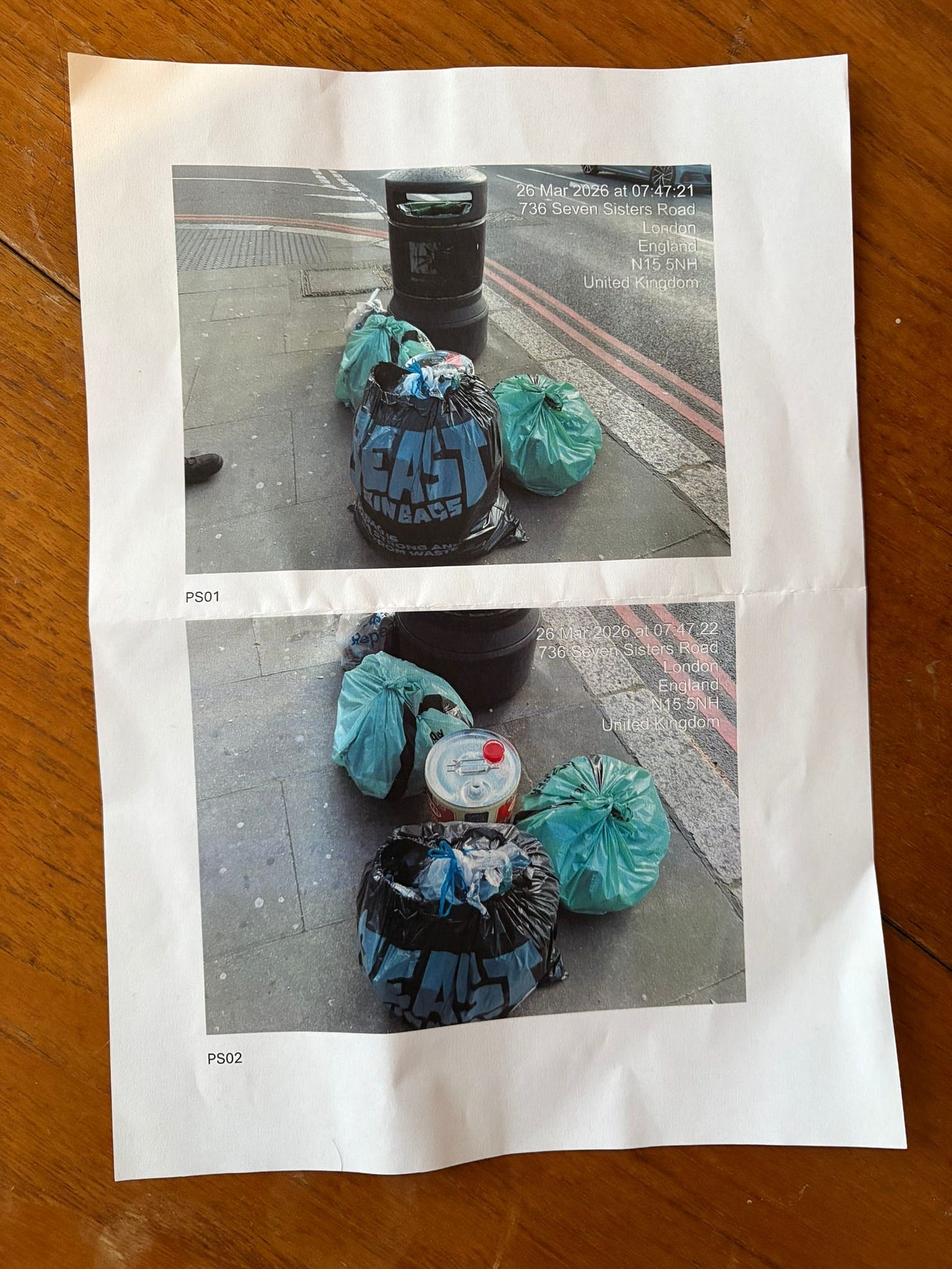
I am currently investigating suspected waste offence(s) at Seven Sisters Road, N15 which consisted of an addressed parcel found in a black waste bag amongst waste pile. As part of the investigation, evidence containing your name and address was found amongst the waste. Please see the attached photographs, Exhibit PS01–PS03.
I am writing to provide you with an opportunity to answer questions relating to these suspected offence(s), and to invite your written comments under caution. It is recommended you seek advice from a Solicitor or Advice Agency before answering the questions below.
Please answer all questions and return to me within seven days from the date of this letter.
And:
I must inform you that if you do not respond we may issue you with a Fixed Penalty Notice requiring you to pay up to £1000 based on the information we have.
At first glance, coming on so strong, so puffed up with officious legalese, it must surely be a scam.
But no. Some Googling reveals that this might actually be the real thing.
What’s going on is that councils are contracting out to this outfit to prosecute fly-tippers, that is to say, people who just dump their bags of rubbish wherever it suits them, which of course is an anti-social bit of fuckery that you would want to control.
Various stories litter the news archives, along the lines of this Guardian one headlined: Firm ‘uses aggressive tactics’ to collect millions in fines for councils.
Kingdom Services Group, it seems, likes to target elderly people and vulnerable residents in deprived areas with this intimidating standover stuff because they’re more likely to just pay up. Councils pay nothing; Kingdom recovers its costs entirely from the fines it issues, then shares the revenue. That creates an obvious incentive: issue as many fines as possible. Internally they ran a leaderboard for officers who hit 100 fines a month. Training teams allegedly told staff to hide behind cars and bushes and conceal their logos to improve their catch rate. Company turnover went from £28m to £103m in five years.
But hold that thought, because we’re going to go back to the flat in Newington Green where our daughter is still waiting for her phone to turn up. You’ve probably guessed by now that it will not be turning up. Because as she tracks back through the Royal Mail delivery system and the online store, it becomes apparent that somewhere between Manchester and Newington Green some bastard has pinched it. And what is now also clear, from the photo attached to the prosecution notice, is: somebody stole the phone and ditched the packaging in the bag of rubbish they fly-tipped somewhere around Seven Sisters.
The operative question has obviously moved on from:
What has happened to my phone?
to:
I can tell you what happened to my phone, it was clearly stolen. So what happens now?
The answer is that the online shop is happy to refund her money. Royal Mail is happy to confirm that it was never signed for, and because delivery requires a signature, clearly it never made it to her house. Some bastard stole it at some point in the process.
She also contacts Haringey Council, who keep her hanging on the line forever, and then when she gets through, tell her she has to ring the people they’ve contracted this out to. And no, they are not interested in hearing that this outfit is clearly useless and has wrongly accused her. Take it up with them, they say. She says: I don’t have a number to quote to them. So this is going to go around in circles. Call them, they say.
Good luck with that. You can’t talk to anyone. The terms on which you might endeavour to explain that this was not you, this was someone who stole your property before it ever got to your house, are difficult verging on impossible.
This outfit’s website rhapsodises to prospective council customers about its effectiveness. But it is as blunt an instrument as you could find in terms of distinguishing the innocent from the guilty, and there are various media stories of people being prosecuted to the full force of this law for something they never did.
Our daughter is highly organised. She works in comms. She’s in a better position than most to respond. But it’s still both stressful and exasperating to have to grind through the whole thing, knowing that this clearly blunt instrument of a machine with a default setting of intimidation and soft thuggery was very likely to lack the right people or the right process to hear what they were being told and respond in a reasonable way.
Nonetheless she fires off all the right requests, gets all the right confirmations, sums it all up and sends off a comprehensive denial of the charge: it wasn’t me. My phone, and the packaging containing it — the one you show in the photo — was taken before it ever reached me.
But because they themselves have not provided the case number they say is required to engage in the process in any way you get the feeling she may have been set up here to fail.
There follows silence for such a long period that she begins to think that must have taken care of it.
But no. Machines like this work at their own lumbering pace. They don’t acknowledge that you have responded, and neither do they tell you what is happening.
Until last week when a second notice arrived saying she hadn’t satisfied the criteria, so now she would be prosecuted. This time at least there’s a case number. But it’s also evident that they had not heard a word of what she said, or had decided in their thuggish way that it wasn’t enough.
But at least now there’s a number she can quote. So she does:
This is a totally unjustified prosecution. You’re citing me for dumping something I never had in my possession. My phone was stolen. The bastards dumped the packaging for it. And here’s a clue — did you find a single other thing in the bag of trash with my name on it? Of course you didn’t. This is outrageous.
Etc. Also: I’m sharing this with the media.
She sent us a copy of this fresh notification they’d sent her, really just to let us know how things were progressing and assuming we’d see it in our own time.
But Karren happened to pick it up coming in on her phone in the middle of the night, and so then we were both awake, and having at it.
Mary-Margaret laid out her draft response, which was excellent. I said I’d take a look at the online process as well.
Before long I was in an exasperated exchange with a chatbot, going around and around, soon typing in all caps saying she never had the phone, it was stolen, it was never her packaging to dump — and the bot mindlessly saying: are you saying it didn’t happen?
Next I try to find someone to take my call at Haringey Council. I’m fully aware if I tell the what it’s about they’ll just refer me to Kingdom — so I tell the voice menu I want to report a crime. When I finally get a real person I tell them it’s the crime of harassment being carried out by the organisation they have contracted to responsibly police fly-tipping. She naturally has a complaints email to direct me to. But not before I work her through the hypothetical of: how would you like this if it happened to you?
Karren texts afterwards:
Your dad just phoned the complaint system to get to a real person and tore a strip off them!! He will follow up tomorrow via the council’s feedback system. Never heard him so angry!!!!
It was satisfying, but it probably didn’t make a whit of difference. It was the comprehensive rebuttal Mary-Margaret sent that did the job, I have no doubt.
Sure enough, a couple of days later it came: they were satisfied now. They were dropping the charge.
She was of course delighted, and also withering in her scorn.
We were relieved; not because she was in any way liable, but because this looked so much like a system that will arbitrarily punish. The bluntness of the whole process looked highly likely to fail to serve justice, leaving her on the hook for a thousand pounds for something she didn’t do and had no part in.
Now read on, because she’s fine now. but you really could not say the same for the system.
Chapter Two
Kingdom Services Group did not begin as a fly-tipping enforcement operation. It began as a private security company, and that tells you something useful about how it thinks.
The same apparatus of uniforms and quasi-authority intimidation could be pointed at environmental offences just as easily as at shopping mall undesirables. And unlike a security guard, who is a cost, a fine-issuing officer is a revenue stream. Kingdom’s contracts with councils are typically structured so that the company recovers its costs from the fines it issues, then shares what remains with the council. The incentive is obvious: issue more fines, make more money. The council gets enforcement it doesn’t have to fund, and Kingdom gets a profit engine that runs on the public.
Former officers told The Guardian the company deliberately targeted elderly people and residents in deprived areas because they were more likely to simply pay up. One put it plainly: I believe this company is profiting from poverty.
The fly-tipping extension of this model relies on the legal concept of strict liability: if your name is on it, you’re responsible. Frustrated by drug dealers saying it was just in my house, you can’t prove it’s mine, the law decided to tilt the result a bit more in favour of the prosecution by applying strict liability to the possession of controlled drugs. If it’s in your possession, that’s it, matey. It’s a contentious enough proposition where the stakes are high and where they’re trying to deal with what can reasonably be called a serious social harm. Leaving aside the thorny question of treating drugs as a criminal matter rather than a health one, it seems hardly reasonable to apply such a harsh standard to the question of household rubbish, in order to assist the case of someone whose business model depends on the fine being paid.
There is no meaningful appeals process. You cannot talk to anyone. The complaints process routes back through Kingdom itself. The council, when contacted, refers you back to Kingdom. If you dispute the charge, your option is to decline to pay and defend yourself in court, which stands to be expensive, slow, and terrifying for most people — which is rather the point. It is a system of moats, each one designed not to keep wrongdoers in but to keep the wrongly accused out.
What Haringey Council contracted for when it signed with Kingdom was the appearance of environmental enforcement without any of the accountability that real enforcement requires. They outsourced not just the work but the moral responsibility, and then, when the complaints came, they outsourced those too.
Chapter Three
Kingdom is not an aberration. It is an example of something that has been spreading through the architecture of public life for decades.
Private security guards now outnumber police officers by nearly two to one in Britain. The same ratio holds in the United States and is approaching it in New Zealand. These are not police. They have no more legal authority than any other member of the public. They can detain someone only as a citizen’s arrest, and only when a crime is being committed in their presence. They cannot search you. They cannot compel you. They have no jurisdiction in public space.
That is the formal picture. The operational reality is a bit messier.
The key conceptual problem is what researchers call quasi-public space. The modern city is increasingly made up of places that look and feel entirely public — shopping centres, transport hubs, mixed-use precincts, privatised town squares — but are in fact privately owned and privately controlled. In these spaces, a security guard stopping you from filming, or asking you to move on, or removing you from the premises, has the property owner’s authority behind them. The legal right is real, but the democratic legitimacy is much less clear.
The right to film in a genuinely public space is well established. You can film a police officer performing their duties. You can film a protest. You can film the street. But when the street is owned by a property developer and managed by a contracted security firm, that right for the largest part quietly evaporates, not through legislation, or democratic process, but through the slow transfer of public space into private hands, and the attachment of security personnel to enforce the new terms.
The same logic applies to protest. Council-contracted security officers increasingly exercise what amounts to move-on power. They will tell people to leave, to stop, to put the camera away. They don’t necessarily have the legal authority to compel compliance, but they have enough presence and implied threat that most people comply anyway. This is soft power operating in the space where hard rights should be. The outsourcing of their exercise to companies with no democratic accountability makes misuse not just possible but structurally encouraged.
We have allowed the built environment to be reconfigured in ways that erode the rights we thought we had, and then staffed the new configuration with people whose job it is to enforce the reconfiguration on behalf of whoever is paying them.
A cynic might also note that this leaves police with more time to go after 82-year-old grannies who have shown themselves to be a clear and present subversive danger to the state by combining the words Palestine and Action on a placard to be used at a peaceful demonstration.
Chapter Four
Michael Lewis has a great podcast that explores a core issue at play here. In the opening episode of Against the Rules, about the decline of the referee in American life, he describes how someone stole his identity and used it to open a Citibank credit card at an address that didn’t exist, borrowing thousands and repaying none of it. Lewis found out not from Citibank but from his credit report, which now marked him as a delinquent debtor. American Express had already reduced his credit limit in response. Citibank said they had no record of him. The FTC told him to go to the police. So Lewis found himself driving to Berkeley Police Department to file a report about a problem a Wall Street bank had created entirely by itself.
His question to the officer captures it all: Does it not strike you as strange that I’ve never had anything to do with either of these parties, and yet it’s my problem?
Our daughter never had anything to do with Kingdom Services Group or with whoever stole her phone and dumped its packaging in a rubbish bag in Seven Sisters. And yet it was her problem. It was her time, her stress, her phone calls to the council, her risk of a thousand-pound fine. The institution that created the problem, in Lewis’s case a bank, in hers a contracted enforcement company backed by a council, was under no particular pressure to fix it. The cost of the error had been efficiently transferred to the person with the least power to bear it.
Lewis calls this the removal of the referee. When there is no independent party to whom the wronged person can appeal, the institution has no incentive to correct its errors promptly or fairly. The costs don’t disappear, they are transferred.
Councils are invested with democratic authority to enforce environmental law on behalf of their communities. When a council contracts out enforcement to Kingdom Services Group, it behaves as though it has transferred that authority — but who said they could, and why should they? It’s lazy, and it sets the system up for abuse. Kingdom acts with the force of the state behind it. The state then washes its hands of what Kingdom does with that force.
No one should be a judge in their own cause — and yet Kingdom Services Group reviews Kingdom Services Group’s fines. The appeal process is crappy, rigid, and opaque. The presumption of innocence is structurally reversed: you are treated as guilty the moment the notice is issued, and the burden of disproving it falls entirely on you, through a process the issuer controls.
These are not technical complaints. Power must be accountable to the people over whom it is exercised. What councils have built with Kingdom is not that. The player sets the rules, processes the appeals, and profits from the outcome. The innocent party carries the costs.
Our daughter carried those costs. She was better placed than many to deal with them and she got through. Many people might well see the letter, see the legalese, see the fine, and pay it, not because they are guilty, but because the cost of being innocent is higher than the cost of giving in.
The castles have their moats. The lords are not paying attention. The moats do the work so they don’t have to.
As wealth inequality grows, so, it seems, do the moats.