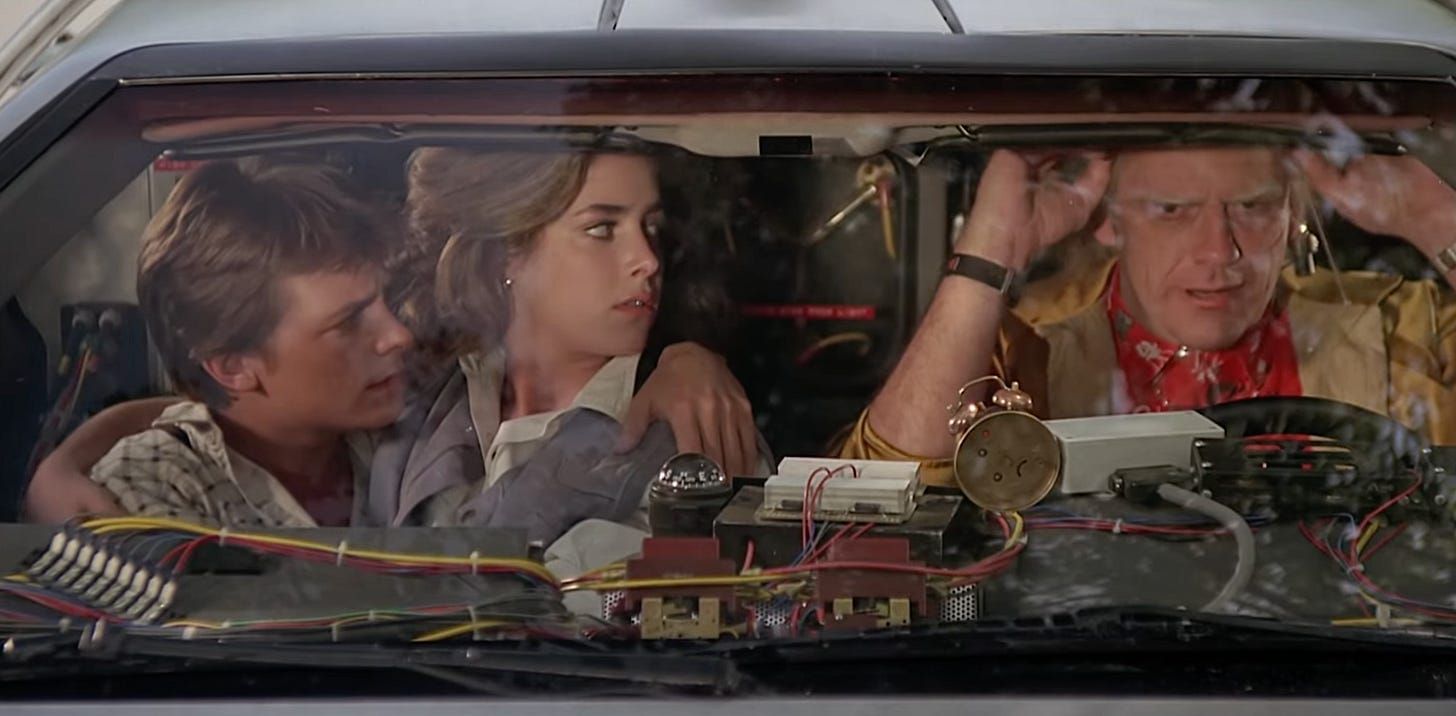
It’s a joyous moment, the final scene of the final Back to the Future movie as Doc flicks on some silver goggles, grips the wheel of the DeLorean, fixes his gaze out ahead and replies to Marty,
Roads? Where we’re going, we don’t need roads!
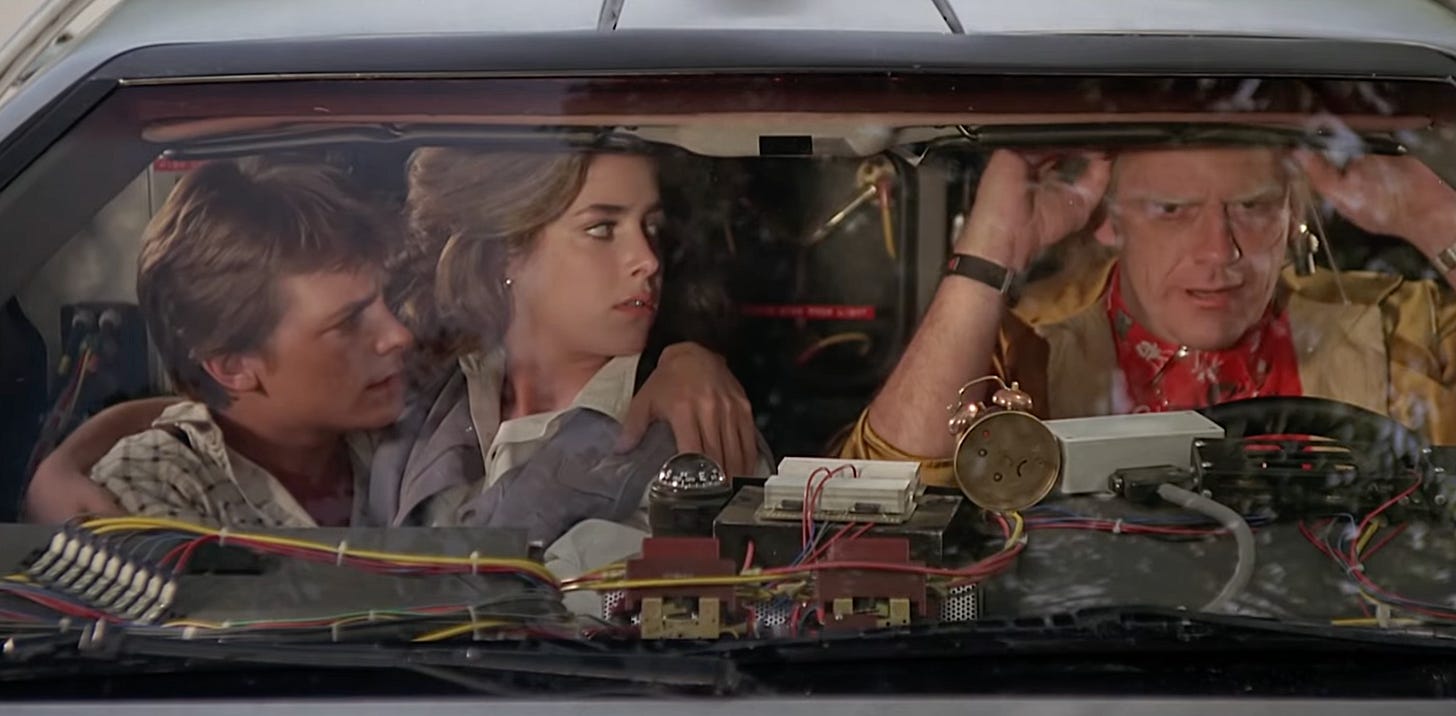
I don’t know who coined the phrase future-proof but I’d guess their thinking was imbued with some of that same sense of excitement about the future; the notion of making things fit for all the thrilling changes to come.
The world of business is where language goes to die, but not before it has first had unspeakable indignities inflicted upon it by godawful people.
This, it feels to me, is how the expression future-proofing evolved from conveying excitement for everything ahead into a wary growl of that’s mine not yours, don’t even think about it, asshole.
I am thinking in particular of the way it tends to be used by the New Zealand National Party of New Zealand: A future where your right to go on doing what you’re doing right now is not inconvenienced by any kind of change or unacceptable truth.
Let’s say your work involves encouraging some of our largest enterprises to move towards a greener future. Let’s say some of those large enterprises are in the freight sector. Let’s say you’ve found that some of the key players are very determinedly diversifying and adapting, adding electric vehicles to their operation to get their carbon impact down, preparing themselves for the day when ICE and petrol will be yesterday’s option.
Let’s also say there’s another big operator who doesn’t see things that way. He says they’re not bothering with any of that bullshit. Get back to us when it’s conveniently tied up in a bow for us. Those other wankers are just virtue signalling. We’ve run the numbers and I can tell you for nothing they don’t stack up.
You can yes but all you like about the process of transition, and how the numbers are all going the right way, but he’s not listening, mate. And don’t waste your breath about taking some larger corporate responsibility or simply looking out over the horizon to the inevitable future. Some people prefer a tomorrow as little changed from today as possible.
Hey champ, how’s all that bombastic sneering at those dumb green ideas working for you right now?
While the fitters were putting on our solar panels, a neighbour was explaining to me like I needed the rules of poker spelt out for me, if you crunch the numbers it doesn’t pay off.
I explained to him that our motivation for getting an electric car and getting rid of gas wasn’t purely a question of best bang for your buck, it was also a question of how can we help reduce the carbon for its own sake.
We also took the view that if you’re in an advantaged position to do this stuff, you should try and help the market grow and give the transition momentum. The more people you have buying new ones, the more the second hand market grows.
You do what you can to get fitted for the future.
At certain points you’ll feel glad you got ready. By my calculation it would currently cost about 250 dollars to fill a Ford Ranger. Every time.
The power for our car comes from our roof, most of it. Yes, it cost 15k to put in the panels, but now the power keeps coming and there are no trips to Gull to fork out more than 200 dollars.
We live the 15-minute-city life, plenty is walkable, we range all over on e-bikes. Those things make it very easy to replace a hell of a lot of what might otherwise be car trips.
You might say we future-proofed ourselves, you might simply say we looked at what was coming. Nice to have the money to do it, of course, I fully see that. I fully see that some help would go a long way if we had a government that saw that as future-proofing.
Oh but what about the billion they’re stumping up for on an LNG project? Bzzzt, wrong answer. It was at best a line call and now as the prices go north the whole thing has to be one sick parrot doesn’t it?
What I’m thinking of is something else that cuuld be done swiftly and effectively:
A different approach to energy where you go local and individual, and help people get solar on their roofs and get a bike or e-bike into their garage to cover the many short trips people make.
And while we’re at it how about free Public Transport for under-25s, to really encourage people into different patterns? The future of cars is electric, but the future is not cars.
And to stress: Yes I know this won’t work for everyone, but why not do it for the many it could work for?
The LNG argument is: we need backup for the next 5–7 years while renewables catch up, and we need it fast. But what if there might be alternatives that could be deployed faster?
Auckland has roughly 600,000 dwellings. Call it 400,000 that are detached or semi-detached with viable rooftops. A standard 7kW system generates about 9,000 kWh per year.
If you got 200,000 Auckland houses fitted (about half of suitable homes): 200,000 × 7 kW = 1,400 MW of installed capacity 200,000 × 9,000 kWh = 1,800 GWh per year of generation. That’s the same order of magnitude as the dry-year backup gap.
Yes there’s a big catch: solar is a daytime, summer-skewed resource. The dry-year crunch is a winter problem. Auckland solar generation in June/July is maybe 40–50% of midsummer output. So solar alone wouldn’t solve the timing mismatch.
But what if you add home batteries? A 10kWh battery per household means you can shift daytime solar into the 5pm–9pm peak. Imagine what 200,000 houses with solar and battery could do to lighten the national load.
10k for every last Auckland house would cost 4 billion. Just work back from that to figure out what’s doable, starting with the billion that you were going to spend on the LNG that will surely become 2 billion, or let’s say the 23 billion on a motorway to Whangarei. Or 3 million e-bikes.
The more we equip ourselves for a sustainable and just and low carbon future now, the better things will progressively get. A far better way to go than sneering. A far better way to get to the future.