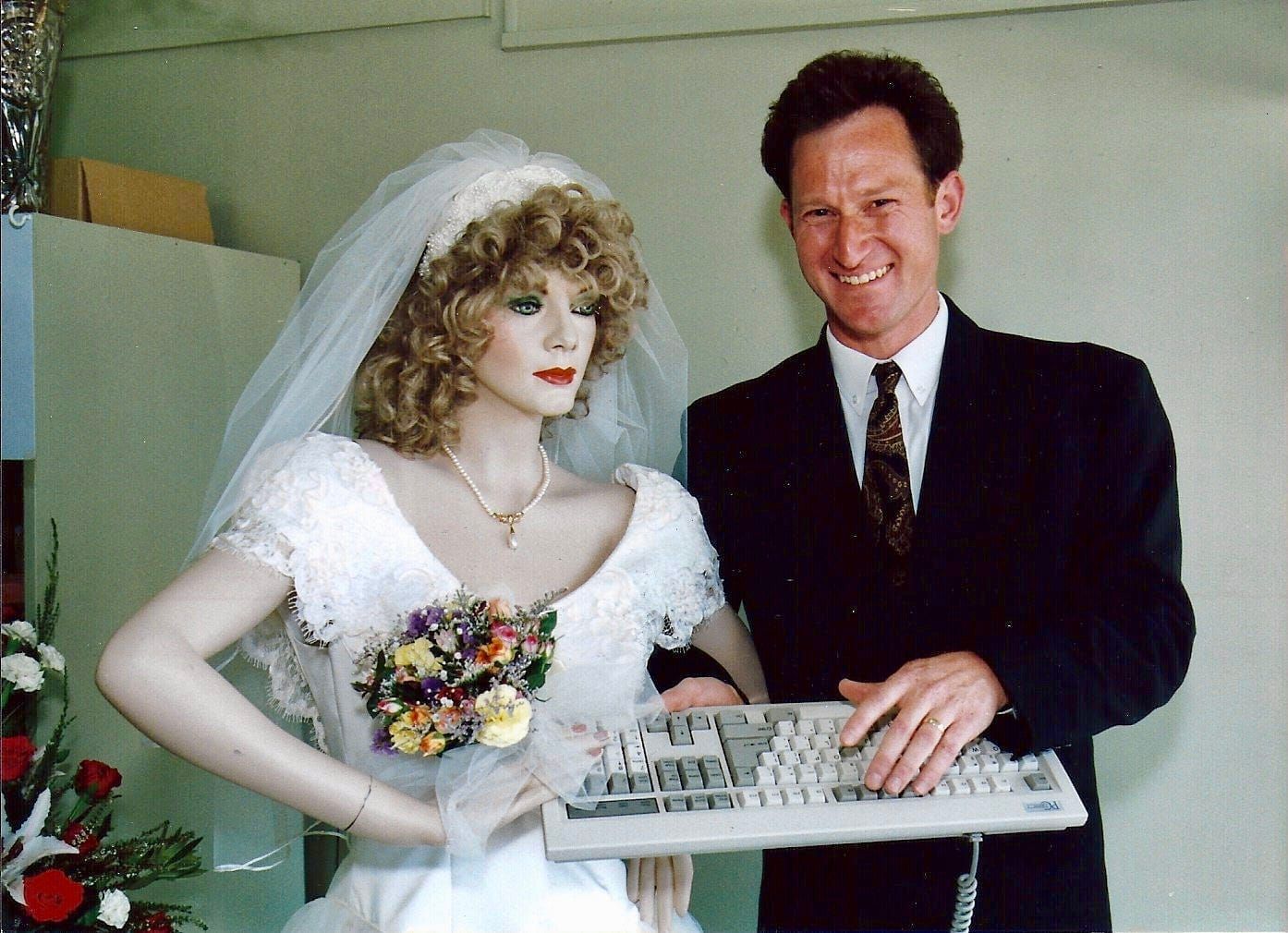
Technically I still work for a PR firm in downtown Auckland. It’s just that since the second week in October 1994, I haven’t gone in.
I just stopped. I no longer wished to work in that way. Instead, I bought a PC, connected myself to the internet and never looked back.
My solution to the problem of being at the end of the world where you won’t find too many customers for your writing services was to connect myself to the whole rest of the world. I worked out how to make a website with an automatic wedding speech writer, and a form you could fill out to commission a speech about whatever you wanted, and I waited for customers. It went well. In they came, from London to Mexico City.
These were frontier days. The only way you could get paid over the internet was to set up a 1-900 number with AT&T and charge people for an access code to your site. In 1996 it was more or less just me and the first porn sites, god bless them. But I was not wrong to assert that this was the future.
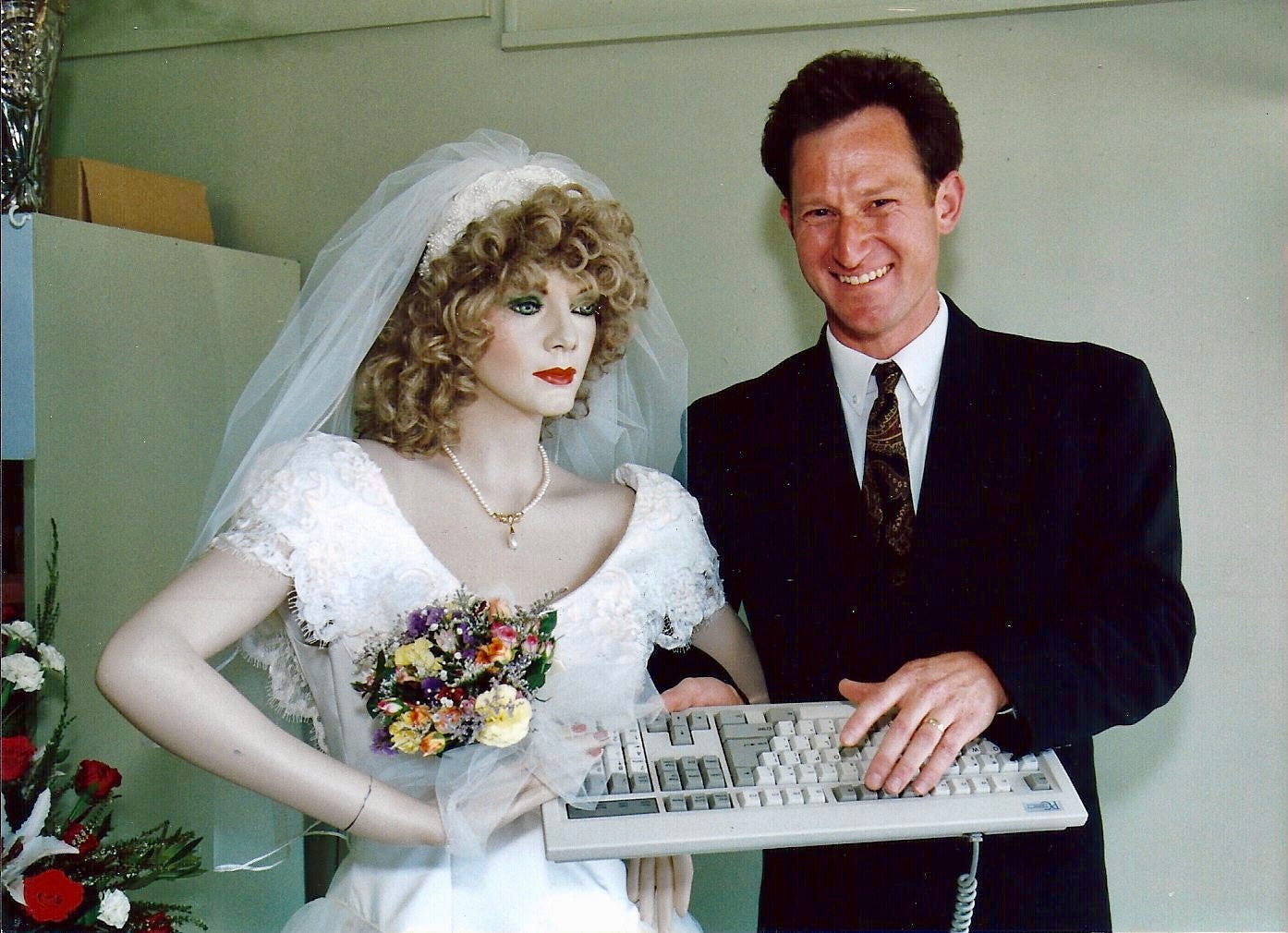
If it all sounds impossibly long ago and far away, well it is; especially in internet time.
Naturally when my friend and erstwhile editor Finlay Macdonald started a Sunday magazine radio show on Radio Live, he suggested I might like to be their weekly correspondent on all things digital and tech. More than happy to, I was. Off we went, exploring all the shiny new things as they came along, a new thing called YouTube, a new thing called the iPhone, a new thing called Facebook. I tended to be an enthusiast about all of it, he tended to skepticism. Yes, he would say, but can we trust them?
Yeah, I reckon, I would say. I was a believer in a golden age of innovation and prosperity. I don’t want to be a Cassandra, he would say.
Whaddaya know. Turns out the horse really was full of hidden soldiers. Things have not turned out nearly as well as I optimistically predicted.
Enshittification, the process by which two-sided online products and services decline in quality over time is rife. Social media serves to polarise and endumbify, the internet which was going to put the news and knowledge at our fingertips has been the prime force in seeing legions of journalists displaced and publications closing by the thousands. And now AI clears its throat to use the words it stole from us to tell us we’re all goddamn fired.
Golden age of innovation and prosperity indeed.
This is not the only promise of a brighter tomorrow I fell for. I was strongly persuaded by the free-market arguments of the incoming Lange government, although by the time I went to work for them as they staggered towards their unhappy end, I was not quite so sure.
My justification is this: I believe in trying new ideas, looking for better ways. I get excited by novelty and innovation. I can talk it up, I can talk myself into it.
But I also believe in trial and error, testing and massive course corrections as you go. Change can be good, change can also be a mistake and change will almost always require adjustments as we go.
But god, it would be a mistake to turn our backs on it altogether, to deny ourselves the possibility of doing things in a new and better way.
I say all this by way of putting the monster Trump into some broader context.
We have all struggled to make sense of him because he doesn’t really make sense in any conventional way. But he entirely makes sense if you see him as the embodiment of deep and seething discontent.
He’s resonated with the disaffected and they are disaffected in a variety of ways: the economy they knew has been gutted and nothing much of any substance has replaced it; life’s become ever more competitive and lonely; nothing feels stable anymore; they fear losing what they had, they sense that they no longer belong.
His problems are not necessarily theirs, the hollowing out of the American economy did him no harm, but he entirely overlaps with them in resenting other aspects of change such as you’re expected to respect, and show respect to, people of colour; and women; and all the other people you used to smugly consider yourself superior to.
In other words: there have been two large waves of change, one the free market, the other progressive politics and they’ve ended up all being lumped together by many people as what they are doing to us and what they are telling us we can’t do, and really that’s been Trump’s whole victim pitch, they shouldn’t get to do this to us, I’m going to make us stop.
It’s pretty dispiriting to see the wave that went way too far—the free market and all of its libertarian nostrums that instituted a toxic late-stage capitalism as the prevailing order across our world—getting conflated with progressive politics about minority rights and dealing with the climate crisis and every other target of the culture wars. But that’s where it’s landed, all strapped together in a choking bundle for demagogues to thump a tub with about what they, the elite, the establishment, the deep state are foisting on us. But here we are.
So now what?
Trump is just the product of these deep problems and we have to deal with the conditions that made him possible: the unchecked market forces that hollowed out communities, and the cultural changes that left people feeling displaced and resentful.
The lesson from history isn’t that change is bad, it’s that change without attention to who it harms becomes a weapon. Harms can accumulate, and fester, and eventually find a voice. If we’re fortunate, the voice will be for progress, and when we’re not, it can be a demagogue.
The Industrial Revolution saw much of all this. It wasn’t a grand plan designed to improve humanity; it was a series of innovations that made money, and the people who controlled those innovations extracted every ounce of profit they could. They built factories that poisoned the air and rivers; they worked children until their bodies broke; they paid starvation wages and when workers organised, they brought in the police and the military. Social reforms, worker protections, the weekend, the end of child labour came not from the goodness of industrialists’ hearts but from decades of struggle, unions fighting pitched battles, regulations forced through over howls of protest, and hard-won political change over decades.
The owners didn’t wake up one day and think, Perhaps we should treat people better. They were made to by strikes and riots and laws and by the sheer weight of human misery that became impossible to ignore.
What too many people tend to do with an advantage is use it to the hilt. And here we are again. The digital revolution has created extraordinary wealth and convenience for some, and precarity and displacement for others. AI promises efficiency and abundance, and it will deliver profit to whoever controls it, and we’d be fools to assume they’ll worry overmuch about who gets left behind unless we make them.
We need to pay attention to who’s getting hurt, and do something about it before the discontent festers into something we can’t control.
So here I am now, thirty odd years since I stopped going into work and still getting excited about making a new website and still getting excited about huge possibilities like some sort of green new deal, some sort of degrowth, some sort of universal basic income, still getting excited about the new. What’s tempering it is a greater understanding that if it’s new ten things will go wrong almost right away and there will be plenty of people ready to make the most of that, because they hate change; or because change scares them; or because they fear advantage will undermined; or because over their dead body will you take their right to be a pig away from them. They will fight against it tooth and nail.
And as if that isn’t enough of a headwind we need to be alert forever to the possibility people will get left behind or fucked over. They surely will be, history is unambiguous about this.
And if we ignore them long enough, they may turn to someone who promises to burn it all down. And make them rich with tariffs.