I had this thing in my head some time ago, maybe a year ago, I thought: “I really need to publish this before I turn 80.” And I did.
I talked last month with the wonderful warm and creative Helen Schamroth about a memoir she has, in a sense, been working on her whole life.
Helen Schamroth’s parents survived the holocaust against impossible odds. In the new life they made in Australia for their two girls, they scarcely spoke of it.
It was far too painful. And children didn’t need to know that. It was only with hindsight, years later that I thought, yeah, they got that right. But while we were growing up, it was just tantalising. Because we knew there was something. We picked up these fragments. And they were clear that they didn’t want to tell us.
Sometimes in the moment, something would slip out.
Whatever they’d say — something that was relevant to the situation at the time —there was this hint of the past. And a child’s curiosity pulls and pulls and pulls at it. Because we wanted to know more. But I was shut down so often that I figured it wasn’t worth getting Mum angry.
That was typically how it ended. She would explode.
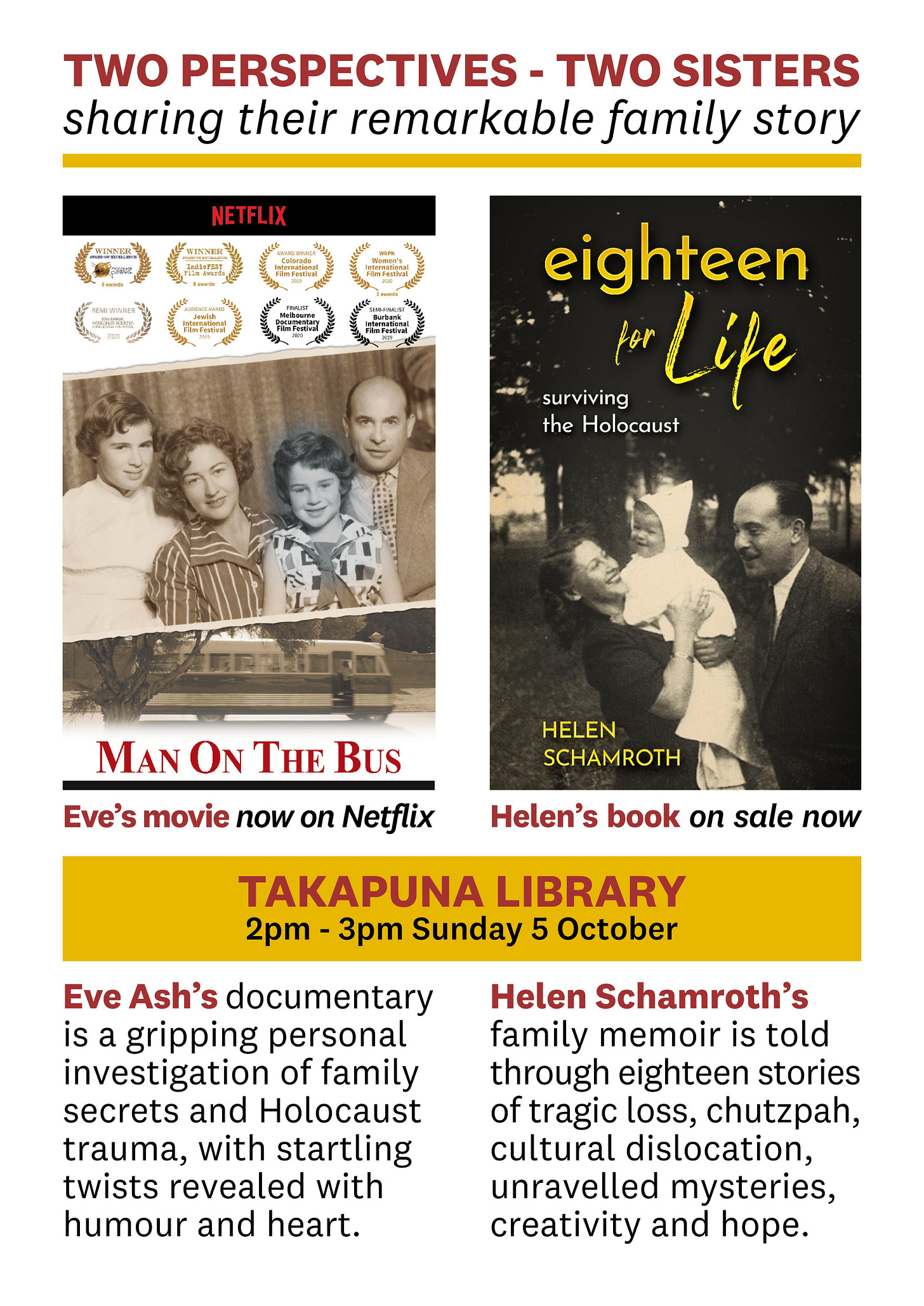
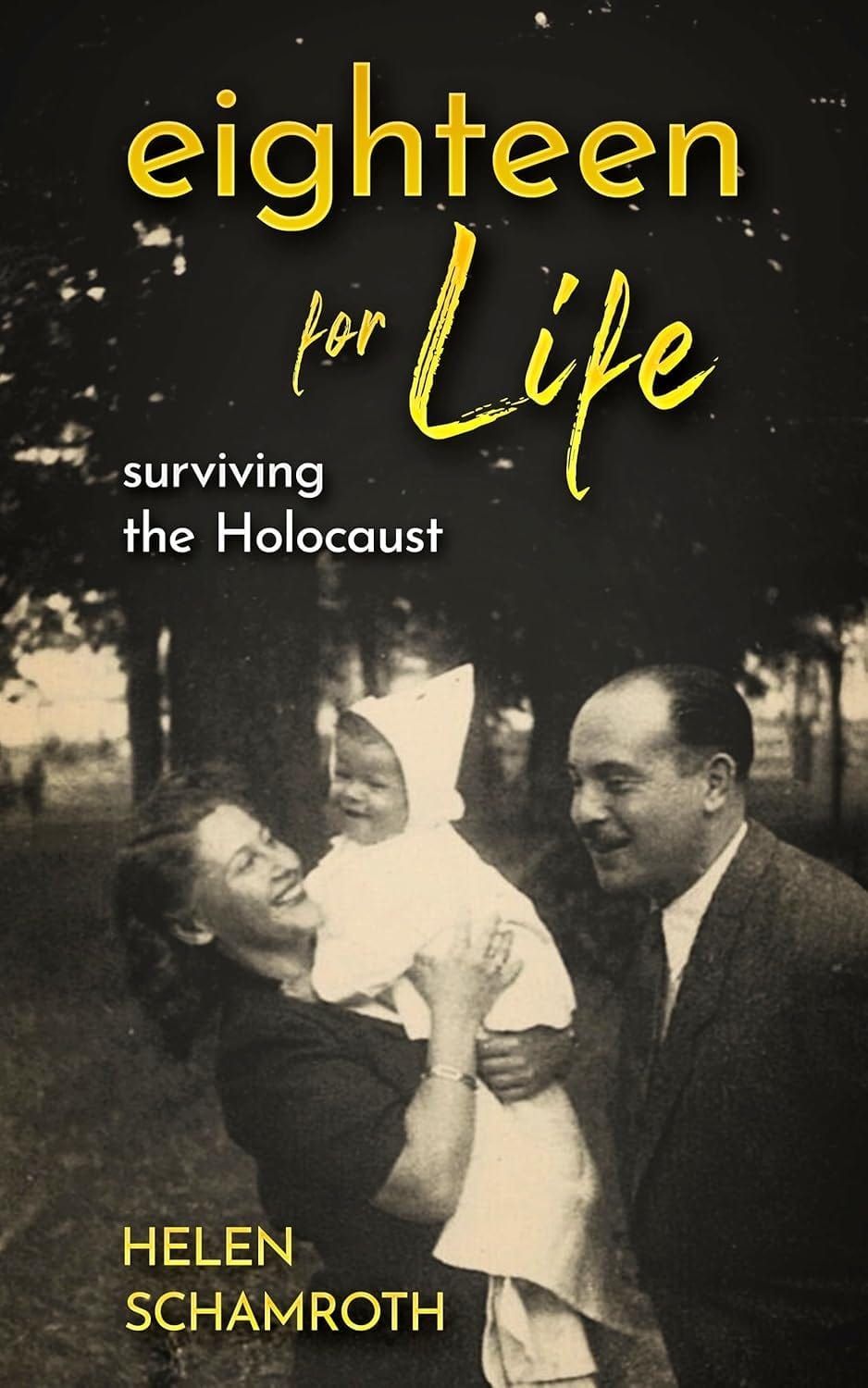
Helen and her sister Eve would come to know more. They have each recounted it in their own way; Eve the filmmaker in Man On The Bus. Now Helen, in a memoir, 18 For Life.
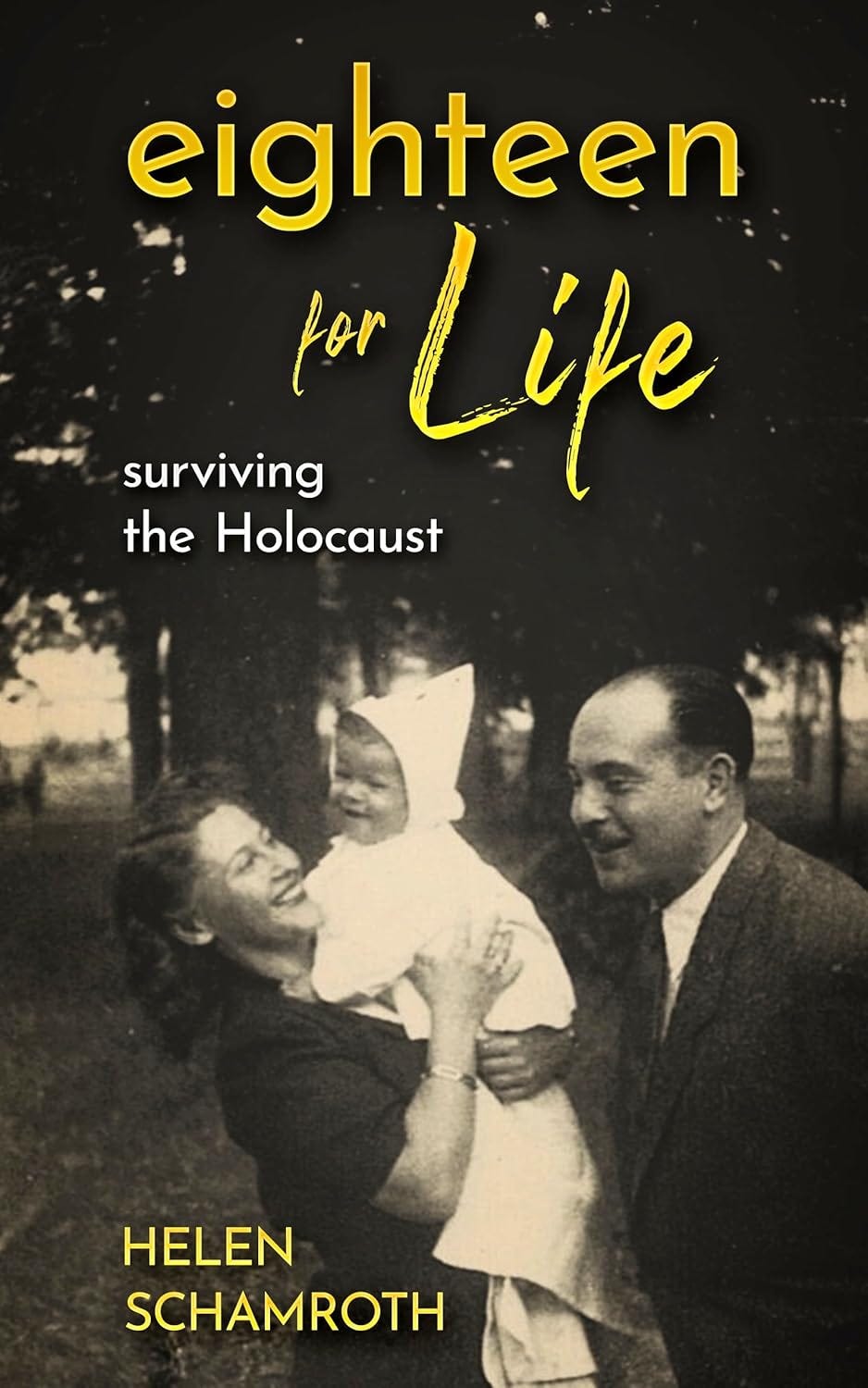
She has been working on it for years, eighteen stories that she first wrote as fiction because it seemed only possible to do it in an indirect way.
I did it because I couldn’t face doing their survival, you know? I couldn’t face writing about their survival for real, but I could use the stories of survival about somebody else. And my publisher was quite happy to go along with the fiction originally. And it wasn’t until we were just about there and the family read it, they said, “no, no.”
It had to be the real thing.
And then I had to work out what I’d invented and what was for real.
Eighteen For Life: a declaration that meaning can be made from fragments. Each story stands alone while building into a sum greater than its parts.
Chai, the Hebrew word for life, carries the numerical value of eighteen. In Jewish tradition, gifts are given in multiples of eighteen, celebrations marked by this number that means alive.
He had a very good mind, says Helen of her father, the one who built up a successful clothing business in Melbourne, the one who was fascinated with science, the one who was an eager early adopter of computers and home appliances, the one who only survived a concentration camp because at the right moment he and a dozen other young men in a work party overpowered the guards, grabbed the guns and shot their way free.
He just had this amazing ability to think numerically and so on. The maths gene, we called it. And he was terrific at that.
Impossible odds for anyone to survive a concentration camp, let alone escape. All the more amazing, she says, when you knew him as she did. In every, every way, I mean…this is no commando, absolutely not. And yet, apparently from what I could gather, he was one of the the drivers of the thing.
Their mother, having seen loved ones all around her killed, survived on false papers, finding different ways of not being Jewish when being Jewish meant death.
Mum’s story is equally vivid and equally traumatic. She had to use every trick in the book to stay alive if it meant lying or telling half truths. The sexual advances she encountered, some she manage to dodge, and some she didn’t. And I suppose she was fair game: she was single, she was alone, she was beautiful, she was charming and articulate. She had, I mean, if you said she had it all she did. And she had nothing. Because she’d lost everybody.
You’re mindful as you reconstruct a story from fragments of the games memory can play.
What I used as my base material — the interviews that my parents did under the two different circumstances — I started to query: how accurate is that? Especially when mum had told us fragments of stories and they were different to what was in the [later interview] tapes.
It’s like, when I said to Eve: “Mum did go by train from Lvov to Krakow, didn’t she?” And she says, “yes”. Then I go into the tapes, and I found that she went by truck. And I think to myself, had she sanitised it in order to tell us, or had she just rewritten it because it just seemed better?
It’s kind of “this much I know.” This much I know about what they went through. Well, this much I think I know. And I do have the disclaimer, this is the truth to the best of my knowledge, because we don’t know.
There’s this total not knowing about what goes on with memory. I thought about Dad talking about his time in the concentration camp and in the death brigade in particular, and his escape. And it seemed so vivid that to me, I had to take it absolutely face value. There was no questioning that. But in the back of my mind afterwards, after I’d written it, I thought, I hope that was accurate, you know, because it was so specific.
And I did do some research, as much as one can about these things, because they’ll be other people’s memories. that’s what it’s based on, because there’s not nothing recorded, the Germans didn’t record this, the escapes and the breakdown. They were very good at recording all sorts of things but not the escapes.
Her mother, the garrulous storyteller, had only a little to say about the past.
I got snippets. I got snippets in strange ways. I mean, sometimes it was behind a closed door trying to understand the Polish. My Polish got quite good at one point.
But sometimes it was when she was talking with her very good friend, Lydia, and those, Saturday mornings around the kitchen table, when Lydia would come to visit. She’d worked all week, and it was just full of laughter, because the two of them had this great sense of humour. And then little things would pop out, and I’d store that away and not dare question, just let them keep going.
And so the stories that weren’t in the tapes were from memories and from things that were said to the point where I didn’t know whether I’d invented them or whether they were real. But there’s a lot you can extrapolate from any given thing, any given mention. That’s how we discovered the camps and asking, “Is it a camp with tents?” You know.
We talk about the capacity of someone to go on after they have seen and suffered more than you can bear to imagine, to find a way out from under.
Maybe you don’t get out from under. Maybe you just have to go on and take a new road. That’s what people who survived the Holocaust, did. And I knew quite a few of them, of course. And it’s like, they put a shutter up. Sometimes the shutter moves a bit, but they put it up, and it’s like, you know, it’s the ruling off and you’re starting again.
And I guess it’s that thing when you feel that you can’t bear to think about it, because it just gives you nightmares and migraines and keeps you awake all night, and you can hear the dogs barking, and you know that that’s not a benign dog, that’s a bark.
If you have all of that, it makes sense to just try not to revisit it.
The new life, the fresh life, in Melbourne was exuberant.
They partied. I love, you know, the dressing up and, oh, they did that. And they had so many different parties. In this little house, they do party after party and everybody there, pretty well almost all of them were either survivors, or had family who were survivors. They knew how to grab at life. They knew how to do it all.
Her father made a success of his fashion business, but he ran it on too long.
He wanted to die with his boots on. That was his raison d’etre, right? He loved his business. He loved it, that all the headaches of it. He loved it despite that, yeah, and he wanted to do right by other people, but ultimately, he just he didn’t want to let go, because it was the meaning of life that that and his family was, was all that he really had, and he’d lost so much. He didn’t want to lose that. That was my interpretation of it.
Eighteen For Life. Eighteen stories that say: they survived, they continued, they grabbed at life and refused to let go.
Helen’s daughter Natalia has stacks of copies in her Engine Room restaurant.
She’s my best sales woman, because people say, “Oh, what’s this?” And she says, “Well, my mother wrote it, and those are my grandparents”
The memoir stands as proof that survival multiplies. The story endures; so do the ramifications.
You know, I’m coming up for 80 this week, and if I’d been born four months earlier than that, I would be a survivor, as opposed to a second generation survivor. And people of my generation may or may not be thought of as neurotic or quite sane or anything in between. But then it impacts the mental health of the following generation, because there’s this history that goes through.
Eighteen stories that transform trauma into something ordered, bounded, countable; affirming in the end and uplifting.
Each number a victory against the calculation that would have reduced them all to zero.
If you’re in Auckland today Helen and Eve are talking this afternoon at Takapuna library.