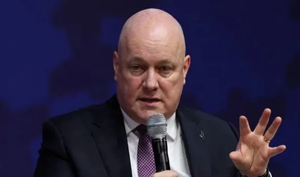
The name Christopher Luxon is not one that comes to mind when we speak of oratory, or inspiring words, or even the ability to talk in whole sentences.
He’s a jargon-gargler, a happy burbler of Americanisms, a visitor from far, far away. Yet somehow he remains installed as Prime Minister of this sorry, economically-bedraggled little nation.
What a Sisyphean ordeal it must be for the likes of Farrar or Hooton to watch him each day. They don’t want a lot, god knows, they just want him to go out there and remind people of the National Party creed: We don’t want anyone getting their filthy hands on our money, and we want to be as selfish as we like, but we don’t want people to think less of us for it.
How thrilled they must have been, then, to see him get up last week and read out a speech that had a beginning, a middle, an end, and a point.
How predictable that they would go completely off the deep end and call chuck steak filet mignon.
The speech was, in its way, compelling. It reached back through history — the Western Front, the Depression, the Wall coming down — and assembled a genuine argument about courage in the face of impossible odds. The Greatest Generation didn’t flinch; neither should we. Fair enough, although that sort of valourising can carry you an undue distance. It’s always complicated.

But what matters more here is what they actually did when they didn’t flinch. They didn’t prop up what had failed. They didn’t double down on the systems that had produced the catastrophe. They built new ones — the Marshall Plan, the UN, an expanded welfare state. They kept looking forward, not back.
Luxon’s version of this courage leads somewhere different. He wants us to be brave enough to procure 90 million litres of diesel, to maintain the strategic coal reserve at Huntly, and to press on with the LNG option that was looking dicey even before prices took off. He frames this as treating energy as an immediate national security interest, instead of a contributing factor to a long-term climate strategy.
All that’s actually saying, if we take it out of its uniform and stop saluting, is: let’s keep doing what we’ve been doing and stop worrying about whatever might lie ahead. The trouble, Eisenhower, is that the crisis we have now is precisely the product of that preference.
As it happens, right now is a bloody good time to break with the past. There’s a quick short way we can go first of all, to deal with urgent shortfalls. Those better options exist now. And then in due course there’s a bigger and much more substantial way to go that could absolutely transform things.
I’ll get into the details in the next post, but suffice to say that the so-called energy trilemma — security, affordability, sustainability — has effectively been resolved. For the tenth consecutive year, the cheapest way to get more generating capacity is solar or wind, which is altogether immune to the geopolitical chaos Luxon rightly identifies as a threat: no fuel cost, no exposure to the Strait of Hormuz.
You'd think we'd have been going full tilt — if not a Greatest Generation, at least as Great Generators. But no. Serious investors with serious money were ready to go on New Zealand offshore wind. But this government decided the seabed miners should have a go as well, which made the whole thing untenable for turbines. The investors left.
In other words: a government that invokes the spirit of the Greatest Generation to explain why we need to be resilient and self-reliant keeps taking the chicken’s way out, clinging to the way we’ve always done things.
There’s a similar sleight of hand in how Luxon handles diversity. He talks about being proud to represent Botany: the Chinese, Korean, Malaysian, Indian Kiwis who volunteer, who teach, who practise medicine, the kids playing cricket with your kids, but next moment we’re getting a doubtless-focus-group-tested spiel about European immigration politics stoking division. The people he just named turn out to be decoration for the actual message aimed at voters who feel, he says, a certain unease. He’s telling them he hears them,without quite saying what he’s heard.
What this lauded speech is doing is using a language of transformation to deliver the politics of caution. You invoke the Greatest Generation, then you explain why we need more coal. You celebrate your diverse community, then you signal to those who’d prefer it otherwise. You invoke the courage of those who built forward, in service of your policies that are all looking timidly and/or selfishly backward.
Meanwhile your government is courageously telling thousands of public servants they can take a hike, and yukking it up for laughs in parliament; courageously telling families doing unpaid caring work that no court decision is going to change anything and they must continue to work for free; courageously telling anyone trying to use the courts to get action on climate change that no stupid bloody court decision is going to stop your mates from doing whatever suits them; and courageously telling teachers to deliver a bright new white syllabus emptied of Treaty and woke.
I don’t see much Great in any of it.
Next edition: What a genuinely forward-looking short-term energy strategy actually looks like.
Cheers for the nice birthday messages from all of you who remembered today. We are both a year older which adds up to a ridiculous total.
But good news! Karren came back from the supermarket yesterday beaming. It being Gold Card discount day at the supermarket, she had proffered hers and the checkout operator had looked at it and asked Is this yours? Karren told her she was afraid so but also thanked her kindly for absolutely making her day.
True, though. Absolutely does not look her age.