This newsletter is only occasionally and tangentially about the proud little town of Feilding. For this reason, there’s a name change coming soon.
But not today. Today’s story begins on Kimbolton Road, and you cannot get more Feilding than that.
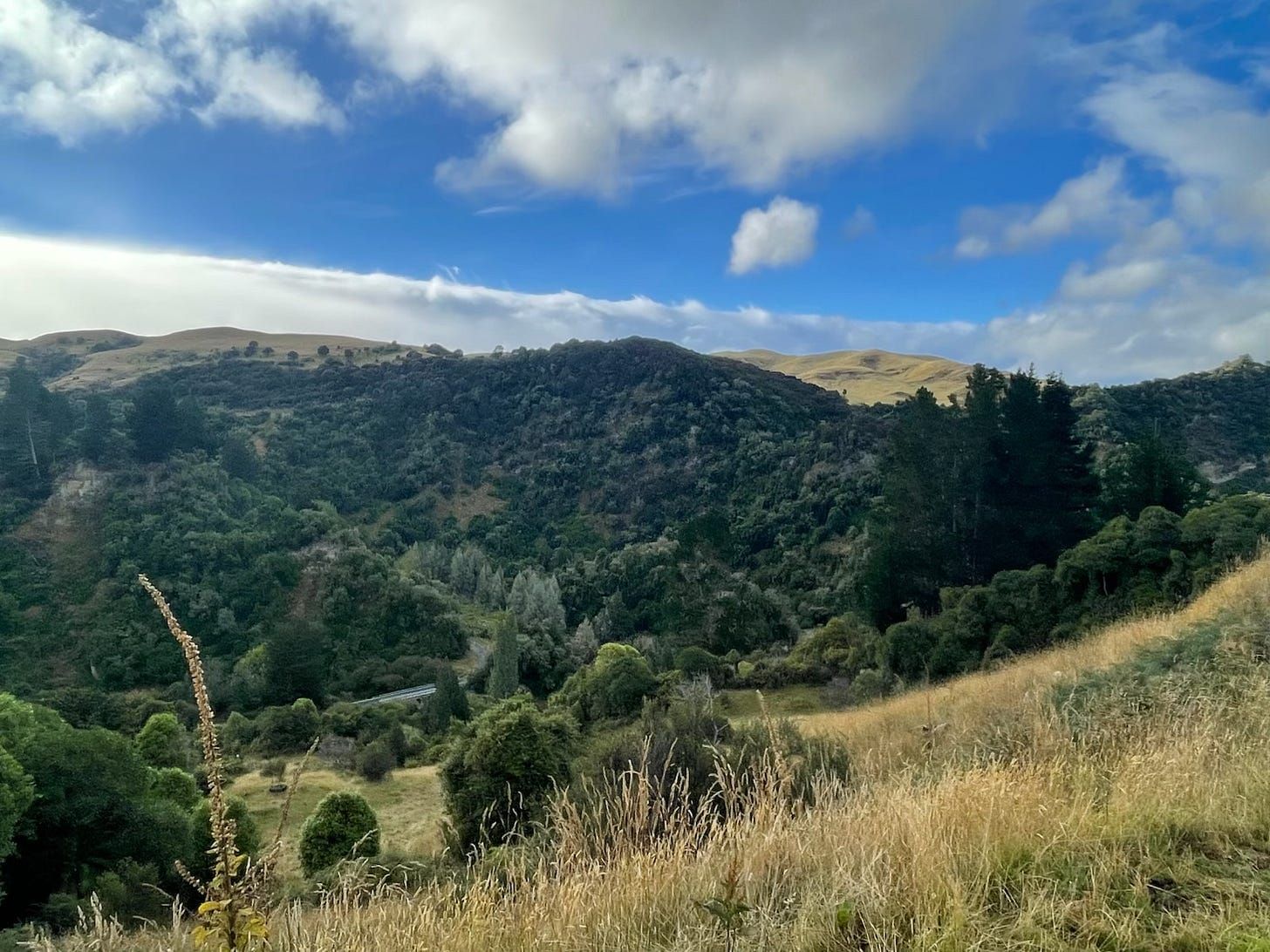
Kimbolton Road carries you north through farmland to the foothills of the Ruahines, to Rangiwahia and Apiti and Peep o’Day, and other places you may never have heard of but which sit large in my memory.
That road was full of stock trucks when I was a kid on a bike. You would grab their slipstream as they flew past: a cocoon of hot air, diesel fumes, smells of sheep and cattle and hay.
They called the flatland part of Kimbolton Road where we lived Ram Alley. Well-kept farms, with white-railed fences, large gardens, grand trees, expansive lawns, fancy cars in the garages, home to prosperous stock breeders.
The permanence and solidity of that life gave certain men great certitude. I would chafe against them and their attitude as I grew into my teens and before too long got the hell out of the place.
My attitude would soften in time, as the journey I had made so often up and down that road became the occasional visit and then years apart.
The farms became less shiny as the decades passed, and grand houses decayed. You would know as you drove past that the people you remember were no longer there, had moved, or sold up, or retired, or gone into a home, or were gone now from this life. Little by little the field of recognition shrinks.
Eventually you are driving, on Wellington anniversary weekend, up Kimbolton Road to a wedding in the hills. As you come through the alley you register that not a single one of all those people — not Jean, not Elliott, not Gordon, not Molly — not a single one of them, is still here. You are driving through ghosts.
I used to think sadly of someone: They are gone from this world. At some point that becomes something else. It’s not that they are gone from this world. Rather, that world is gone.
I am not offering any startling revelation about mortality here; I’m just thinking about how we process what we have been aware of all along, and what arguably art is all about: the living of life and the torment of knowing it will end.
So; a wedding in Apiti. I promised the bride I wouldn’t write about it, and I won’t, except to say she was 75 and the groom was 80 and they have both been bereaved in recent years and it is a cheering thing to see such people find fresh warmth in their world. It is a cheering thing to see, when your life is taking you to many more funerals than nuptials.
There is a grim gallows humour in the expression Sniper Alley. It really does not let up. The expression continues to feel apt, the fresh shock of it each time, another friend of our age, and the knowing there will be more.
Several times in the past couple of years, because I have been getting out into the world while I still can, I have several times not been here to say goodbye. Sometimes, too, I’ve gone to write a goodbye, didn’t want to say too little and ended up saying nothing at all.
This is not my only remorse. Richard Llewellyn, a good friend of this newsletter, was in touch a couple of years ago to let me know that his brother Andrew, an old friend from my Public Address days, was now in a home with a debilitating disease and he would very much appreciate visits, even though he was no longer able to speak.
Oh that’s terrible I said of course I will, and then I went away intending to visit when I got back, and then the going away and coming back continued, and I never made it there. This is not how you support people in hard times.
Lat month Richard posted on his Facebook page: Andrew passed away peacefully on 21 January after a long and cruel illness.
He wrote a eulogy from which I’m excerpting just a little:
He was also one of New Zealand’s early internet citizens, long before social media was a thing. He blogged under names like SunnyO, writing about attempts at gentleman farming in Ōtaki, and Observing Trifles, where he gently skewered the absurdities of modern life.
A witty, clever writer, he was active on forums like Public Address, The Wellingtonista, Graham Reid’s Elsewhere, and early Usenet groups.
His bio at the Wellingtonista reads “Andrew Llewellyn likes to be recognised around town as Viggo Mortensen’s stunt double. But never is. Because he wasn’t.”
He spent most of his work life in Wellington, originally working for a bunch of different Government departments in some kind of IT role - to be honest I never knew what he did - for all I know he could have been a spy.
This was followed by a move into a private training business with his then wife that morphed into a few years on the Kapiti Coast when he nearly became a macadamia farmer.
About 10 years ago he moved to Auckland and took on a variety of different jobs, including working in a Telco call centre, working as a live in handyman at a social housing village, and as a social worker with the Walsh Trust helping vulnerable people look for social housing options.
The last decade wasn’t easy for him. Things didn’t always (or often) go his way, but he never complained. A true stoic.
His last few years were no fun - PSP is a particularly cruel disease - but he could find the funny side in it from time to time.
It was Andrew’s wry sense of humour I enjoyed most of all. He observed without rancour, he was his own person, he happily asserted his point of view but he only ever did it with an admirable calm. It was a very good way to be online.
He was endlessly creative and imaginative, always great for swapping ideas. We once met for coffee to try out my post-GFC idea for a New Zealand dustbowl odyssey: a Jewish family shutters its failing Kaitaia deli to sell pancakes from their yellow Mini as they make for Invercargill, working title The Crepes of Roth. He was the perfect person to bounce such ideas with, the smile never left his face.
I last saw him when he came over for the launch of Bullrush. It was lovely to see him again and I’m so full of regret that it was the last time, ever.
You can say, Oh I don’t have time today, I’ll do it tomorrow.
You can say, I’m not sure how much good it does anyway.
And you can have regrets.
We’ve reached the stage with Dad where the greeting is warm as ever and he emphatically knows who you are and says your name, but any sort of meaningful exchange of words is too much to hope for now.
What I learned on the last visit is that the exchange can still be meaningful just by sitting there. Being with him.
Life comes in, life fades out. You vow to go on making the most of whatever it’s giving you.
Not yet ghosts.