Troubles can build by the hour. It can take you some time to fully register their meaning.
Friday morning began with Karren phoning to check on her mother Betty who was in hospital, for a second time, with heart problems.
They had been monitoring her overnight.
The rain was coming down. We looked out the window and agreed that Auckland Anniversary weekend was clearly going to be as mediocre as the rest of this summer.
Karren thought it would be a good idea to go up to the hospital to give some support and get a clearer picture.
The rain was still coming down as she left.
I thought, you’d have to be keen to take a seat in the rain tonight with a 300 dollar Elton John ticket. I sat down and added this thought to the day’s newsletter.
The rain kept coming.
Mary-Margaret is in the middle of a three week holiday between quitting Newshub and beginning a new comms job.
She rang Karren at the hospital, had a happy chat with her grandmother, who had been at times serene but also confused, hallucinating, agitated.
More and more and more rain.
I finished the newsletter, sent it off early for the weekend.
Karren rang to say Betty was about to be moved from North Shore to Auckland Hospital. We arranged that I would run Mary-Margaret up to Takapuna to join them on their way over.
Out we went in to the weather. It was arrestingly wild. Absolutely unrelentingly bucketing down.
I made my way home, waited.
From Auckland hospital, Karren called to explain the relocation: a dedicated doctor at North Shore had put three hours into ringing around Auckland’s vascular surgeons to explore the possibility of performing a procedure and an operation.
They were now using words like poorly and grave and sustained hypoxia. The essence of it was that Betty’s heart was weakening.
Peter — Karren’s stepfather — had gone back home to collect some things for Betty. We arranged that I would run him across to the hospital.
I opened the car door to him and the wind ripped at it with a fury as the rain came sheeting. We headed for the city, wipers doing as much work as they could, but the way ahead was a blur. Coming through Spaghetti Junction, waves from the lower roads were splashing across motorway bridges above. Sounds utterly improbable, but there it is.
We reached the emergency department, Peter stepped out into the shelter of the covered way; his shoes were submerged by a river of running water.
I set off for a carpark, found the parking building closed, drove down into the Domain where almost all the grass was under water, parked and left the shelter of the car, was drenched in three paces, arrived at the ED sopping.
I found Karren, Peter and Betty in the windowless Resuscitation ward where the outside world barely exists, save to make phone calls to clinicians saying would you be available to assess this 93 year old patient?
What possibly lay ahead overnight was a procedure to mend an artery to the gut, followed by substantial surgery to remove tissue that may have necrotised for lack of oxygen.
If all the participants agreed, it would proceed. But in its absence, the prognosis was only days.
It was not clear if Betty, whose hypoxia was causing confusion, was altogether grasping this and you wondered if you’d want her to.
Karren and I went for something to eat, talked about what might be ahead. She praised the compassion of the young man at North Shore who had put in those hours phoning.
We agreed it was probably best I go home, that she might follow later, that Peter might stay the night, and we’d see what would come.
I came back out of the Resus ward to find the rain had only intensified.
Back into the torrent, back to the Domain, into the car, up the hill onto Park Road. turning right and headlong into a lake, pulling as far to the right hand side of the road to get clear.
When I saw a sign at the bottom of Grafton Road telling me not to take the motorway onramp because of flooding and to divert to Fanshawe St I wondered: wouldn’t Fanshawe be even lower lying? But I figured they knew what they were doing and made my way down there in stop-start traffic of the very kind I had been writing that morning for comic effect.
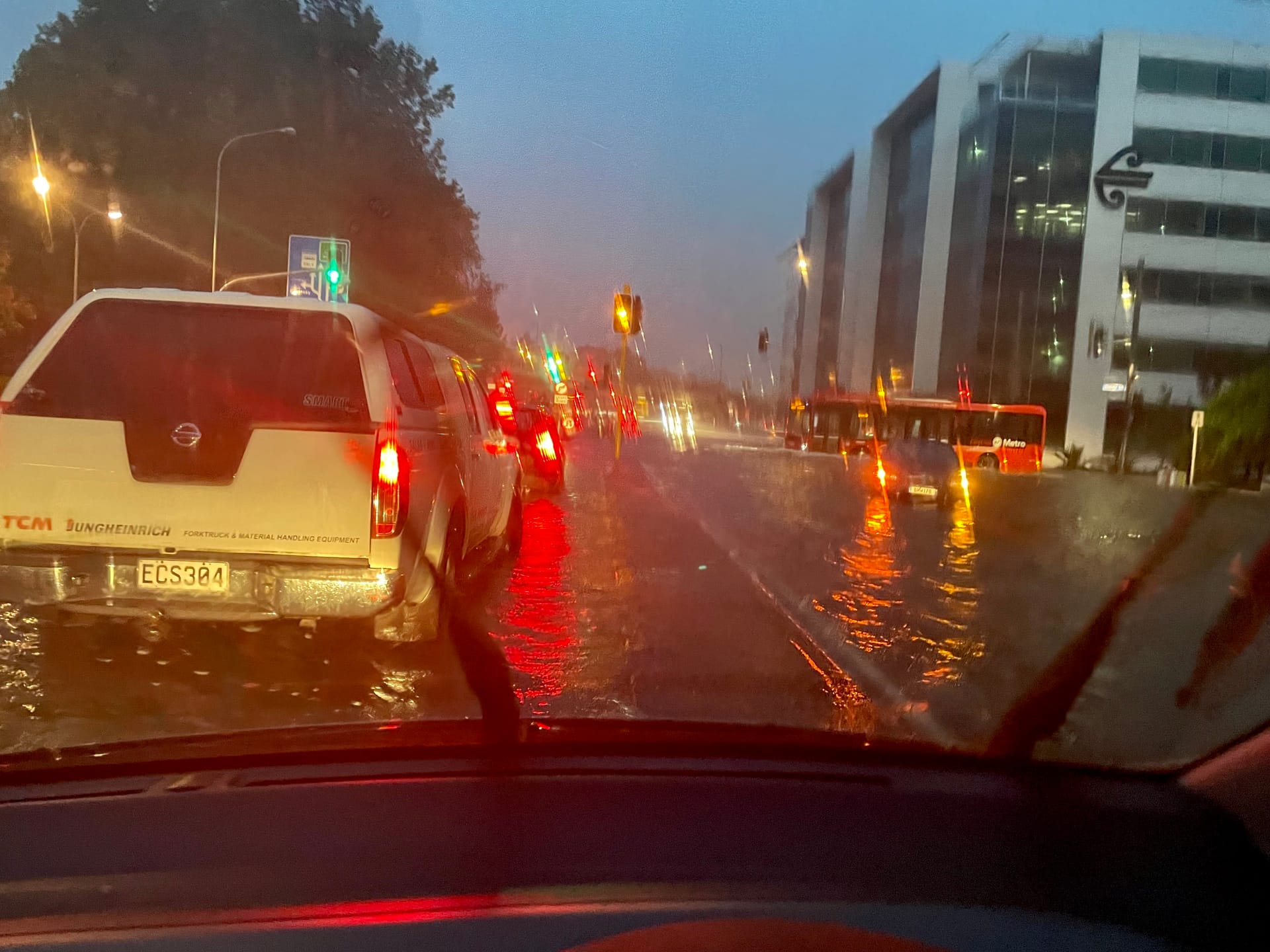
Eventually I rounded the corner to join Fanshawe and beheld a monster queue. It would be a long slog to the harbour bridge.
Not to worry, I’d just listen to RNZ emergency coverage and wait.
And the rain kept sheeting.
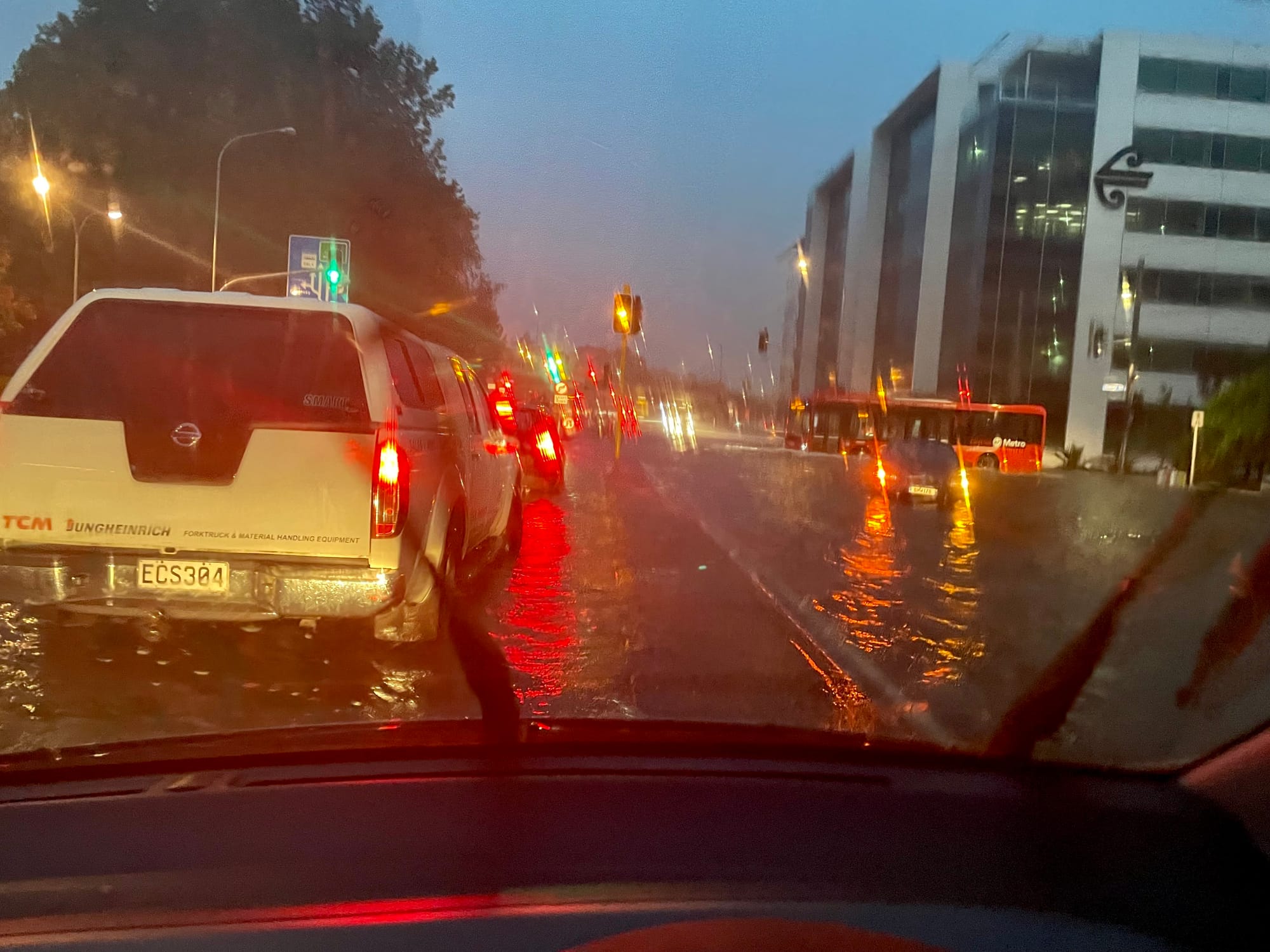
And then you began to see it. Deeper and deeper water ahead. A torrent of deep water.
And holy cow, there’s an abandoned, Audi submerged with all the doors flung open.
This is when you pull hard towards the high ground, and start calculating your chances in a little shopping basket car, as the traffic crawls and the river keeps rising.
The initial and continuing results of my calculation were: I am very possibly completely fucked.
But I pressed on, seeking out the highest ground and weighing the options - swing left past Victoria Park and make for the Ponsonby ridge? I judged I’d hit water too deep before I got to the other side. No point trying to go back, the river on the other side of the road was just as bad, and the blocks past there even more low lying.
So I pressed on, and hoped I could make the bridge before the water got too high, and rode the right hand wheels up onto the traffic island strip, and kept painfully crawling past more and more abandoned submerged cars.
By the skin of my teeth, I got to the bridge onramp and then I was making for the relatively untouched seaside village.
10 O’Clock I was back home, and soon I would learn that this was also the hour at which the anaesthetist arrived to assess Betty, all the other clinicians having already made theirs and having said: this may not work out well, but we’re prepared to go ahead if the family are.
But the anaesthetist was not. They looked at the weakened heart, the demands of the operation, and saw too much of a risk of death on the table.
This is how these things build: by the hour, to an end you were not necessarily contemplating, even if there were all kinds of gathering signs.
They found a bed for Betty, in a nice room of her own, and a chair for Peter.
Karren hugged her mother and made her way home and we talked about the mortal significance of a heart grown old and weak, and also gave thanks for so much care and consideration given by so many people gathered on a night when moving from one place to another was its own peril.
Karren left her phone on. Just after 5 it rang. You could hear the sounds of the hospital monitors, still, as Peter, desolated, gave her the news.
We put ourselves back in the car, made our way back over and all hugged. Karren and Mary Margaret brushed her hair, gently gave her the makeup she would have wanted.
Karren’s sisters and families made their way in for a wake of words and hugs and tears and being with her one last time; comprehending, now, more fully, all that had been coming in those hours before.
She was Betty Zimmerman, and Betty Beanland, and Betty Cornwell, and she was loved in all of those names. Some time this week we will honour her and say more goodbyes. But first there will be even more rain, we are told.