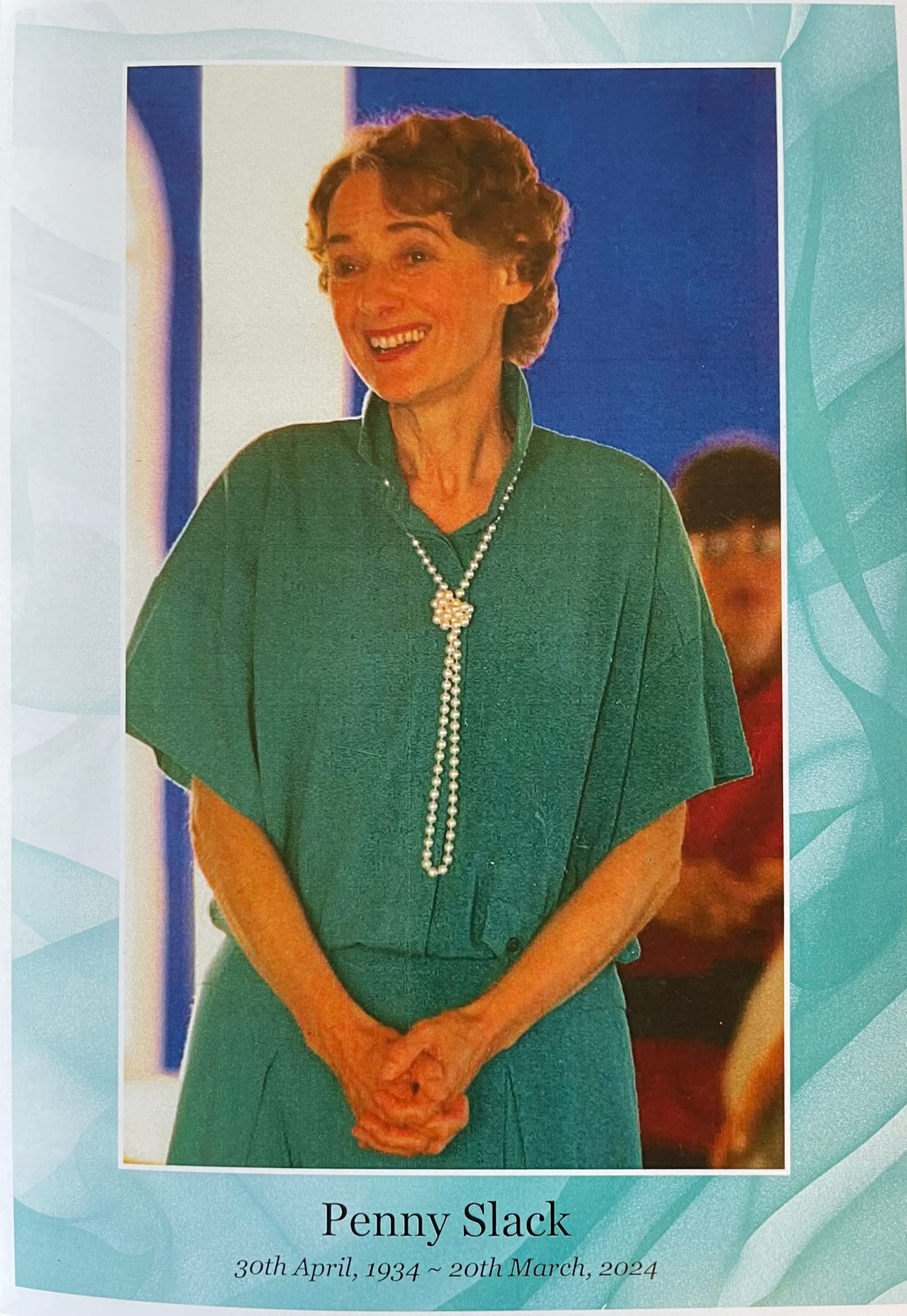
My sister Belinda asked Dad yesterday what one word would describe Mum best.
He said: vivacious.
If you only knew her from the photos on the slideshow we've made for today,
you might wonder about that, because the camera tended to lie with Mum.
If ever she saw a camera pointed at her, she stiffened up and the image only captured half the person.
It was only when she was unaware, the way you see her on the cover of the service sheet, that you’ll see the Penny everyone knew.
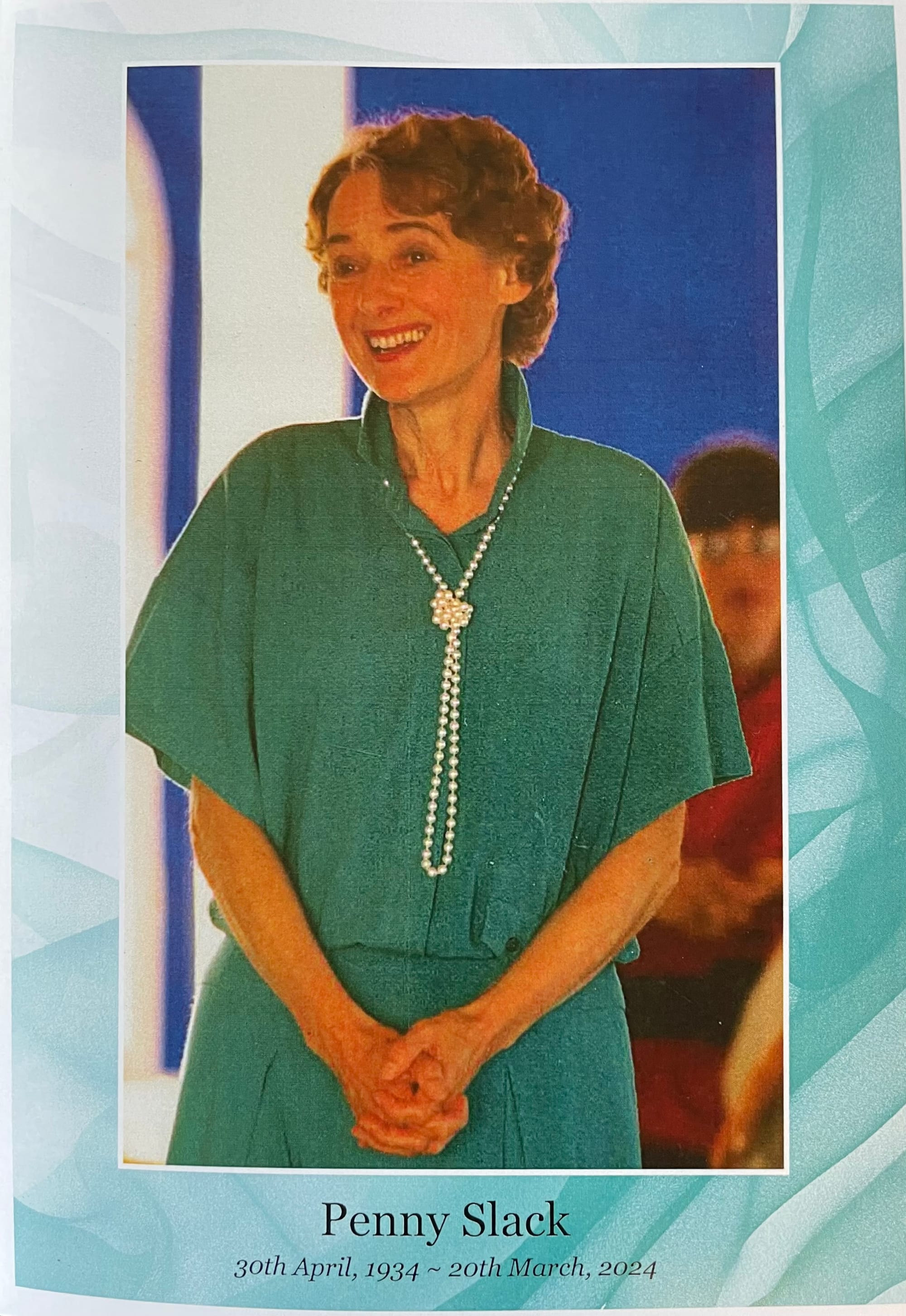
She's speaking at the wedding of her goddaughter Judy Oakden,
and you can see everything she was there:
engaging, thoughtful, vivacious,
and also, if you look closely,
a little anxious underneath the assurance.
She could worry, a lot sometimes, about things that might never happen,
but I like to think that was the cost of a great imagination.
Mum was just so full of enthusiasm.
It was there in her eager smile,
it was there in her encouraging words,
it was there in the way she would sense any low-temperature mood in a room and do her best to warm it up.
It was there in the way she would hear or read about something that was new to her and decide that this was her new thing.
And it was there in the vivacity. Dad knew.
You can think you know the whole chronology of a person's life,
but there will always turn out to be more you didn't know.
It was only a couple of years ago, I was talking with Mum and she pulled out an old photo to show me the place where she first lived, and it was right here in Masterton,
I had no idea that's where she was born.
The photo was blurry and old, just a snapshot of her father holding her outside the house he’d rented here at the end of the Depression.
He would have been in his late thirties in that photo.
Behind him already was a war in Europe, and the rehab farm near the bridge to nowhere that he and his brother had left behind when the slump came.
When the photo was taken he was selling insurance around Wairarapa. Ahead of him was another war and an assured steady income. He signed up again, leaving behind three children and their mother, because his thinking was he would be worth more to them dead than alive.
At that point they moved to Mangaweka, possibly to be back nearer family, or possibly because Mangaweka was a place where meagre savings could buy you a house and a paddock.
Mum’s mother Vi came from the hill country beneath the Ruahines. She had lost a sweetheart on the Western Front. She was a school teacher in the back-blocks when she met our grandfather one day out riding. They had three children, the last of them Mum.
Years later when Mum was worrying about the possibility of another baby on the way her mother offered her comfort with the story of the time she had thought she was in the same position at the age of 40 and couldn’t imagine having another:
Your father said ‘we can fix this’ and he ran a scalding hot bath and filled me up with gin.
And what happened? asked Mum.
Her mother smiled and said, Nine months later you were born.
Anyway, Mangaweka.
The world was in turmoil, there were daily air raid drills at school, there was precious little money, but Mum only ever recalls that time with the deepest fondness.
She remembered that time as a little village and a loving mother and an idyllic life, a house cow in the paddock that her mother would milk and cream cans they would carry to the greengrocer.
She and her brother John and sister Adrienne would walk home for lunch each day. There was a piano, and there was a radio, and on Sundays they would go to church and her mother would play the organ and teach Sunday School, and there were two Māori brothers Semple and Savage, who were invariably punished each day at school, but would never be punished by her mother. Mum loved her calm, wise, thoughtful way; the warm world she made for them.
And then their father was on his way home on a hospital ship, and their mother was on the train to Wellington to meet him, and Mum’s first sight of them was in the railway carriage together as they got ready to step off in Mangaweka.
And that night at the dinner table her Dad said, come sit on my knee dearie and hoisted her up. And this man was a stranger to her and the rough material of his uniform scratched and he had the smell of cigarettes.
As her mother tucked her into bed that night, she asked, How long does he have to stay with us?
But of course he stayed. And the ballot took them onto a hill country farm just in time for the wool boom years.
But also, this man home from war, a man in a man's world, took charge and the household had a different mood forever after.
For her, those years in Mangaweka were her warmest times.
Later, she would come to see, too, how tough those days had been for their mother, and it would make it all the more bittersweet.
But it was the strongest warmth of family, and that meant everything to her. And that would stay with her, always, the importance of that.
And there was something else from that time she carried all the way through her life. She was out walking with her mother, not yet old enough to go to school. They stopped to talk to one of the neighbours, standing in her garden, and little Penny asked something about one of the flowers or remarked on it in some way. And the neighbour beamed and answered her question, and they agreed what a beautiful flower it was.
And then the neighbour said something to the effect that little Penny Oakden had a great affinity for flowers and gardens.And this praise made her glow, and she would feel forever after: I have an affinity for flowers and gardens.
And there was a third insight that would eventually determine the direction of her life.
One afternoon in teachers' college in Kelburn, the lecturer was talking about the role of the parents in a child's development. It could be profound, he was saying:
The more you help them, the more you engage with them, the more you fascinate them, the more you explore the world with them, the more you notice them, and recognise them, and respond to them, the more they flourish.
Or something like that. She told us this story many times, but the moment your mother is gone, you're wanting to ring her to get the exact words, and here I am, trying to put them back together.
But her essential point whenever she mentioned this story was that what was going through her mind was not: where do I fit in this scenario as the teacher, but, when I’m a parent I’m going to do the most I possibly can, because what could be more valuable than that?
But that's jumping ahead of a life in Rangiwahia - the hill country farm they moved to where she had a horse named Whisky, and somewhere there is a photo of her doing a handstand on that horse.
She would ride over every hill of that farm, to help with mustering and for the sheer fun of it.
She loved to play netball, and run, and jump. And her adored big brother John helped her to build up her long jump by making a long jump pit.
On this hill country farm, there wasn't quite enough level ground to do that, so the track and pit had a bit of an incline to it.
Come school athletics day. this proved to be all to the good. Because when it was her turn for the long jump, she jumped so far she cleared the pit and hit the grass on the far side of the pit to set a school record.
And then to New Plymouth for high school, and her world opened up a whole lot more, and she was still jumping impressive distances and making rep sports teams and loving her studies and her life in this new place with new friends.
And then there was Teachers College in Wellington, which she loved because, of course, even back then you couldn't beat it on a good day, but not before she had also applied to Massey for some horticulture-related course, thinking to follow her brother who had studied there. Little Penny Oakden had a great affinity for flowers and gardens
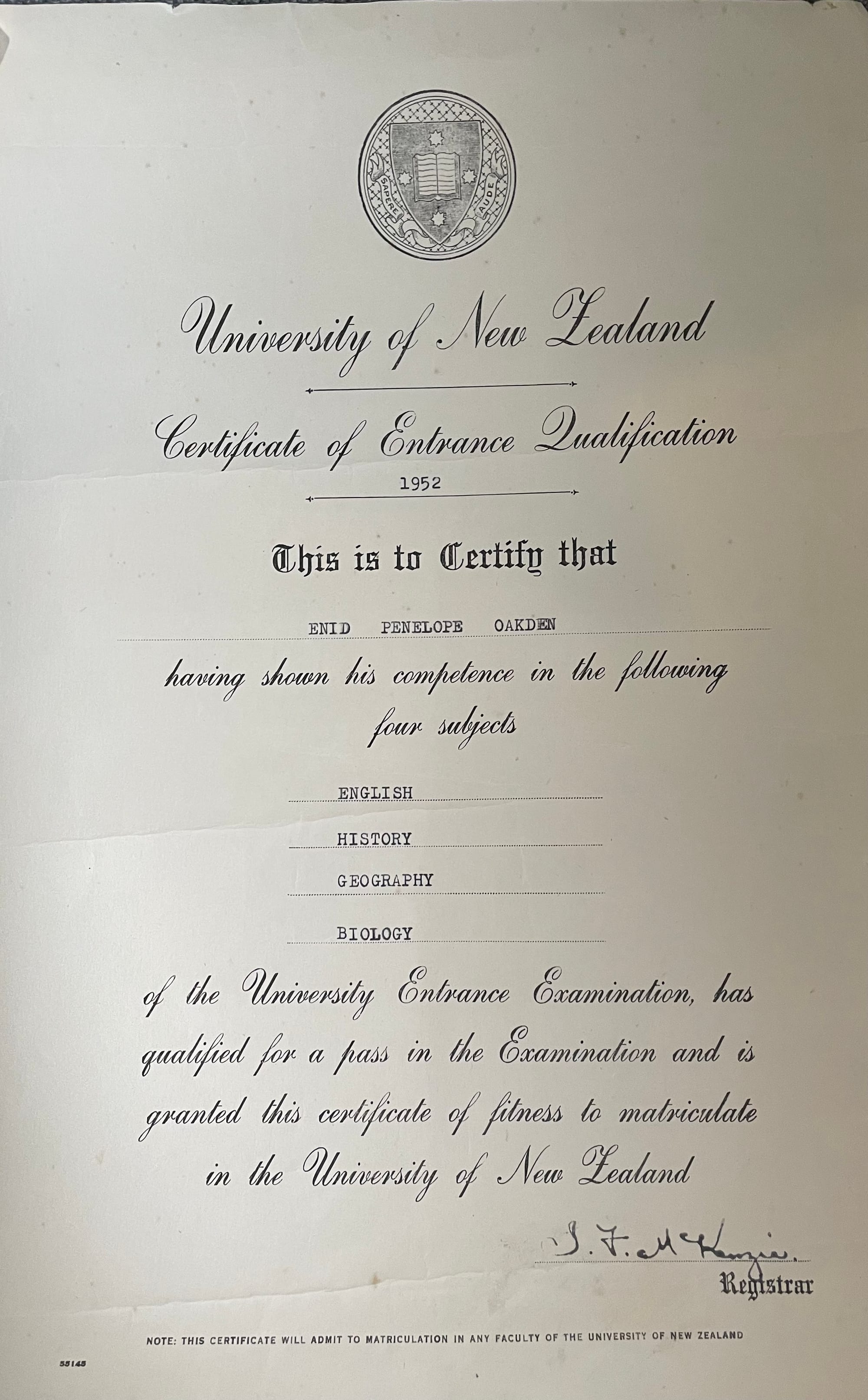
She received a letter to the effect that this was not really a course for a woman.
I want to show you her UE certificate. Having shown his competence.
It was so very much a man’s world, this world she was entering as an adult.
A woman living in that time and place could be constrained and agonised by attitudes that were as harsh as they were unfair.
But her enthusiasm also told her: make the most of what you have. If life has limited your options, or put something in your way, explore the possibilities such as they are, make the most of those.
So on she went to Teachers College and that revelation that afternoon.
And after Teachers College there was teaching at primary schools in Palmerston North, and meanwhile, there was also skiing.
This was pioneer skiing. Brother John and friends had tried out this skiing business up in the Ruahines behind Rangiwahia, and they had got keen on doing it on Ruapehu.
And this was how a bunch of enthusiastic young Manawatu friends came to build a little hut that became the Summit Skiers club
And Mum was in there, on the working bees and the fun of it all, and boy did she take to this skiing business.
So much so that she got herself a teaching job in Raetihi as well as the job as the school cleaner so that she could fund her weekends up on the mountain.
She had an absolute ball. The keen runner and rider and long jumper became the bold skier who would be fastest down the runs and at night would take up the dare of skiing over the top of the snow-covered hut roof for a spectacular jump.
And meanwhile, Tony Slack who had been living nearby in Bunnythorpe and Kiwitea, becoming a successful stud stock breeder after a time with J Force in Japan after the war, a keen horseman and stockman and sportsman was on his way home one Sunday from playing cricket, stopped into the Cheltenham store and his neighbour, Molly Ross was parked outside in the car with a pretty young woman in the passenger seat.
He liked the pretty young woman. The pretty young woman liked him.
He thought she was vivacious. She liked his calm, mature, nature.
I wrote this about him once:
Dad is quiet. He treats his words as though they cost ten dollars each.
People think well of him.
I have friends who still feel the sting of a father who was cold, or manipulative, or feckless, or violent, and mine was not one of those things, ever, just good and decent; a provider, a quiet perfectionist.
He invited the vivacious pretty young woman to a Rangitikei Hunt Club ball. They married in Palmerston North in 1958.
Dad was working on his father's farm, waiting his turn to run it, and they were living in a cottage just down the road from there when I was born.
But by the time Tim and Belinda came along, we had moved up the road to another stud Southdown farm, where Dad had been taken on as manager.
And that was where the young teacher who had been so inspired by what she heard about the role of parents, really went into overdrive.
She and her friend Jean Warburton got her old Teacher's College lecturer, Jack Shallcrass, to come and walk the parents of the district through the idea of a play-centre, this place where parents take the role of first educators.
They leased a section opposite Kiwitea Primary School, moved an old house onto it, and made the Kiwitea playcentre. You can see pictures in the slideshow of the working bees.
Before long, I was covered in paint and making new friends, and soon Tim and Bindy were too.
That play-centre is still there today.
And there was the world of books. They opened a wonderful new library in Palmerston North and enthusiastic Mum made a big adventure of going to explore this new place and getting our very own library cards and choosing an armload of books.
And over we went, each week, swapping them for a fresh armload.
And there was the world of theatre and music. She took us to the musicals in Palmerston North, took us to Downstage in Wellington, to the symphony orchestra.
And as each one of us turned seven, the keen skier took us up the mountain to become members of Summit Skiers. And what a mission that was, but man, she was so enthusiastic about that.
And because she lived so wholly immersed in our child's-eye view of the world speaking that language, enthusing in that way, a person might have taken from this that she was somewhat innocent and naive. But that would have been a misapprehension.
She knew what men talked about when women weren't there, she understood the ways people can be. But she preferred to see the best, or encourage the best, in people.
Although it's equally true that living in that world took her out of circulation for a while. A few months after she went back to teaching, and back to lunchtime playground duty, she came home one night and asked us, What's a wanker?
The enthusiastic runner and jumper and skier was also an enthusiastic driver.
Our Vauxhall Velox had a speedo that changed colour as the bar moved through fifty and sixty and seventy, changing from green to orange to red.
Dad was always green. But Mum was orange and quite often red. We found that exciting. It could also prove hazardous.
One day, Dad struck some trouble with the tractor. He needed to get it towed down to George Johnston.
Some of you will remember George Johnston, proprietor of the Cheltenham garage, chief of the volunteer fire brigade. He would come out to fill your tank with a burning ciggie hanging from his mouth.
Anyway, Dad gets Mum to give him a hand to get the tractor down to George, and gets the tow-rope hitched to the car.
Mum gets into the car, he gets onto the tractor, gives her the thumbs up, and down the drive they go and out onto Kimbolton Road.
And now they're setting sail for Cheltenham a mile down the road, and she rolls along and they're all good.
But then, perhaps there's someone on the radio that distracts her or maybe she starts thinking about something she needs to do in town.
Whatever, she starts to pick up speed.
And now the tractor's bouncing around quite a bit.
And Dad the horseman is now having to stand to stay steady and he is really being put through his paces.
He’s waving furiously to get her attention but there's no attention to be got. Clearly Penny's on her way to Feilding.
And now they're at full speed, and they're coming down the hill into Cheltenham, flying past the Chelty, with Dad getting bounced all over the show, and hurtling past the store where he met his vivacious bride who is now in with a reasonably good chance of killing him.
And on they go until finally she looks in the rearview mirror. And Dad lives to ride again. And back they go to the garage.
So she had her dangerous side. But really what we had was so very special. The home they made for us was utterly secure and safe and loving, and what more can any child hope for?
Naturally, I grew into the teenager who didn’t think about that at all, too busy doling out withering putdowns.
They came back from a teacher-parent evening one night and Mum, equal parts relieved and amused, said that one of my teachers had told them: It can't be easy being the parents of David Slack.
She had better luck with the next two teenagers, but I would still have to reassure her a lifetime later that the failings were mine not hers, that what she had done for me had meant everything - the books, the reading, all of her project of giving your child every possibility. The thing I've ended up most able to do is write sentences for people, and I absolutely owe it all to her.
Dad had constantly told us as we grew up that there was no future in farming. I came to wonder later if what he was really saying was, there's no future in farming for you.
Anyway, once the three of us had left home for higher learning, they sold the farm, and that created the possibility to do many different things, and that's what happened.
While we were still at school Mum had gone back to teaching, at Feilding Intermediate, and as they moved around the country, this teaching continued, for the first few years taking regular classes and then moving into work experience and kids with learning difficulties, and also outdoor education, and she made some lovely bonds with so many kids.
They moved to Palmerston North, to Waikanae, and for a time in two different houses because even the strongest of marriages can have its trials. But not for too long.
And from Waikanae, they moved north to Kerikeri to try out the winterless north and live in a lovely stone house that happened to have a kiwifruit orchard, a sort of semi-retired interest for Dad that would have been great if the 1980s kiwifruit industry hadn't turned into a nightmare.
That included, after selling the house and subdividing the section with the kiwifruit crop on, setting up camp in a garage shed to get that last crop out, which ended up being one hell of a slog but they were always dogged, both of them, always capable of adapting to difficulty.
And next they moved to Cambridge just because they had always loved the place and there were elderly relatives living there they were very fond of.
And then when Tim and Barb started a family they offered to be the daytime carers for Jaime first and then Jessica. And so they moved to Napier.
That thing Mum talked about, the care of a child, the best start, was happening again, and this time Dad, who didn’t have a woolshed or stock to worry about, was involved too. And the smile on his grandfather's face was just a delight.
And when Tim and Barb moved to Auckland, Mum and Dad came too, and for a time, that meant they were living just one street away from us and our daughter Mary-Margaret got to spend precious years with Gran and Pa.
And when Belinda’s daughters Ariella and Mili arrived, the trips to Wellington became more frequent, because when making a family is your first priority, there is the greatest joy in seeing it grow, and grow.
And the moving wasn't over; they moved out to Coatesville with Tim and Barbara and Jaime and Jess for lifestyle block living, and after that ended, down to Masterton, back to where Mum's life had begun, and they made friends in the same way she had in all those places, through church and book clubs and swimming.
Mum loved the pool here and even got the attention of a TV crew for it, because there aren't many people who were put off swimming because of eels at the school creek and finally got around to learn it in their 70s and ended up at the Masters' Games.
And at all those places, she and Dad made the most beautiful gardens, because a lady in Mangaweka had given a little girl the idea that this was a thing she could do.
She would spend hours and hours in all those beautiful gardens.
And until just two years ago Mum was still gardening all the time and swimming most days. But then almost overnight everything changed.
Polymyalgia and a deteriorating hip caught up with her and she couldn’t move a single step without a walker. It was time to move into a home.
And in place of a pretty solitary existence, Mum and Dad found themselves in a new more sociable one especially the music on Thursday where everyone sings. They loved it, had always loved singing together.
They would sit with their door open for the world going past, and their world was smaller now but they were happy, and glad for the help and care of the wonderful staff at Lyndale.
Some of them are here this morning and we want to thank you so much for all the love and care you've shown Mum and Dad.
You're very special people.
Mum rang last Sunday afternoon to check on me, because a mother can worry about you forever.
She told me they had an isolating covid case too. She told me she hoped they wouldn’t end up cooped up again.
She told me the really frustrating thing about life now was the inaction. Her whole life had been running and riding and netball and skiing and gardening and crossing rail viaducts on a dare.
She told me she really missed it all.
We also talked about New Plymouth because Tim and his family were there for WOMAD. After I'd explained what made it such a magical festival, we enthused over Pukekura Park and the Bowl of Brooklands where she and Dad and most of the parents of the lower North Island went to see the Seekers in, what, 1968? I said remember that holiday in 1975? The motel right opposite the park, and the lights at night?
She didn't, but then we reminisced about how much she loved being a private boarder there to go to New Plymouth Girls' High, and how much she had loved it there, and the all-round achiever cup that had made her so proud.
And we talked about how they were now just four years away from the 70th wedding anniversary, and boy, wouldn't that be something, even if Dad would need to be 103.
And we said love you and I went back to my covid rest.
And two days later, she was gone.
Because I am tragically unco, she had said to me many times, On my deathbed, please try not to knock it.
I'm glad we got to talk the way we did two days before, and so I’m not grieved that I didn't get here in time. And I’m even maybe a little relieved. As we sat down at the funeral home on Friday, the first thing I managed to do was knock the coffee table with a crash.
Well Mum, I'm here now, and guess what?
Judy our cousin, Mum’s goddaughter messaged me this the day she died:
I remember when Mum died Penny gave me great comfort by saying that she would live on in my mind. She said that whenever plants I knew Mum loved came into season I would remember her.
That has turned out to be true, every season every year and I pass that idea back to you all and hope it offers some comfort.
Family was everything, to her, Mum told us.
The most rewarding, most important thing in her life, above everything else, she said, had been having a family.
One day I was carrying trays of breakfast to them in the last days before they moved to the home, and Dad said to Mum,
This is pretty good service isn’t it Gran?
Mum said to him,
Remember when we had babies in high chairs and we were feeding them?
He nodded.
She said,
It was lovely.
And after another pause,
It was hard work. But it didn't feel like hard work.
Things you do out of love or affection are really not work at all
A few years ago, they were working in our garden, doing some work for us. They didn't know I could see them from my desk.
Dad had his earmuffs on because he belongs to the generation that loves a chainsaw. He was pissed off about something, because that's what chainsaws will do to you.
Mum walked over to him, cupped his head, lifted up the earmuffs, said something, and kissed him on the forehead.
They stood there, together, still, calm, warm.
My strongest images of her are the one on the service sheet,
and the two of them that day in the garden, together, still, calm, and warm.
Love you, Mum. We all do.