Amsterdam to Hong Kong16,000kilometres
41days
18trains
13countries
11currencies
6long-distance taxis
4taxi apps
4buses
3sim cards
2ferries
1tram
0medical events (surprisingly)
I
Frankfurt → AmsterdamI’d become fixated on travelling overland from the west coast of Europe to the east coast of Asia, and decided I should get on with it. With increasing age comes increasing awareness that things not done now might not be done at all before The Coming of The Reaper, so the year of the end of the end of travel seemed a good year to knock it off. After the knocking off, Uncle Dave1 said it might make an interesting story. I wasn’t so sure. Who needs another travelogue from some wanker with a camera and opinions? But then I thought, if I don’t write it down, I’ll forget most of it: the age thing again. And if I’m going to write it down, I might as well try to make it interesting, and if I could make it interesting, Uncle Dave would have been right. I’m not sure quite how to attack it. Chronologically has a logic to it, but no one wants a diary. Topic by topic perhaps – but how many topics could there be? Maybe not many. Would be embarrassing to run out. So I’ve made the bold decision to do both and neither. I’ll start at the beginning and then say whatever I feel like saying whenever I feel like saying it. Having said that, I’ll start just before the beginning. I left Donna at Frankfurt Flughafen. She was flying home alone, having never thought my overland plan looked either sensible or pleasant2. Attached to Frankfurt Flughafen is Frankfurt Bahnhof Flughafen - because Europeans have proper transport infrastructure. From said bahnhof, it would be an easy train trip to Amsterdam, I had thought. But then, looking at my booking properly for the first time, I saw that there were two quite tight connections, so if a train were more than a bit late for either, I would have a problem. The first connection was Dusseldorf. The train was late. I had only minutes to find the train to Arnhem. I found it in time, but not in time to board it. I arrived just soon enough to hit the external button that opens the door, but only at the moment that the train started moving. The door didn’t open. I found a place where I was issued another ticket and eventually found myself on another platform waiting for another train that would take me on a different route to Amsterdam, but now with a further two connections, both of which were going to be tight. Stop me if this sounds familiar. The platform was crowded with: A. a lot of people who seemed to be in the same boat I was, and B. a lot of drunk German football fans, singing. The train arrived late. It was already full, but a full train has an awesome capacity to absorb more people, regardless of whether there are enough seats. I spent the next half hour standing in very close quarters to many people, a large proportion of whom were drunk and singing, or, more accurately, drunk and spraying virus about the carriage. This was the first of several occasions on which I expected to leave a conveyance with at least Covid, if not Ebola. The football fans got off, and there was space, and I had a group of four opposing seats to myself. A stop or two later a pack of skinheads boarded. Two of them sat across the aisle from me. Another two invaded my seat-group and sat facing me. Weirdly, every skinhead had what could only be described as a handbag. They spoke loudly. They seemed to find each other’s comments hilarious. Fortunately their conversation wasn’t in English, because if I’d been able to understand it, I’m sure it would have been even more annoying. The one directly opposite me eyeballed me from time to time. To be fair, I might have eyeballed him once or twice myself. I was definitely eyeballing the handbags. After a while he addressed me. ‘Where are you from?’ ‘New Zealand.’ ‘Zeeland? In Netherlands?’ ‘No. New Zealand in the South Pacific.’3 ‘Do you think I look like a Nazi?’. Perhaps he thought I’d find it awkward to answer that. I didn’t. ‘Yes.’ He considered that for a moment, then: ‘Does my friend here look like a Nazi?’ The questions weren’t getting any harder. ‘Yes.’ Silence for a while. ‘Do you smoke weed in New Zealand?’ ‘Sometimes.’ I got a fist bump for that. ‘I’m not a Nazi. I’m Russian.’ In 2023 that didn’t seem like a sound distinction, but it wasn’t a question, so I didn’t need to respond. Probably a good thing. The Nazis left. The train was late and I missed the next connection. I had, at least, reached the Netherlands: a town called Venlo. I found a place where I expected to be issued another ticket. The woman behind the glass looked at me as though I was an alien – which I was – and said, ‘Just get on the next one.’ I bought a bottle of water and waited and got on the next one. The next one was a double decker with a single WC. Not a single WC per deck. Not a single WC per carriage. A single WC per train. I established all this after the large bottle of water had worked its way through me. I established also that the single WC was out of order and that its door was locked. This was problematic. For a small eternity the pressure came in waves of increasing intensity. Walking helped. I walked the length of the train many times. There was nowhere private to make use of the empty water bottle. The only private space was behind the locked door, and was ironically the only place where I wouldn’t have needed the bottle. Extreme solutions crossed my mind. After about a week, the train arrived in Utrecht, where I had another connection. The WC-free train was on time, so I’d be able to make the change – for the first time that day – but I wouldn’t have time to find and use a comfort facility at the station, as well as make the change. So if I went WC hunting, I’d miss a third train that day. But there would surely be a functional toilet on the next train, right? The probability of hitting two consecutive trains with no toilet had to be close to zero. But it was one of those low probability – high consequences situations: unlikely but calamitous. I chose to miss a third train. It was dark before I got to Amsterdam – reputedly a jewel of Europe. I found my hotel. It was crap. I went looking for a restaurant. The streets were teeming with tourists. Tourists of debatable quality. Various species of the genus Moron. Brits on a weekend away. Hen parties. Teeming to the point where it was physically difficult to walk along some streets – like trying to get out of a sports stadium at full time. Teeming to the point where it was difficult to find any restaurant with an available seat. I found a spot in a small Thai place by bypassing some women who made the mistake of hesitating to look at the menu on the window. It doesn’t matter what the menu says, ladies; it’s the only food in town. I ate. It was OK. I went back to the crap hotel. The end of the day before the beginning. 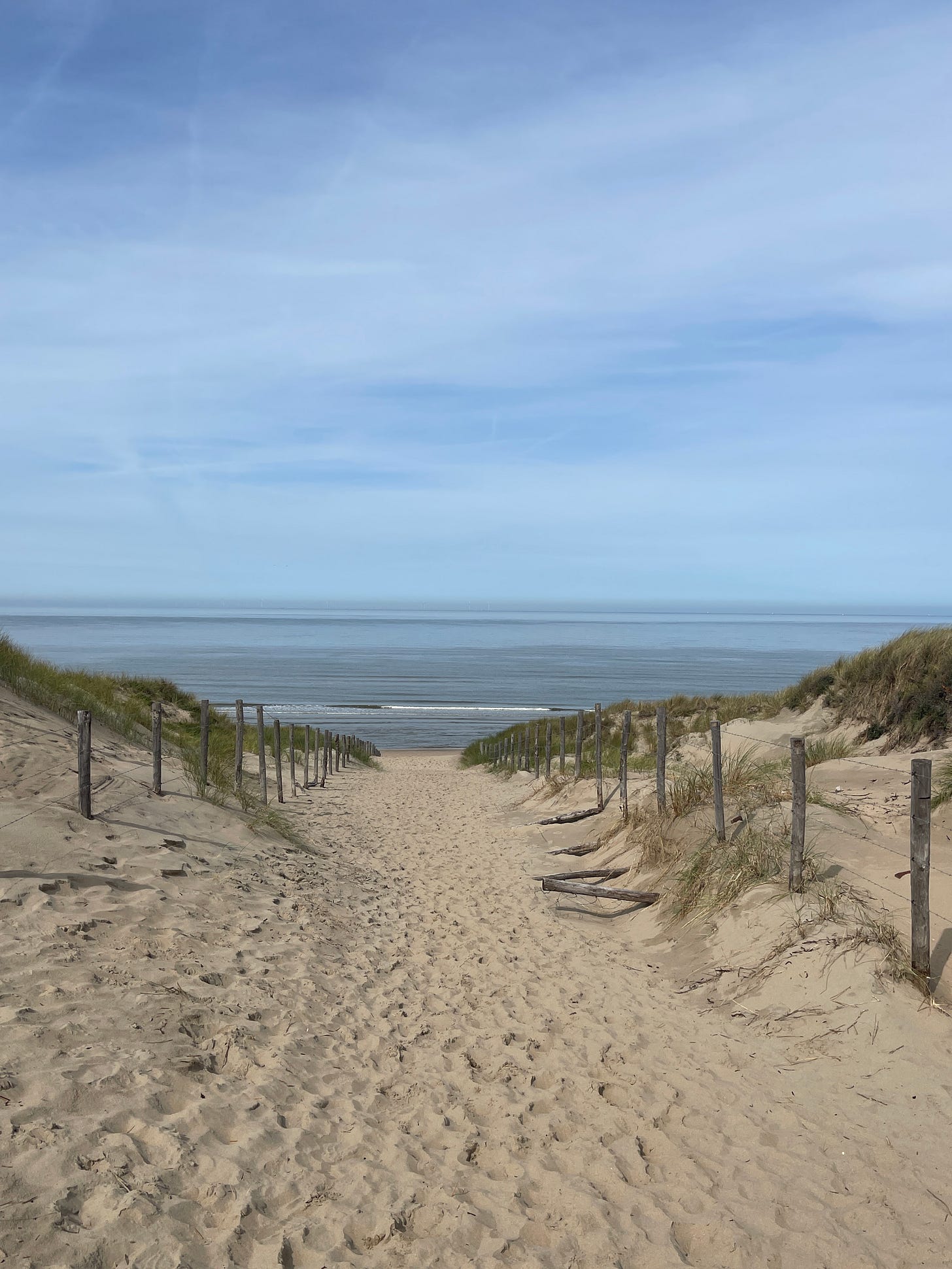
1Slack, ex Feilding 2There are people who argue that Donna is more sensible and pleasant than the author. 3Proof that it’s a dumb name. II
Amsterdam → ViennaThe morning in Amsterdam dawned well, weather-wise; not so much the street-scape. I walked to the train station past trash and dirty canals. Things improved from the station. I took a near-empty half-hour commuter train through rural-ish landscape to Zandvoort, a small town on the edge of the continent. The beach, or, to make a technical distinction, the coast, was the reason I’d gone to Amsterdam. To properly travel from one coast to another, in the reckoning of this author, one must start and finish fully immersed in salt water. It being early on a Sunday, not much was open, but with the assistance of Google Maps (coffee/open now) I found a small café in a residential street a few blocks from the Zandvoort station. To my surprise, they had flat white on the menu. To my greater surprise they made it well. Good coffee isn’t ubiquitous in Europe; West or East, and a good flat white is downright rare. Turkey is Turkey (well, actually it’s Türkiye) and Turkish coffee can be found in any corner of the country, so that’s a coffee pass-mark for Türkiye. In Central Asia the pickings are slim. In China, Slim’s left town. In 41 days, including that morning’s coffee in Zandvoort, I found only four (4) establishments that made a good flat white. So the next time someone serves you a good coffee, be thankful to the universe, and FFS congratulate the barista. It will make the world a little bit better for all of us. I rented a three speed bicycle and headed south, out of the town and onto a bike path that ran behind a large dune parallel to the beach. It was a good day for cycling. I came to a spot on the bike path where a lot of bikes had been left, so I left my bike. I walked to the top of the dune. The North Sea spread indefinitely west before me to a hazy horizon. Wind turbines faintly visible in the distance. The water was more brown than blue, but the sun was shining, and the beach was pretty good. I fully immersed myself (three times, of course, otherwise it doesn’t count). Standing on the dune again, I perceived some distance between me and the South China Sea. One can get from Amsterdam to Vienna on a single sleeper train: an OBB Nightjet. OBB for Österreichische Bundesbahn; aka Austrian Federal Railways. It was a sleek and modern machine. But sleeping carriages can be lotteries. As a solo traveller, what you want is a one-bed compartment. One bed, one window, one door, one human. Where there are two-bed compartments, it’s a reasonable option to pay double in order to exclude other people. But then there are the four-bed compartments, with bunks on both sides. To be avoided. The more bunks there are, the greater the risk of one being occupied by a Bad Person, who sniffs every two minutes, or hums, or eats loudly. I admit this has never happened to me, but the thought is terrifying. Paying quadruple for a four-bed compartment is technically possible, but it seems excessive, and it’s not improving one’s carbon footprint, nor that of the three other now-excluded passengers who can’t book a sleeper so take a plane instead. But the Nightjet had none of those. It had three-berth sleepers, arranged in triple bunks on one side, and a blank wall on the other, with a sort of table thing attached to the wall, and not a lot of space between the wall/table thing and the bunks. Paying triple for a three-bed compartment is only marginally less silly than paying quadruple, and it being an Austrian train, sleek and modern, and it being Western Europe, and it being a sixteen-hour trip, even a single bed was quite a lot of euros, and the Scottish genes in me weren’t up to buying three. And also, when I’d booked, it wasn’t apparent that the layout was as stupid as it was. But, praise Allah, I had it to myself, apparently. I counted down the minutes to departure. At T minus 5, I was confident no one else would be joining me. Who would be disorganised enough to turn up to a sixteen-hour train with only five minutes to spare? At T minus 4: a clean-cut, but obviously disorganised, young man, that’s who. He had the top bunk and I had the bottom. At least there weren’t three of us. He wanted to close the door. I suggested we leave it open, the better to disperse his viruses, but closed is the standard arrangement, so closed it was. Somewhere in the night there were suddenly three of us. OK, not so bad; bearable while we were all horizontal in our own bunks. But in the morning we had to sit up. The bunks were folded away by an efficient Austrian conductor, and replaced by three seats, side by side, facing the wall and table thing. The nocturnal arrival turned out to be another clean-cut young man. I was therefore the exception. Breakfast was served on the table thing, then cleared away, and we were left, side by side, facing the wall, which was close enough to touch. I was in the middle seat. There was a window, but it was ninety degrees to the right. I’m sure that someone, somewhere, thought they were fucking clever when they designed this abomination. There were three hours to go. I cracked first. Quite quickly. Österreichische Bundesbahn hadn’t provided a dining car, so I went looking for a seating carriage and found one, and it had a much more acceptable ratio of people to seats than my sleeping compartment. I saw out the remaining hours to Vienna with no close neighbour and many windows. There’s a lot to be said for standard seats. III
Vienna → IstanbulI didn’t stop long in Vienna. It was too convenient to get off the Nightjet from Amsterdam in the morning, and onto the Dacia, to Bucharest, that evening. I happened to know where to find Café Wortner, one subway stop from Vienna Central Station. Wortner has stood on that spot since 1880, and its exceptionally forward-thinking architect designed it with outlets for charging laptops. I spent most of the day there. It turns out you can occupy a table indefinitely, sucking Wortner’s electricity, provided only that you keep ordering beer and food. The Dacia is Romanian. It’s old and it’s slow – twenty-two hours to Bucharest - but it has single-bed compartments, which makes it One of the Best Kinds of Train. Romanian countryside rolled past my window at speeds that at times put us in danger of being overtaken by a jogger. We weren’t, but chiefly, I think, because there were no joggers. I arrived early evening in Bucharest, where, by coincidence, number two child Finn was temporarily resident. We tracked each other down in the Old City, then together tracked down my accommodation. I’d received a message that my original booking was “unavailable”, but the provider was very pleased to give me the “opportunity” of an alternative. Drawing on his recent experience of Europe, Finn’s firm view was that “unavailable” meant bed bugs had been discovered. The alternative, when we found it, had an entrance that would have been at home in Guantanamo Bay. Behind the steel, graffitied, security gate, was a seemingly empty building with a vibe that fairly shouted HORROR MOVIE. It was one of those places where you don’t see any other humans – you just get a couple of codes on your phone and directions to your bed. The elevator had a loose floor. You read that right: loose floor in the elevator. 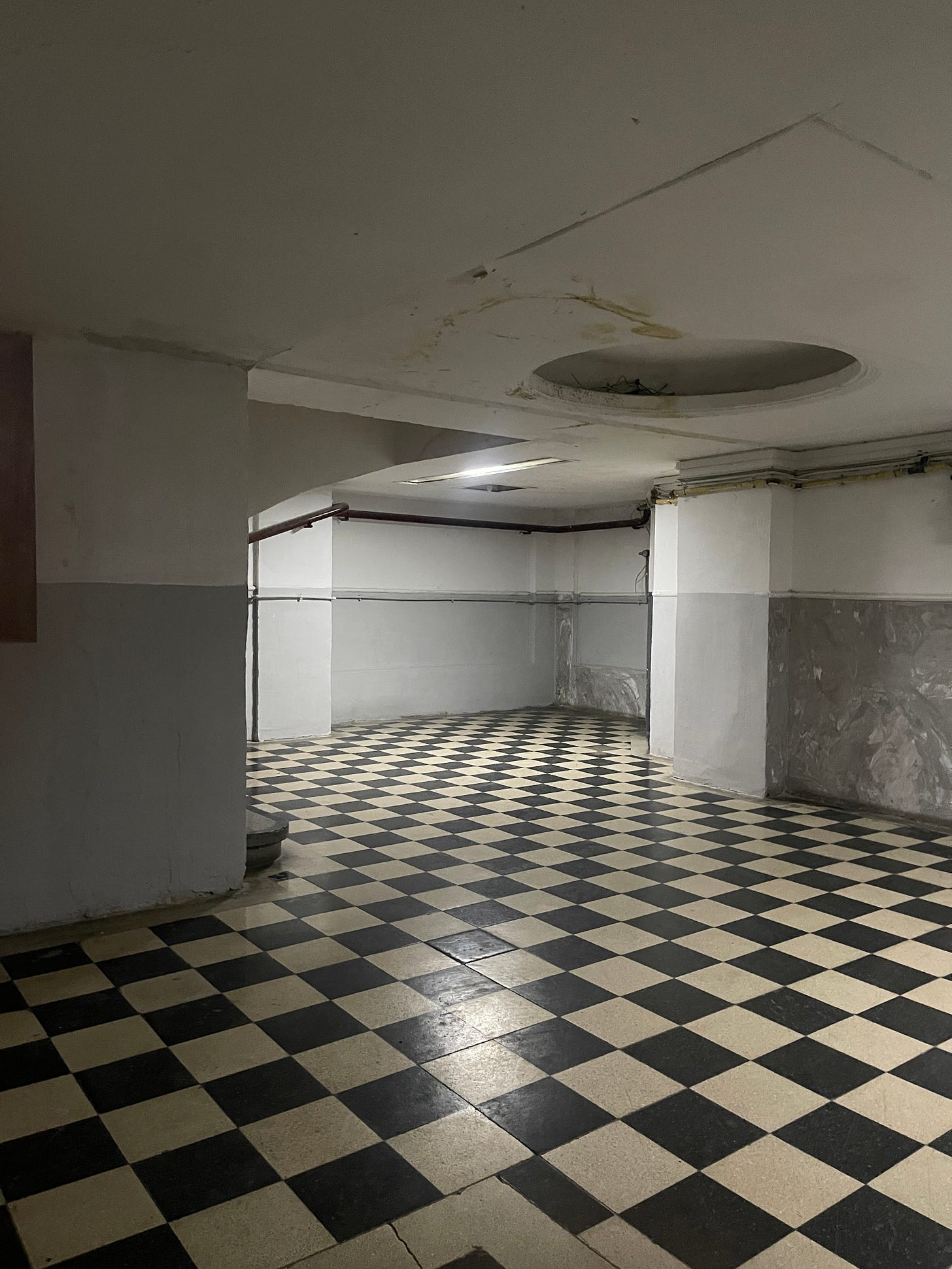
I left my bag with my new bed, and we found a restaurant with passable beer. Good beer, like good coffee, was hard to find everywhere on this excursion. Having brewed my own beer since 1980 (not continuously) I admittedly have a high bar for what I’ll describe as good, but Western Europe objectively has a long way to go on the beer front to catch up with more civilised parts of the world1. My theory is that the Germans and the Czechs believe they perfected the art of beer-making five hundred years ago (consistent with the timing of the Reinheitsgebot in 1516) and therefore aren’t going to bloody-well change anything now. The Belgians have been doing more interesting things for a long time, but the beer in Belgium seems to mostly stay within its state of origin. I slept without bed bugs, and in the morning boarded another slow train, bound for Sofia. I shared a six-seater compartment with a retired Welsh couple and an ancient Romanian woman. Or Bulgarian. It was a hot day, Europe having just dropped off the peak of a heatwave, and there was no air-con. But the person who designed this carriage, probably before I was born, knew what it’s like to actually travel in a train (take notes here OBB). It had wooden joinery, and the compartment window was of the opening kind. On the interior side of the compartment the door and wall were mostly glass. The sliding door could be left open, and beyond that, the corridor also had opening windows. For ten hours the four of us rattled along in a warm breeze with views out both sides. After crossing the Danube into Bulgaria we stopped at border control in a town called Ruse. A dog appeared from a station building and bravely, despite the heat, limped on three legs toward our train, across several railway lines. I doubted his bona fides (bone of fido’s?) from the start - it had the makings of a scam. He received multiple gifts of food from the train windows, then turned and strolled back home on four legs. Couldn’t be arsed pretending for one more minute. No shame. A town well named. The ancient woman spoke no English, and Mrs Wales no Romanian. Or Bulgarian. But that didn’t stop them chatting, not especially aided by a variety of indecipherable hand gestures. They became quite friendly. God knows what they each thought the other was talking about. I failed to avoid the madness. Before the end of the day, there I was, showing them photos of my children and making indecipherable hand gestures at the ancient one. LOL. In Sofia I had breakfast overlooking a large roundabout, which was graced with two gardens, four lion statues, and, running through its centre, twin tram lines. I do like a good roundabout. So much more efficient than the stupidly blunt instrument of traffic lights. If you doubt that, next time you’re stopped at a red light, count how many seconds pass while zero cars are allowed to negotiate the intersection. Count how many cars are therefore unnecessarily stationary. I ordered “newspaper eggs”. I didn’t know what it was, but it was cheap, so that’s what I ordered. The eggs were delivered, and had apparently been cooked, on actual newspaper. They were accompanied by a good flat white: the second of the trip. Newspaper eggs, flat white, trams, and a big roundabout – what’s not to like about Sofia? Next stop would be Istanbul. The overnight Sofia - Istanbul Express was the only train on two continents that I couldn’t book online; someone has to physically buy a paper ticket from the Sofia station. You can risk turning up to the ticket office when you get to Sofia, but if you prefer more certainty you email a person called Nigel, or Tim, or something, and deposit money to an account in the UK2. A single bed sleeper ticket to Istanbul has a face value equivalent to about £30. James, or Andrew, charged me £130, for which someone bought a paper ticket and delivered it to my hotel a week or so before I got there. If you think Simon’s, or Tony’s, profit margin is excessive, it seemed a better deal than trying to get to Istanbul without a ticket. A word on European train-booking generally. Should you want to do anything similar to this folly, start with The Man in Seat 61. The Man in the title has been on every train in the world and written it all down3. It’s not all up to date, and it could be better organised, but there’s a shit-load of good information in there. The train companies have their own apps of course, but there are also two third party apps - Trainline and Rail Europe – with clever algorithms that allow you to plan and book using multiple train providers. Both are wont to offer solutions with short change-times, which doesn’t always work in real life – hence my three missed trains on day-minus-one - but you can tweak itineraries to your personal level of risk tolerance. Tickets and reserved seats are different things in Europe. If you’re offered the option of paying a bit more for a reserved seat, pay a bit more. Otherwise you can find yourself standing in an aisle, and if you’re standing in an aisle, there’s an overwhelmingly high probability that you won’t be the only one, so your aisle might be quite crowded. The European apps will get you as far as Budapest. For the rest of Hungary, and all of Romania and Bulgaria, you can use the Romanian Railways website CFR Calatori. It’s slow but it works, and it will sell you tickets for all points between Vienna and Istanbul, subject to the just-mentioned exception of the Sofia-Istanbul Express. But there’s an exception to that exception. CFR will sell you an online ticket on the Sofia-Istanbul Express provided you choose to take the version that goes directly from Bucharest to Istanbul, without actually going near Sofia. Any questions so far? Also, if heading from Bucharest to either Sofia or Istanbul, although you can book online, you still need to front up to the international ticket office at Bucuresti Nord and uplift a paper ticket before boarding the train. Don’t get a Eurail Pass. I made that mistake in 2019. It was right bastard to use. Before going full gangster on Eurail, I thought I should have a look at its current website, and it does seem to have upped its act since my experience. You now have the option of asking for an electronic pass, instead of carrying a folder of fucking paper. Jesus. And it’s still only the 21st century. Whatever next? The Man in Seat 61 has written, according to my MacBook, 12,717 words on the pros and cons of Eurail and how to use it. The fact that 12,717 words were required should tell you everything you need to know. Last tip for today’s episode: Rome2Rio app. “Discover how to get anywhere” it says. And you can. Does what it says on the tin. Gives you all transport options between any two points on the Earths’ surface4. Like Seat 61, not always up to date, but useful as, bro. 1New Zealand 2Details on Seat 61 3Author’s exaggeration 4Author’s exaggeration IV
Istanbul → AnkaraWhether the Sofia-Istanbul Express really qualifies to be called an express is debatable, but it’s another one of those likeably old and slow trains that offers single sleeper cabins, and most of the fifteen hour journey happens at night, so you get your money’s worth from your bed. When crossing a border on a train, you get a double hit of bureaucracy. The train stops at a station before the border, where you have the pleasure of being processed by the bureaucracy of the country you’re leaving. Then the train continues over the border itself to a station in the country you’re entering - the distance might be might be two kilometres; might be twenty kilometres – where you do it all again. There are two kinds of processings. The first is where border guards enter the train, take your passport away for an hour or so, then return it with a stamp in it that has the name of the border town that you haven’t really been in, and often also a little picture of a train. That’s the kind I had when leaving Bulgaria. The second kind only seems to happen in the middle of the night. The second kind was what I had on entering Türkiye. Border guards entered the carriages and demanded everyone disembark, with everyone’s respective luggage. We were ushered across a dimly lit platform to a building in which our luggage was x-rayed. Then back to the platform, then to another room in another building, for passport control. Passport control at most borders was a source of amusement. There were nearly always Official Persons at borders who liked to have a jolly good look at my passport, flicking through the pages as if they knew what they were looking for. Often, one Official Person would be engaged in the page flicking, when another, presumably more senior, OP, would take the passport from the hands of the former, and start their own page flicking. There were often penetrating questions asked. The two most common penetrating questions were “Mr William?” and “New Zealand?”. When I answered in the affirmative, the OP would generally give a knowing nod of his head, to show that that was the very answer he had been expecting. I say “he”, because in the cases where the OP was a woman, I don’t recall getting stupid questions. The record for the most page-flickers at one border was five. I can’t remember what border that was, but I remember counting. Under International Law it’s illegal to place a stamp in a passport in chronological order. So for any OP to reconstruct any passport’s movements from the information provided by the randomly scattered stamps, at a minimum they would need a pen and paper and a bit of time. And even then it would be dependent on whether any of the stamps were illegible, and because International Law also requires that every seventh stamp must be illegible, the OPs are on a tricky wicket. They can’t have been looking for evidence that I’d visited a country that disqualified me from entering theirs, because none of the countries I entered had any disqualifying-country-visit criteria, apart from Azerbaijan - which has an issue with Armenia - but Azerbaijan was one of the smoothest entries (though had the most difficult exit – go figure). Were they hoping to identify me as an international criminal, attempting to illegally enter their country on public transport, with a passport in my real name? Isn’t that what the computers attached to the fibre optic cables attached to the passport scanning machines are for? Was it a psychological tactic, to see if I’d wilt under the extreme pressure of the flicking and the penetrating questions, and spontaneously confess that I harboured nefarious intent? Fuck knows. If they thought that was stress, these are people who haven’t experienced toddlers. But, back to the Türkish border in particular. After the flicking there was more standing around on the dimly lit platform. I was shouted at by a man with a gun, for, I think, getting too close to a group of passengers from a different carriage, who might or might not have been at a different stage of processing to the passengers from my carriage. It was all a bit loose on that platform. Any international criminal worthy of the title could have avoided the luggage x-ray and the passport flicking altogether, merely by effecting some competent skulking. We arrived in Istanbul in the morning, an hour or so behind schedule, which was to be expected. Passport flicking can’t be rushed. In Istanbul I did something I don’t recommend: I went straight through it. Istanbul isn’t a city to be missed, but I’ve had the good fortune of visiting it more than once, and Donna and I had been there only a couple of weeks earlier. Better yet, consequent upon that recent visit, I had on my person some Türkish lira, and, really better yet, an Istanbul Card, which is what one needs for public transport. The Sofia-Istanbul Express ends at Halkali, which is the western end of Istanbul’s newish Marmaray light rail line (construction greatly delayed and cost doubled – it’s not just us). I got off the Express, swiped my Istanbul Card and was straight onto a commuter train. It took a scenic route along the Sea of Marmara (from whence the name of the line), then dived underground. 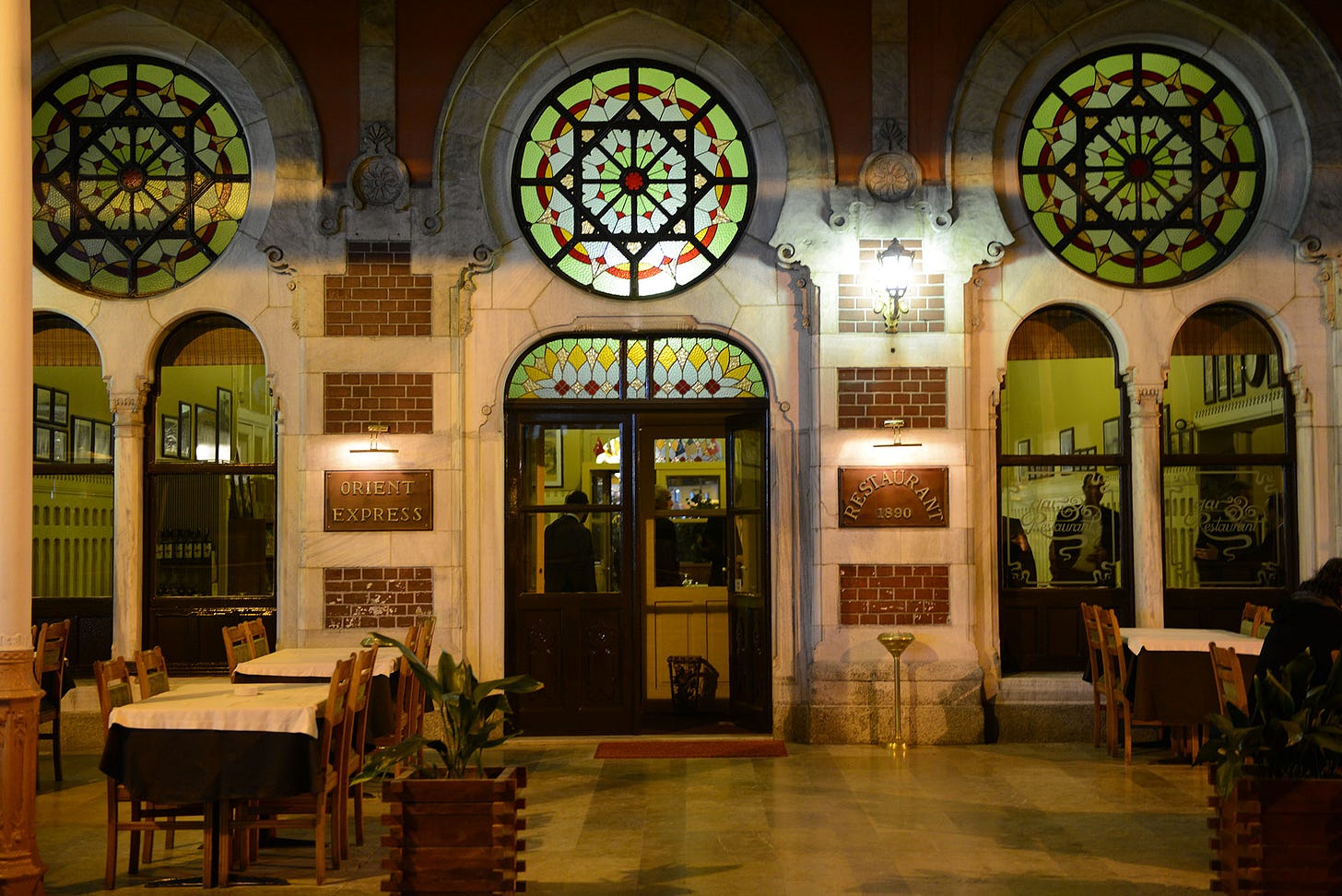
I could have continued underground, and under water, emerging on the far side of the Bosphorus Strait, but I wanted to take a ferry instead, so I left the Marmaray and surfaced at Sirkeci Station. Sirkeci, on the European edge of the Bosphorus, is the grand old station that was once the eastern terminus of the Orient Express, and the place where the said OE was boarded by Hercule Poirot and 007. Using again my hand-dandy Istanbul Card, I took a short tram ride to Eminönü Ferry Terminal, then a ferry to Kadiköy, where I stepped off in Asia. Of the many attractions in Istanbul, the humble ferries are one of the best. If you visit, don’t let yourself be sold an expensive sight-seeing cruise. Take a ferry: cheap and chilled, and you’ll see just as much, and someone’s always walking around selling fresh bread and hot tea. Is it the best transport in the world? Yes. Bread in Turkey, BTW, is always fresh. The selling of stale bread is punishable by death. The ferry to Kadiköy, passes, on the Asian waterfront, Haydarpasa Station. Sirkeci is merely grand; Haydarpasa is magnificent. In the early 20th century trains ran from Haydarpasa as far east as Tehran. It’s been closed for a decade or so. Public pressure prevented the government from selling it for development, and it’s now under scaffold, under restoration. It’s not currently a functioning part of the rail network, and there’s no firm plan to make it so, but it’s escaped no-one’s attention that it's the ideal western end for the Istanbul-Ankara high speed rail. At present the high speed line terminates a mere two kilometres inland at Söğütlüçeşme (So-yout-lu-ches-meh, for any non-Türkish speakers). It was Söğütlüçeşme where I was now heading, but by the time I got to Kadiköy I knew I had a problem. I couldn’t predict what time I might arrive either at Halkali or at Söğütlüçeşme, but the high speed trains to Ankara leave every hour, so I’d decided to wait until I was on the ferry, then go online and book the most convenient departure. What could go wrong? Quite a lot. It was quite a dumb idea. When I tried to book, every train was sold out for the next three days. Having meticulously planned the series of trains that had brought me to Istanbul, suddenly I was just another idiot tourist. The obvious (really obvious) tactic would have been to book a failsafe train late in the day, but to do that, I would have had to be thinking. I found a small travel agency in Kadiköy. The sole occupant was a woman a lot more Muslim than I am Christian. She spoke about as much English as I speak Türkish, and my Türkish is limited to “hello”, “please”, “thank you”, and “beer please”. We communicated via the wonder of Google Translate. She could sell me a bus ticket to Ankara, but a bus was going to take a godawful long time compared to a high speed train. Instead I bought a bus ticket from Ankara to Samsun in two days’ time – she deserved a sale of some kind – and told her I’d try my luck at the train station, and if that didn’t work, I’d be back. She wished me well. I started walking. On the way to the station I came upon a small open-air restaurant. It was late morning and I hadn’t eaten, so I chose food over hurrying to a probably fruitless quest for a seat on a train. I put down my pack, and for a ridiculously low price – it was an area not frequented by tourists - I received, from a very affable restaurateur, an excellent shakshuka and Türkish coffee (aka Türk kahvesi). Worst case, I thought, if I did have to walk back to the bus lady, I could at least stop here again and have another shakshuka. The station was busy, but the queues at the ticket windows were small. Probably because people aren’t stupid enough to not buy tickets in advance. I was second from the window in my queue when an American at the window on my left had a meltdown on hearing that there were no seats for three days. But my window was better. At my window was a train lady who said that one seat had just become available on the twelve o’clock, but I’d need to hurry because it was leaving in ten minutes, and I’d need to get through security first, and it was business class. Did I want to pay for business class?, she asked. Fuck yes I did. Ten minutes later I had my arse in a business class seat and was sliding out of Söğütlüçeşme. It was the time I’d “wasted” eating the shakshuka that put me at the ticket window just as my seat (did I mention it was business class?) became available. Otherwise the melting American would have got it. Or someone else. All part of His Divine Plan. Truly, the meek shall inherit the Earth. A little later I was served, at my business class seat, a delicious lunch – food in Türkiye is always delicious, anywhere, any time – then I leaned back and swished through Anatolia. In four hours I was in Ankara, 1155 kilometres and 23 hours from Sofia. V
Ankara → BatumiI had two nights in Ankara, so a day between them to kill. It was better than I’d expected. Not as interesting as Istanbul, but more relaxed. No one, for example, shouted at me that I should eat at their restaurant. I walked up to Ankara Kalesi (a castle, not an unburnt queen). The walk was better than the castle, but the view from the top was good. There was a fence with a strongly worded sign to the effect that going beyond was verboten. It looked, from my location, that the parapet beyond was the kind of parapet from which people would stand a good chance of falling to their deaths. On said parapet were two blokes taking photos of themselves. Welcome to the Darwin Awards 2023: Selfie Category. I went to Anitkabir – the mausoleum of Kemal Atatürk. Jesus, it’s impressive. Makes the Lincoln Memorial look like it was paid for by cotton farmers. Ankara being perhaps more conservative and definitely less touristed than Istanbul, most restaurants don’t sell alcohol. There were bars, but they were occupied exclusively by middle-aged men drinking and smoking. I kept walking. I would have looked out of place without a cigarette. The young and the hip hung out in big coffee shops. I kept walking. I would have looked out of place. But hard work pays off. I found a restaurant that sold me a “Mexico Bir” with salt around the rim of the glass, like a margarita. Surprisingly tasty. And then an IPA with Yakima hops. Yakima in Anatolia - didn’t see that coming. Ankara was the end of the line, train-wise, for a while. There are trains that go further east from Ankara, but the quickest route to Georgia is along the Black Sea coast, and that means buses. With the ticket I’d bought from the bus lady in Kadiköy, I boarded a bus at Ankara Otogar1 – a structure about half a kilometre across, with three levels of buses. They don’t half-arse their bus stations in Türkey. Türkish long-distance buses are pretty good, but they generally don’t have WCs, and they will travel for up to four hours without stopping. Be aware. Türkish roads, though, are fantastic. Türkish roads are autobahns without autobahn traffic. So a Türkish bus on a Türkish road isn’t a bad way to travel. I had an idea that Samsun, on the Black Sea, would be a pleasant beach town. It wasn’t. The beach was bleak, with an optimistically large number of empty beach chairs. The town was dominated by a long, noisy, polluting, six-lane road, a block from the coast. My hotel was large and ridiculously ornate, and I appeared to be the only guest. It had a Russian money-laundering vibe. I’d intended to stay two nights in Samsun. I lasted one. So, another bus, along the coast to Trabzon. A motorway runs half a thousand kilometres along the Türkish Black Sea. It’s mostly not designed to be crossed on foot, except by over or underpass. For someone driving on it, wanting to get from here to there, it’s highly functional. road. For someone living near it, it doesn’t have high amenity value. The engineering imperative is obvious: there are five hundred kilometres of narrow coastal shelf where it’s reasonably practicable to build a motorway, immediately south of which are five hundred kilometres of steep hinterland, where it isn’t. But for the many communities it cuts in two, and/or cuts off from their sea, it’s sub-optimal. I found Trabzon less offensive than Samsun, so I stayed two nights, in an apartment with a sea view, wedged between the horrible highway and a swimmable beach: water temperature 24C. Checking in to the apartment was difficult. I’d texted the manager. He said he’d meet me there. I arrived first. Shortly afterwards a young man arrived, accompanied by a young woman. I established that the young man could speak only Arabic. He established that I could speak only English. No matter, I had Google Translate. But he proved incapable of performing any of the tasks one reasonably expects of a manager. He couldn’t check me in, or give me a key, or show me my room. He was a moron. If he thought I was the moron, he was wrong, it was him for sure. Then the manager arrived, which surprised both of us, given that we’d each thought we were already speaking to him. We were both guests. Yes, both morons. The next day, after a swim at the swimmable beach, I went downtown to find a cash machine. In an unlikely place for a good coffee experience, under an umbrella opposite the central bus station, beside a hot, dusty, smoky road, I had a superb Türk kahvesi. It cost so little I was almost paid to drink it. Then a Türkish delight was thrown in, gratis. After Trabzon, another day, another bus, same motorway. Thirty kilometres from the Georgian border began a queue of trucks parked on the side of the road. Hundreds of vehicles, stationary. I don’t know how long the average truck driver waits in that queue, but my maths says that to travel thirty kilometres at zero km/h would take a long time. 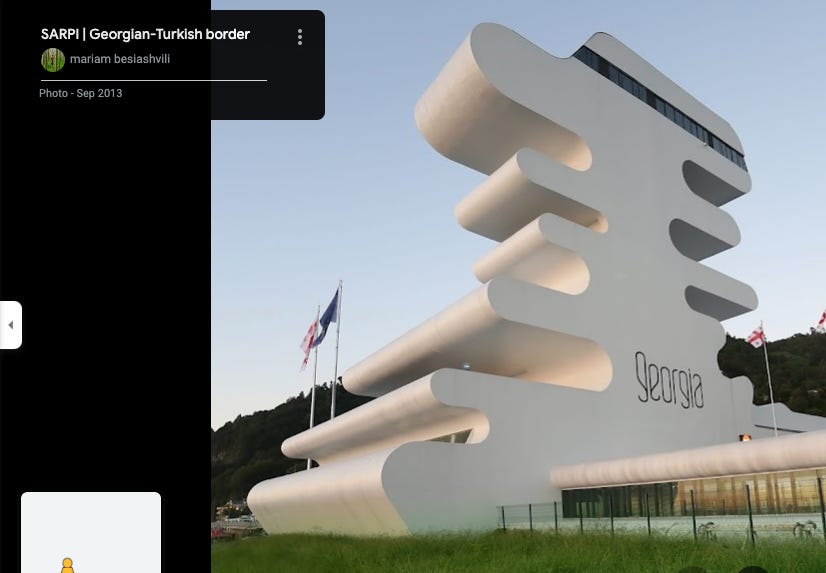
The bus, and the motorway, went no further than the Türkish side of the border, a tiny place called Sarp, from where I walked to Georgia, into a tiny place called Sarpi, which has possibly the coolest customs building on the planet. Exit from Turkey and entry to Georgia respectively, were both fairly efficient. There was some low key passport-flicking and quizzing about whether my name and citizenship really were the same as those shown in my passport. FFS. But I received an apparently sincere “Welcome to Georgia”. Before leaving the Georgian passport window, I had a question. I knew there was a 90-day stay limit, but I didn’t know whether I could leave and immediately return within those 90 days. Answer: yes I could, as often as I liked, and the clock would reset every time I returned. Good information. The relevance is yet to come. I also learnt in the border crossing that Georgians consider queuing to be a contact sport, especially the women. And I was ripped off by a Georgian money-changer: that’s $8 I’ll never see again. It was time to realise another planning debacle. Twenty kilometres up the coast from Sarpi is Batumi, Georgia’s second largest city, from where there’s a train to Tbilisi. I hadn’t been sure how many days it would take to get from Istanbul to Batumi, so I hadn’t booked a Tbilisi train in advance. By the time I was in Trabzon, though, the day of my arrival in Batumi was not only nailed down, but quite close at hand. Did I remember, when in Trabzon, to book a train? Nope. Seems I’d been too busy lounging on my balcony, watching shrimp boats over cans of Efes. 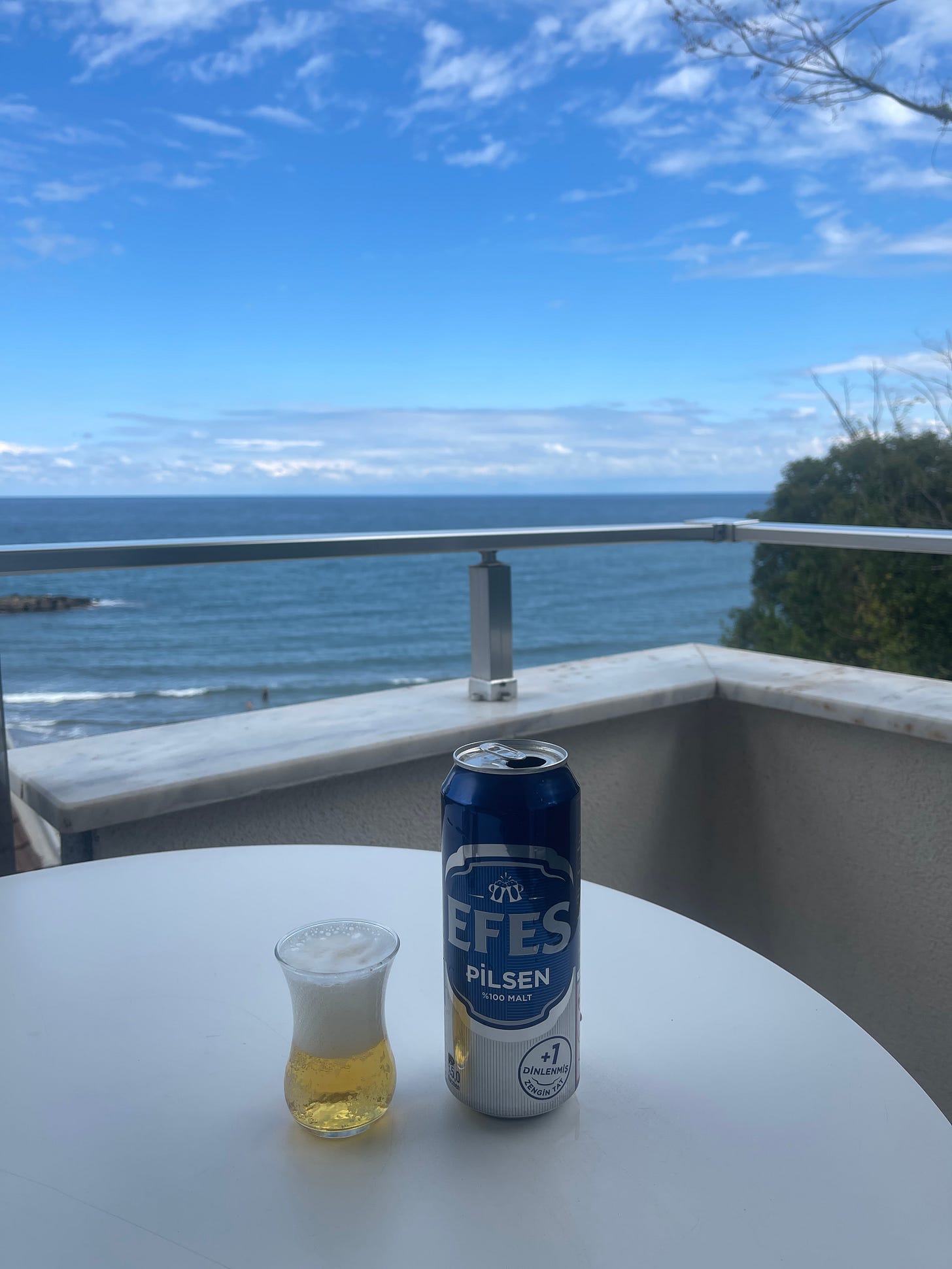
I found a café in Sarpi and looked for a seat for the next day. Sold out. Frik. What about today? One left, but I’d have to travel first class. OK, if I must. I’d miss the delights of Batumi, whatever they might be, but it was obviously all part of the Divine Plan. If it were not so, the only remaining seat would have been second class, surely. I did experience the delights of the Batumi train station. It wasn’t a good experience. A big poorly maintained bunker of a building, with one poorly stocked kiosk. At the WC, a woman was taking money for entry. Payment for WC entry always gives me hope. I want to believe that the money’s going to someone to keep the place clean, and that if someone’s being paid to keep it clean, then it will be clean, or at least better than gag-level unclean. I was often disappointed. I was disappointed at the Batumi train station. It wouldn’t be the last time. Eventually my first class seat arrived. Not as good as business class in Türkey. No one served me dinner. I could have starved. Five or six hours later, approaching midnight, a taxi dropped me in a cobblestone street in Tbilisi, supposedly in the vicinity of my hotel. According to what I understand of Georgian2, it was a hotel the driver had never heard of. I know I hadn’t. Google Maps told me I was within a short stone’s throw of the front door. If I were, it was as obvious as the entrance to Diagon Alley. It took several midnightish walks up and down that street before I eventually found the bloody thing, in, appropriately, an alley. Signage: how hard can it be? 1Good word, Otogar. From the French autogare: bus station. Similarly ‘gar’ is simply ‘station’ - from the French ‘gare’ (related to garage) - meaning a train station as opposed to an auto station. 2Zero VI
Tbilisi → BakuTbilisi. An oasis after the unappealing Black Sea Coast. There was good coffee. There was good beer. If Taj Mahal Indian Pale Ale isn’t as Indian as pale ale gets, I don’t know what is. Narrow streets of beautiful houses. Narrow streets of rustic houses (if rustic means structurally unsound). Houses stuck to cliffs. Trees, bridges, ancient Eastern Orthodox churches, a disturbingly large number of men in cassocks. Tbilisi doesn’t have too much tourist traffic, but it has enough to generate a reasonable supply of civilisation, which I can define in almost a single word: civilisation is a table with a menu, on a warm but shady street, with attentive staff, with proper beer, or coffee, depending on time of day, with payWave, and without campylobacter. Too many tourists, and there will be more tables with menus, but also not enough. Tbilisi is in the sweet spot, somewhere between Slough and Amsterdam. A gondola took me across the Kura river and up to a huge statue of the Mother of Georgia looking over the city, holding a correspondingly huge sword in one hand, and something less huge and less obvious in the other. Mother of Georgia: who knew? 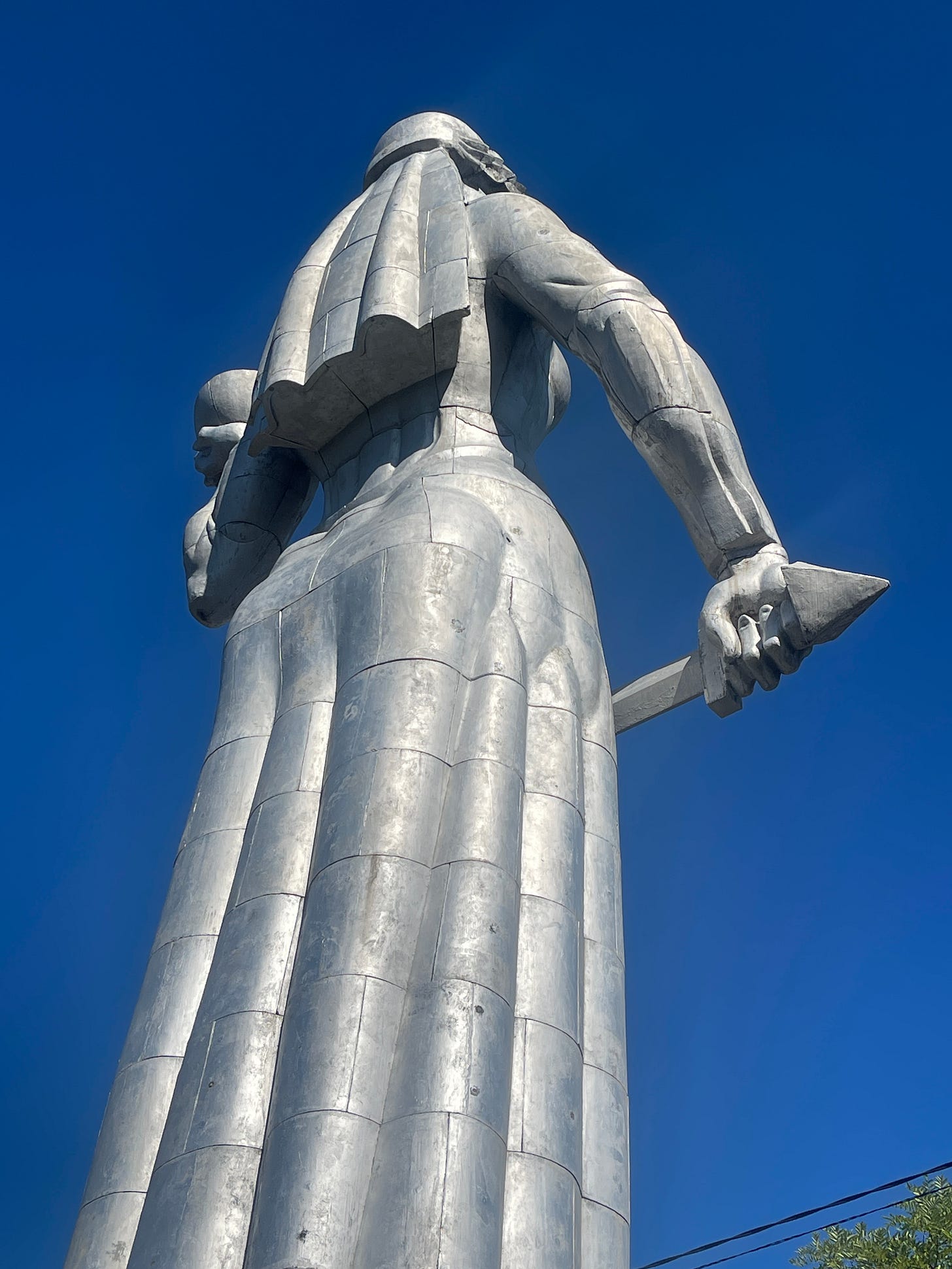
I abandoned Diagon Alley: apart from the unforgiveable signage fail, the wi-fi was rubbish. Interesting the evolution of what we consider necessities. There was a time when prissy travellers like me might have abandoned a hotel only because it didn’t have indoor running water. Before that, substandard camel accommodation might have cost a hotel a picky guest or two. I found another hotel. I asked whether their wi-fi was good. The receptionist said it was. ‘Speed test it’, she said, and gave me the code. It was fast. ‘Have a look at our breakfast’ she said. I looked, and lo, it was pleasing to behold. There was a terrace on the roof, for hydrating at sunset. Seriously, she’d had me at the wi-fi code. I had some days to spare in Tbilisi. Partly because I’d arrived earlier than expected. Partly because my train-booking agent in China had told me my intended travel coincided with the Chinese National Day holiday. Although the word in the title is “Day” singular, it apparently runs nine days. ‘Can’t guarantee we can get you tickets’, she said, and even if they could: ‘You really don’t want to be travelling in that week. We strongly recommend you change your dates.’ She seemed to think it was important. China was aways going to be the rate-determining step. Chinese train tickets generally become available fifteen days before travel, and can sell out frighteningly quickly. You need to buy tickets via Chinese agents, who have the necessary magic that foreigners lack. And once you have a ticket, making changes at short notice will likely be impossible, so if you manage to miss a train, you might be stuck for a week or more. All other travel, therefore, would be subservient to the timing of the run through China. In summary, I needed to start slowing down lest I arrive at the border of the Middle Kingdom too soon. Tbilisi wasn’t a bad place to start slowing down. But first, there was the Georgia-Azerbaijan border to deal with. Azerbaijan closed its land borders in 2020, citing Covid. It hasn’t opened them since. Well, it sort of has. After a while it became possible to leave Azerbaijan by land, but it remained impossible to enter by land. The government keeps citing Covid, but that doesn’t stack up, because there’s no restriction on entering by air. One theory is that Azerbaijan Airlines is more profitable when the land borders are closed, and Azerbaijan Airlines happens to be owned by the government, and the government happens to make the border rules. This arrangement hasn’t been good for a lot of Azerbaijanis who are in Türkey or Georgia, or Turkmenistan, or God knows where, and haven’t been able to get back to their homes for years, because they can’t afford to fly. Some died in the 2023 Türkey earthquake, when they hadn’t even wanted to be there at the time – were only there because they couldn’t go home. But hey, the airline’s doing well. Maybe the CEO will get to be president one day. But back to the issue at hand. The aim of the trip being to cross both continents by land (and sea), the Azerbaijani border was a problem. Just flying over it would have broken my self-imposed rules. Truck drivers can cross in both directions, provided they wait long enough. And I’m guessing Important Persons would get a pass, because. But for tourists and other lowly people, it’s a one-way border: Azerbaijan to Georgia good; Georgia to Azerbaijan bad. The ‘Red Bridge’ border crossing is only an hour by taxi from downtown Tbilisi. I’d scoped the Red Bridge online. The exact line of the border is within a no-man’s land about four hundred metres wide, between the Georgian customs building (in Georgia, no less) and the Azerbaijani customs building (in Azerbaijan, believe it or not). About here, some readers might think this story goes a bit sideways. But rational people will accept that all decisions were necessary and reasonable. Plan A was a devastatingly simple, seven step stratagem:
And then I would have joined the dots: a full land crossing. There was no rule against stop-motion travel. I’m in charge of the rules. Step 1 began with a taxi to the Red Bridge. A pleasant drive through dry, rolling, Caucasian countryside in an old Mercedes, windows down. Ten kilometres from the border another stationary truck queue began - it’s not a great part of the world to be a truck driver. But the Mercedes was unaffected. I was dropped a hundred metres from the Georgian customs post. I didn’t get a lot closer. A police officer intercepted me and told me to piss off back to Tbilisi. That’s not exactly what he said - his English vocabulary didn’t extend to casual vulgarity - but that was what I understood his message to be. He wasn’t persuaded by my explanation that I was entitled to leave Georgia, and that it would be up to the Azerbaijanis on the other side to tell me to piss off back to Tbilisi. He was quite convinced it was his job, and that it was a job that needed to be done before I’d even reached the building that wasn’t even on the border. My logic, obviously, was unassailable, but there’s only so far you want to push an argument with a man near a border with a gun and, possibly, handcuffs. Number of Plan A steps accomplished: zero. Plan B. The policeman suggested I go to the Azerbaijani Embassy in Tbilisi and ask for a special permit to enter by land. Rumours of these special permits float about; on the Caravanistan website, for example, where people have reported being told by Official Persons in various countries that special permits could be obtained, but no-one on Caravanistan could attest to having obtained one, or to knowing anyone who had. The special permit thing was obviously a myth perpetuated by the Azerbaijani bureaucracy, for reasons possibly not known even to itself. It would be foolish to waste any time on it. So: two hours later I was standing outside a closed door at a side entrance to the Azerbaijani Embassy in Tbilisi, wanting a special permit. An Official Person opened the door. Could I get a permit? Nyet. You should have been here two years ago, he said. That was when they were last issued. Good to know. Here endeth Plan B. Plan C. Another consequence of the border situation is that flights from Tbilisi to Baku sell out well in advance. I’d booked a flight for 18 September, but that was another four days away, and despite the beer and the coffee and the tables on warm but shady streets, I didn’t want to hang around Tbilisi for a full five sleeps. There were no plane seats available before 18 September. The earliest was 20 September. I bought one. Plan C would require two flights out of Tbilisi, be that sooner or later. I was hoping for sooner. 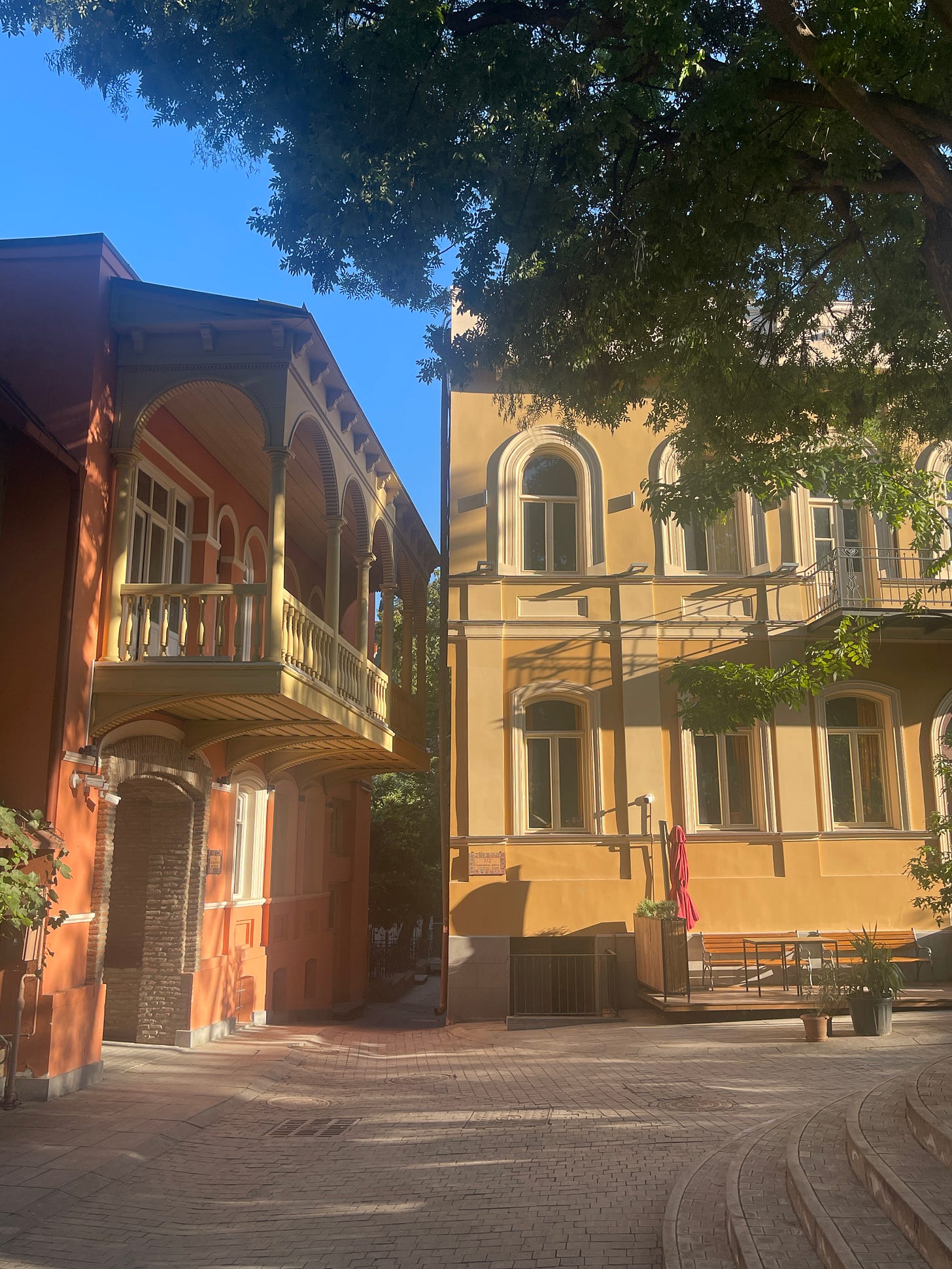
I emailed Azerbaijan Airlines. If I went to Tbilisi airport, could I buy a ticket on the spot, should a seat become available at the last minute? It seemed a reasonable proposition, but I was dealing, by proxy, with the Azerbaijani government, so who knew? On 15 September I received a single word response: ‘impossible.’ Not even capitalised. Pretty concise. Pretty fucking absolute. So: on 16 September I went to the airport, wanting a ticket. The check in lady sent me to a ticket lady, who told me to wait until check in closed, twenty minutes before departure. I waited, and watched, as the flow of passengers checking in gradually dwindled to nothing. Until exactly twenty one minutes before the flight, when a group of five or six blokes arrived and, quite inconsiderately, began grabbing seats that could have been mine, had they arrived only two minutes later and missed their check in. Yet, Allah, subhanahu wa ta'ala1 had saved a seat for me. The ticket lady sold me a ticket, which I took to the check in lady who gave me a boarding pass and told me to hurry, because the plane was about to leave, and I’d need to get through security first. Stop me if this sounds familiar. I jumped the security queue – simply by asking. I got to the plane before I’d looked properly at my boarding pass. Turned out to be 1F: business class, window. I’d paid for economy. This seat thing was becoming a little silly. 1Glory to Him, the Exalted. VII
Baku → Red BridgeLanded in Baku. Tourists need an e-visa for Azerbaijan, but it’s easy to get. I asked the Official Person at passport control whether I could enter multiple times provided I had a new e-visa each time (Plan C). Yes, she said, no problem. Whenever you like. Welcome to Azerbaijan. Exiting customs, I was approached, sort of, by taxi drivers. They tended to skulk around behind me, out of camera shot, uttering words like ‘taxi’ and ‘city’ and ‘Baku’ in the kind of low, conspiratorial tone that one would normally reserve for selling cocaine on a street corner. Poor marketing. I dialed up a car on Bolt – an Uber clone. Immediately I had a man telling me he was my Bolt driver. A man without a car. ‘Where’s your car?’ ‘I have Bolt car. Over there’ – waving in no direction across a sea of cars. ‘Bring your car here.’ ‘No, you come to my Bolt car. Come on, come on.’ ‘I don’t think so.’ I cancelled him and tried again. This time I could see my car arriving on the app, but it was taking a strangely diagonal route through the car park. It was another man without a car. A similar conversation ensued, but this time it might have ended in ‘fuck off’. Eventually I got a real Bolt. Half a day of exploring Baku revealed nothing of interest. There were pictures of the president in public spaces. In the morning there was no running water in my hotel room. Quite inconvenient. I was checking out anyway, but I told the man at reception. ‘There’s no water in my room.’ ‘You can use the phone in your room to tell reception.’ ‘Right. Yes. But I’m at reception now, and I’m telling you.’ ‘You didn’t tell us before.’ ‘There was water before.’ ‘So why do you need water now?’ No resolution was achieved. Later it occurred to me that he was probably talking bottles, whereas I was talking plumbing. I’m sure they worked it out when they found the clue I’d left in the toilet. I had a business class ticket for a train to Aghstafa – properly obtained in advance this time. It gave me access to the first-class lounge at Baku station: an unnecessarily opulent affair, with a picture of the president. Ratio of staff to passengers, 2:1. Absolute number of staff, 2. They seemed pleased to have someone to minister to. I was offered endless coffee and tea and biscuits and chocolate. Just before departure a third staff-person arrived and escorted me all the way to my seat. 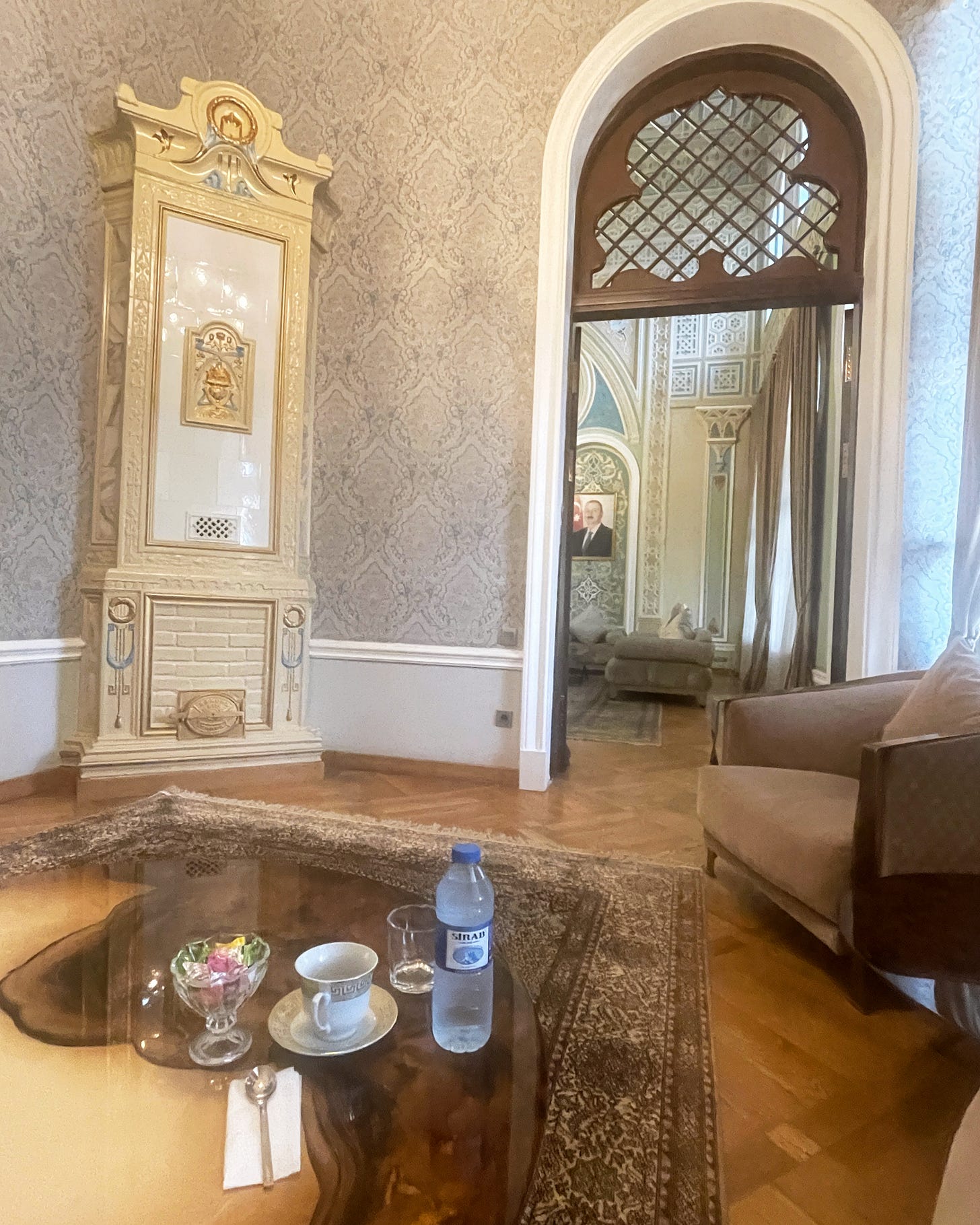
The railway line from Baku to Aghstafa is mostly straight, and the landscape mostly post-apocalyptic. Five hours of not much to see. The taxi drivers in Aghstafa knew I was going to the Red Bridge – it’s the only likely destination for a foreigner disembarking a train in Aghstafa. Among a lineup of mostly elderly Ladas, was one Mercedes. I was expecting a negotiation. I’d read somewhere that the asking fare to the Red Bridge could be as high as seventy manat, which was, apparently, extortionate. ‘How much?’ ‘Thirty manat.’ ‘OK.’ He deserved credit for an opening offer that wasn’t unreasonable, or at least wasn’t ridiculous. I could have gotten him down to twenty for sure, maybe less, but what’s the point? Save myself ten manat? The extra fat would make his day a bit less shit. The countryside up here was an improvement on most of what I’d seen that day. There was grass. There were trees. There was little traffic, and the driver didn’t think he needed to get to the destination by yesterday. He gave me chewing gum (evidence perhaps that thirty manat was too much). It was another pleasant drive through Caucasian countryside in an old Mercedes, windows down, but therefore also spookily similar to my recent failure of a trip from Tbilisi to the Georgian side of the Red Bridge. Even the distance was about the same. I was hoping the result would be different. I was dropped, again, about a hundred metres from the customs building, and, again, I was the only foot-traveller. It wasn’t a busy place. There was a tolerably obvious entrance door. I got quite near the building before being intercepted by a man with a gun. ‘Georgia?’ I wondered whether anyone at my present GPS co-ordinates, moving in my present vector of travel, had answered that question in the negative. ‘Yes.’ ‘That door.’ The tolerably obvious one. ‘Right. Thank you.’ Inside, I was still the only client. My pack was scanned, perhaps to check that I wasn’t illegally exporting a picture of the president. I was quizzed by two men, but they couldn’t speak English, which made it difficult for them and easy for me - for the most part, I was simply unable to assist with their enquiries. Eventually I gathered that we’d come to a question about drugs. Did I have any drugs? Nope. I wondered whether anyone who’d been in that building with drugs in their luggage had answered that question in the affirmative. Then I gathered that they wanted to know if I had medicines. I had medicines all right. Megan - one of Donna’s fellow doctors - had loaded me with a full pharmacy. I had chemicals for everything from malaria to gout. I pulled out two bags of the stuff. One man opened one bag, seemed overwhelmed by the volume, and immediately closed it again. I was free to leave Azerbaijan. Quite why they were concerned about what I might have been taking out of their country I cannot say. I walked slowly and alone across the no-man’s land to the Georgian customs building, smugly absorbing the satisfaction of crossing four hundred metres of forbidden territory (or at least 50% forbidden). The Georgians didn’t care whether I was bringing in drugs, medicinal or otherwise. Exiting the building, I hoped to see the policeman who’d told me to piss off back to Tbilisi three days earlier. It would have been a bonus to let him know I’d beaten the system and completed a full land crossing from Tbilisi to Baku, albeit backwards. The rules said nothing about direction of travel. I’m in charge of the rules. He wasn’t there, but I suppose there’s a fair chance he wouldn’t have understood my achievement of Plan C anyway. He’d probably be a crossing-achievement denier. Some people don’t see the world the way I do. For any other crossing skeptics out there, I say this: what I did was exactly the same as the Raurimu Spiral, and no one complains about that. VIII
Baku → KurykI flew from Tbilisi to Baku again, on my original ticket, but with a fresh e-visa. I was a little apprehensive about my second entry to Azerbaijan. I’d been told it would be OK, but the Azerbaijani bureaucracy had already proven itself … unusual, and I now had a total of six Georgian and Azerbaijani stamps in my passport, five of which had been accumulated in only the previous 48 hours, and, contrary to International Law, every one of them was on the same page, sticking out like dog’s bollocks. If someone wanted an explanation, the truth might have been found less than credible. I wondered whether I’d be getting a seventh stamp or a rubber glove. My sphincter was pleased to learn it was the former. Not an eyebrow was raised. I was free to run the airport taxi gauntlet again. The Caspian Sea was ahead of me. A number of ships cross from Alat in Azerbaijan to Kuryk in Kazakhstan. Some of them new; some a long way from new. They primarily carry trucks and rail wagons, but they’ll take money from tourists. There’s no timetable. They arrive when they arrive, and leave when they leave. According to Caravanistan, the process of buying a ticket and getting on a ship could be tricky and time consuming. I completed an online booking and paid US$70 to ASCO (Azerbaijan Caspian Shipping Company – I know, the acronym is wrong). No response, other than an auto-generated receipt. I emailed the receipt to ASCO. No reply. I told them I could be contacted by email or WhatsApp. No reply. I asked when I should go to Alat – seventy kilometres south of Baku. Reply: ‘Please be advised that you will be contacted in advance.’ I didn’t have a lot of confidence that I would be contacted, either in advance or in arrears. The next day my Marine Traffic app showed one of the new ships, the Azerbaijan, in port at Alat. Predictably, I’d heard nothing from ASCO. I booked a Bolt. It was half an hour away, which should have been a red flag. I waited. It turned up. Wrong car. Wrong plate. ‘Mr William, I am your Bolt car.’ ‘No you’re not. This isn’t the car I booked.’ ‘It’s OK. Get in, come on, come on.’ He showed me his Bolt app. He had my booking, but this was full mickey mouse. I was in equal parts wanting to tell him to fuck off, and wanting to get to Alat ASAP. Was it going to take another half hour for another car? Would another half hour be the difference between getting on the Azerbaijan that was now in Alat, or waiting for the next ship, which might be days away? I took the wrong option. Lesson: in any situation, if one of the reasonable options is to tell someone to fuck off, it’s probably the right option. Away we went. Most of the drive was on a six lane motorway. The car was shit. The driver was shit. I was concerned for my safety. His English wasn’t good. I got him to understand ‘Slow the fuck down’, but I couldn’t get him to comprehend ‘Stay in one fucking lane at a time.’ Somewhere along the way there was a shop on the side of the motorway. He indicated to me that he was going to stop. I told him not to stop. He stopped. Cars were angle parked on the shoulder of the motorway, meaning they had to reverse into a motorway lane when departing. There was a man dancing about on the motorway, whose full time job, it seemed, was to deflect motorway traffic from colliding with departing cars. Jesus fuck. The driver returned with a packet of cigarettes. He offered me a cigarette. Nope. He lit a cigarette for himself. ‘No.’ ‘No?’ ‘No. No fucking cigarette.’ It went out the window. A point to me, but I wasn’t winning this drive. With help from the dancing man we managed to reverse into the motorway and resume forward travel without being taken out by a truck. The driving didn’t improve. To my surprise, we arrived unscathed at a security gate at Alat Port. At that moment I remembered some of Megan’s medico-travel advice: ‘And don’t get into any dodgy cars’, she’d said. Right. Noted. I got out. The driver looked at me, as though, I think, he was expecting me to say thank you, or maybe just goodbye. In a shed-like building was a man in charge of the security barriers. I explained my intentions. He told me to go to another shed-like building. I went. There were no signs. I went inside, still no signs. I picked a room on my right. There was a man at a desk. He was the right man. I showed him my ticket. ‘You want to go today?’ Between Baku and Alat is nothing but sand. South of Alat, sand. West of Alat, sand. At Alat Port itself there are port buildings, and sand. I wondered whether anyone had gotten themselves across the sand to Alat, and into that building, and that office, with a paid ticket, and answered that question with ‘no’. I said yes, and he did something on his computer. ‘You can go on Professor Gul tomorrow.’ The Professor Gul, I knew, was not one of the new ships. One hundred and fifty five metres -according to Marine Traffic - of rusting Soviet steel, built before the Wall came down. Bugger. ‘What about the Azerbaijan?’ ‘The Azerbaijan is going to Turkmenistan.’ Bugger. ‘What time will the Professor Gul leave?’ ‘Maybe 5 a.m.’ 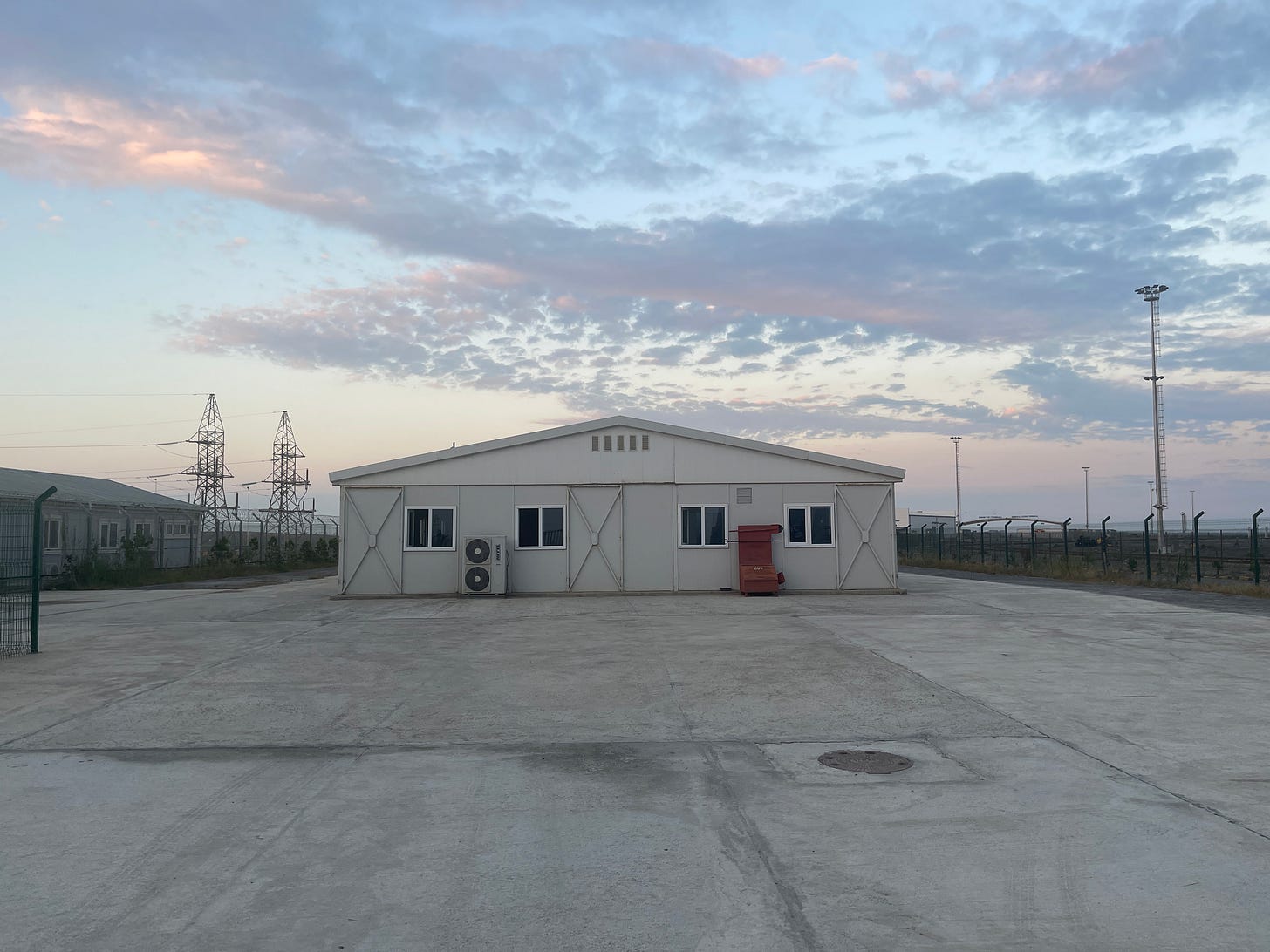
I was sent back to Security Gate Man. He put me into a Waiting Gulag beside the gate. The Gulag was a bare rectangle of concrete, in the centre of which was a building in which were rows of uncomfortable chairs. Around the perimeter of the concrete was a high fence topped with razor wire. Whether to keep punters in or out I’m not sure. 5 a.m. was about twelve hours away. ‘Is there a hotel near here?’ ‘Hahahaha. You wait here.’ Oh well. I had the full set of Harry Potters on my phone. There were twenty-five-ish other passengers in the Gulag; men, women and children, none of them looking like tourists. After a couple of hours we were all ushered outside. The twenty-five-ish non-tourists started climbing into an official-looking mini-bus. It was going to be a tight fit. It wasn’t clear whether I should be joining them. Security Gate Man turned up. ‘Do I go with them?’ ‘They are going Turkmenistan. You Kazakhstan. Kazakhstan. You wait here.’ Right. I was alone in the building for a while until a man arrived. Also not a tourist. Didn’t speak English. After a few more hours an official-looking car arrived and the driver told us both to get in. We both got in. Security Gate Man arrived. ‘Why are you in this car?’ ‘I was told to get in.’ ‘No. This car is for this man. This man is going Turkmenistan. You are going Kazakhstan.’ Security Gate Man asked the other man for his ticket, and showed the ticket to me. ‘See? His ticket says Turkmenistan. Your ticket says Kazakhstan. Kazakhstan.’ Jesus. I really must try to remember where I’m going. At 3 a.m. another car arrived, and this time I left with the blessing of Security Gate Man. After an hour or so of customs faffing and passport flicking I was pointed toward the Professor G. and walked a long railway ramp to the stern entrance. I was taken upstairs and shown a notice in Russian, apparently proclaiming the meal times. I asked where the dining room was - or mess, as we sailors say. By way of answer I was shown the notice again, which didn’t appear to include a map. I was taken to a cabin. It could have passed for a prison cell. At least there was no cell mate. 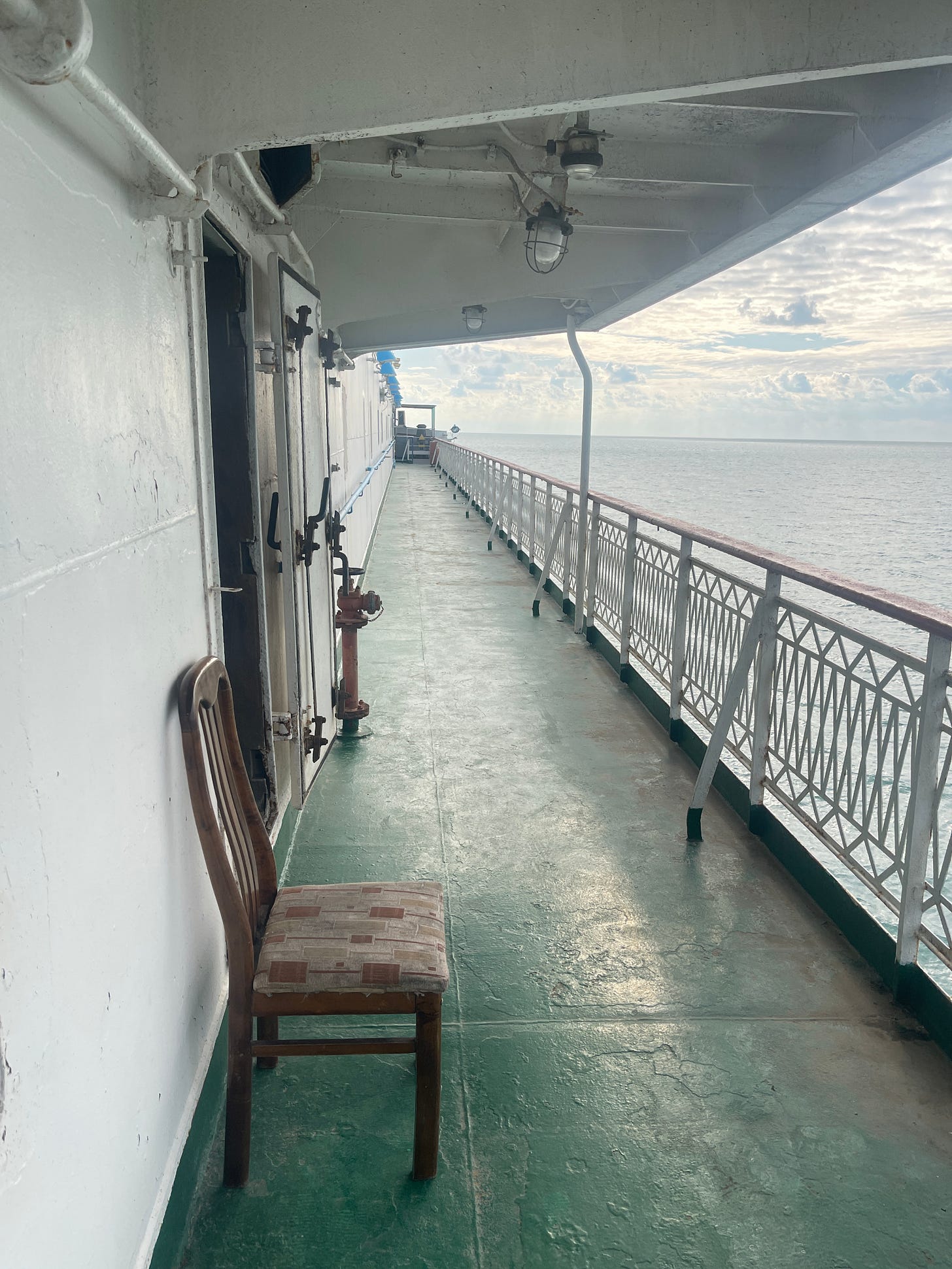
I awoke at sea and found my way outside and walked up and down the ship and confirmed, with the benefit of daylight, that it was indeed about one hundred and fifty five metres of rusting Soviet steel. The meal-time notice turned out to be redundant. Meals were announced by someone coming down the corridor banging on the cabin doors and shouting. The passenger manifest comprised about twenty truck drivers and me. The food was prison-quality. The truck drivers looked happy enough with it, but then they also looked like their usual diet was vodka and camel skin. It was a long day across the Caspian, simultaneously boring and interesting. There were derelict structures, which might or might not have been the outskirts of Neft Daslari - the world’s biggest offshore settlement - which I might or might not have been able to see in the distance, mirage-like. At the end of the day, as they say, the sun set into the western sea, as it does. At 1 a.m. P. Gul reversed into the port of Kuryk and was boarded by Kazakhstan military. There was cabin door banging and there was shouting. I was put in a room with a soldier who had two identical boxes of technology that looked like the offspring of an Atari console and an Enigma machine. I was made to wait in the room while everyone else was brought in one by one and processed. Perhaps I couldn’t be trusted to not jump ship. The processing involved doing exactly the same thing on both machines, which seemed odd then, but even odder later. I would cross a Kazakhstan border three more times, and on each of those occasions only one Atari-Enigma box was in operation. I’ve not managed to produce an explanation for the double Atari-Enigmas on the Professor Gul that doesn’t include a fuck up in a military chain of instructions. At one point a new Official Person entered the room. He must have been the highest ranking officer, because he did nothing other than stand in the middle of the room, scrolling through Russian-language reels AT FULL VOLUME while the Atari-Enigma man tried to do his job. Eventually I was processed and told to go down to the truck deck. I knew which end of the ship was the back, but I had no idea how to get to the truck deck, and I wasn’t assisted by a total lack of signage. I found various narrow stairwells, and got myself lower and lower, but of truck decks there were none. Eventually I blundered into an engine room. Too low. A couple of crew freaked out at seeing me there and I was rescued. Post-rescue I walked another long stern ramp, ending on Kazakhstan soil, or tarmac, as we land-lubbers say. A soldier took my passport, carried out a bit of flicking, and gave it back. ‘Welcome to Kazakhstan.’ Kuryk Port, like Alat Port, comprises only port buildings and sand. Other than the passport-flicker at the end of the ramp, I discerned no life. ‘That way?’ I pointed at silhouettes of buildings in the dark middle distance. ‘Yes. That way.’ It was 3 a.m. Sunrise was two hours off. My destination was Aktau, ninety kilometres away. I started walking. IX
Aktau → NukusI was perhaps a hundred metres from the G. Dog when a car approached. ‘You want taxi?’ Coincidentally, of all the things I wanted right then, a taxi was right at the top of the list. At 3 a.m., in a deserted port, there wasn’t a lot of scope to negotiate price with a monopoly service provider. I could have bluffed, but I really couldn’t be arsed negotiating. They must love the early arrivals. There was a change of drivers, and a change of cars, then away we went, in a crap Volkswagen. This guy was a better driver than the clown who’d delivered me to Alat, but not by a huge margin. Fortunately the road was mostly straight and mostly empty. He thought texting while driving in the middle of the night was a good idea. I thought it wasn’t. It was still dark when I knocked on a glass door of a hotel in Aktau in order to wake a woman sleeping on a couch. I didn’t feel bad: she was sleeping there only for the purpose of being available to let me in. I’d helped her achieve an employment KPI. Aktau is a town on the edge of nowhere. According to Wikitravel:
Hmmm. The sand on the fully sandy beaches looked contaminated. I found a clean-looking part of the coast, but couldn’t decide whether it would qualify as sandy or rocky – it was a bit of both – and therefore couldn’t deduce whether there would be glass or sea snakes. On entry, fortunately, I found glass. Phew. Air temperature 27C, water 16 and clear. While I floated in the Western Caspian, back on the other side Azerbaijanis and Armenians had started shooting each other, again. The next day, a train inland to Beyneu, eight hours to the northeast. Not one of the world’s most scenic train journeys. There was sand and there were camels, Bactrian and Dromedary. I’d taken advice from Caravanistan and purchased instant noodles for the trip. Trains in Central Asia and China have water boilers in the carriages. Perfect for instant noodles. I also had a handy dandy ultra-light titanium spork, purchased solely for use with instant noodles on trains. Instant noodles are under-rated. If Aktau is on the edge of nowhere, Beyneu is right in the fucking middle of it. Beyneu probably exists only due to its railway junction: north to Russia, south to Turkmenistan, east to Uzbekistan. There’s no platform at the train station – you climb down from the carriage onto sand. Sand is a real feature of Kazakhstan. 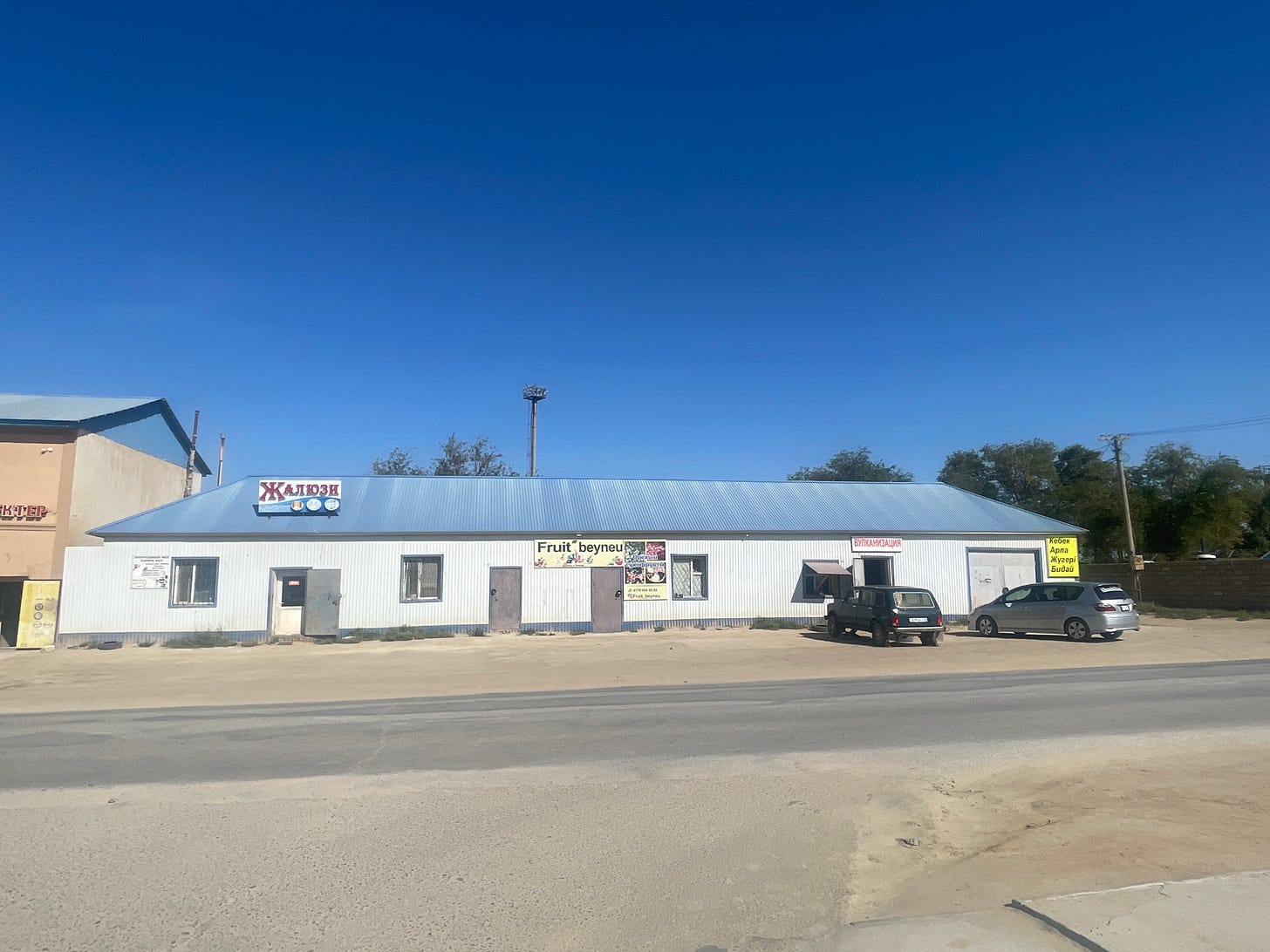
The most surprising thing about Beyneu was an absence of tumbleweed. The most interesting thing was a single large electronic billboard, on a broad, sandy street, near what might or might not have been the centre of the town. It showed railway safety videos. The theme was not to walk on railway tracks: use an overbridge, use an underpass, use a platform. Good advice for sure, but not one of those things existed within a hundred kilometres of Beyneu. My train was due to leave at 5.47 a.m., a time also known as 4.47 a.m. Western Kazakhstan runs an hour behind Astana time, but Astana is the capital, therefore it is decreed that all trains shall run on Astana time. Hence a clock inside a Western Kazakhstan train station shows a different time to a clock outside the station, and trains can leave an hour before expected. It’s useful to know this. Readers will recall that Einstein did a thought experiment involving trains and clocks. It’s a little-known fact that he’d been to Beyneu. Given the need to decamp my hotel at an ungodly hour, I asked the proprietor whether the front door would be locked overnight. ‘No lock.’ I took that to mean it would be unlocked, but later discovered that there was literally no lock. Just a hole and fresh air where a lock would be. Either not a lot of crime in Beyneu, or the crime includes theft of door locks. The only way to board my train, at approximately 04:15, was by walking across a dark track, on which there was another train preparing to depart. In that moment I could simultaneously hold in my mind two opposing concepts: the point of the billboard, and its pointlessness. From Beyneu to Nukus in Uzbekistan (for that is where I was going) you can travel any class you like, provided it’s platzkart – a Soviet design for moving maximum people at minimum cost. Bunks were arranged in sets of six. On one side of the carriage were four bunks perpendicular to the direction of travel. Technically, there were six on that side, stacked three high, but the top nose-bleed level had been converted to luggage shelves. On the other side were two bunks against the wall of the carriage, parallel to the direction of travel. There was an open walkway between the four and the two, running the length of the carriage. So I was sort of in a group of six, but also sort of in an open carriage. Crowded, but not claustrophobic. 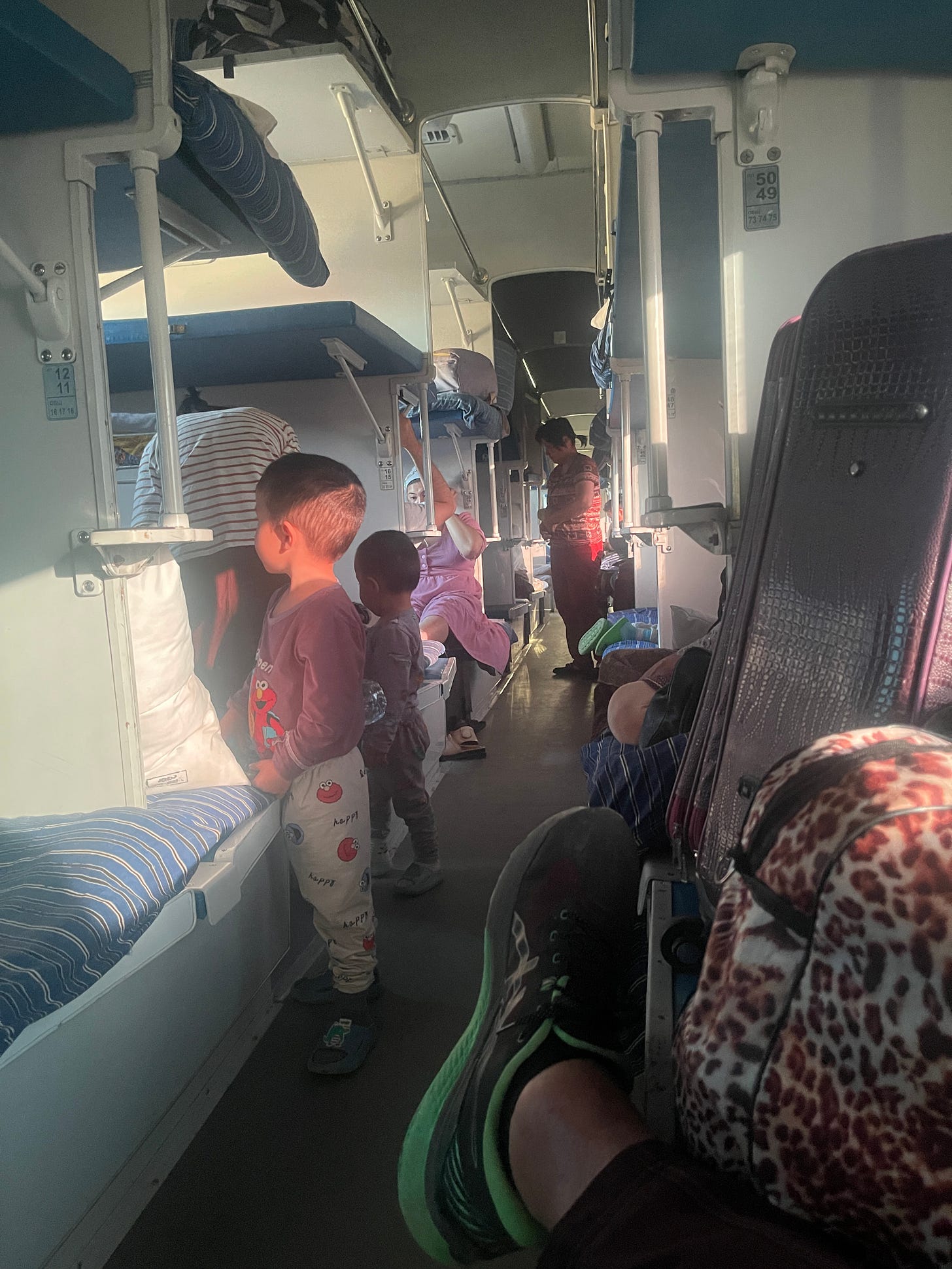
I’d managed to secure a bottom bunk on the parallel side. Bottom bunks sell out more quickly, and therefore, I’d deduced, must be more desirable. I found my bunk, but by my count, there were eight people in my set of six. Above me was a compact German man – didn’t look like he’d cause trouble, space-wise. There was an old woman. There were three younger women, and two small children. The locals, I thought, were probably accustomed to reduced personal space, and in any event their average size was below average. Nothing here, I thought, likely to create an issue for me. Incorrect. The old woman started talking to me. Maybe in Kazakh, maybe Uzbek, maybe Russian – any of which would have made equal sense. She seemed interested in my bunk. Then she gave a physical demonstration of her inability to climb up to the top bunk she had unwisely or unluckily booked. I didn’t think she was faking. At her age she’d have needed a hundred percent Orangutan DNA to accomplish it, and she didn’t look like she had more than the standard ninety-seven. The other two lower bunks were occupied by the women with children, so it wasn’t practical for either of them to swap. The old woman had me properly snookered. Then both children started coughing, at which point I noticed that both tiny noses were running. Fuck. I’d be getting off this train with COVID, at best. But if I had a chance of avoiding the disease that was plainly going to kill everyone down here, being on the top bunk, above the virus cloud, might be it. I couldn’t get up there quickly enough. The top bunk wasn’t bad: had more privacy, and might have been comfortable, if it had been longer, and if there’d been enough headroom to sit up. Only fourteen hours to go. Even with insufficient headroom, lying down is still a good way to travel. I slept and Harry Pottered and occasionally make a dash through the virus cloud (without inhaling) to the end of the carriage for instant noodles, and/or to watch the sights of Uzbekistan (sand) rolling by. The sights of Western Uzbekistan were difficult to distinguish from the sights of Western Kazakhstan. Also at the end of the carriage was a foreign exchange operation – two women on a bunk with a calculator and a large bag of cash, and, as a side hustle, snacks for sale. It was smart to identify which market you were in. I didn’t identify my market. I pulled out a bundle of Kazakhstani Tenge to buy a drink, whereupon the whole wad was whisked from my hand and was being converted to Uzbekistani Som before I knew what was happening. If you cross a border on a train and some random offers to change money, it’s a good idea to change some. I’ve yet to be given a bad rate, and even if the rate were bad, it’s better to get off a train with expensive local cash in one’s pocket than no local cash. Also, the random has gone to the trouble of acquiring quantities of cash, and a big bag to put it in, and paying for a ticket, and getting on a train to nowhere, in order to provide a service. Such effort and investment deserves reward, and a transaction will make his or her day less shit. And you don’t need to be walking around with exchange rates in your head. My phone, or more specifically a thing called xe on my phone, could give me every rate for any currency, everywhere, updated every minute, and I could get an update on a moving platzkart carriage in the middle of the Western Uzbekistan desert. In the decade I was born that sort of thing was called witchcraft. Money, while we’re on the topic, had been trending cheaper all trip, and now it was almost free. One New Zealand dollar was buying 283 tenge, which seemed like a lot, until I found that one tenge would buy 26 som: ergo 1 NZ$ equalled around 7,358 som, and that, I later discovered, was about enough for 750 ml of beer. So much for the Big Mac Index. I’d discovered a better measure of purchasing power parity. Below my bunk, the coughing continued and the runny noses ran. My chances of escaping Uzbekistan alive were decreasing by the hour. Feeling a strange pang of, I don’t know, near-death empathy perhaps, I offered one of the child minders a couple of chocolate bars. She gave a whole bar to each kid. Jesus. High risk manoeuvre, given the kids weren’t much bigger than the bars. It can only have been by divine intervention that we avoided projectile virus. I arrived, still breathing, in Nukus, capital of the autonomous Republic of Karakalpakstan. In Nukus in 2022, in response to a proposed erosion of said autonomy, there were, depending on whether or not you believe the government of Uzbekistan, either peaceful protests or riots. No more than twenty-one people were killed, according to official statements. None of the dead were members of the security forces. Thank God for small mercies, eh? It didn’t seem a riotous kind of place. It was downright tranquil, and unremarkable but for three things: 1. Every car was a white Chevrolet. 2. Taxi drivers opposed the use of seatbelts. One had a sign on the dash saying “No Belt”. I failed to comply. In another, my seatbelt buckle was occupied by an orphan seatbelt tongue, presumably to stop an hysterically out-of-control passenger inserting a tongue that might be attached to an actual seatbelt. I reacted hysterically, by removing the orphan tongue and attaching my seatbelt. I have no idea what the fuck these people were thinking. 3. There’s a good bazaar. 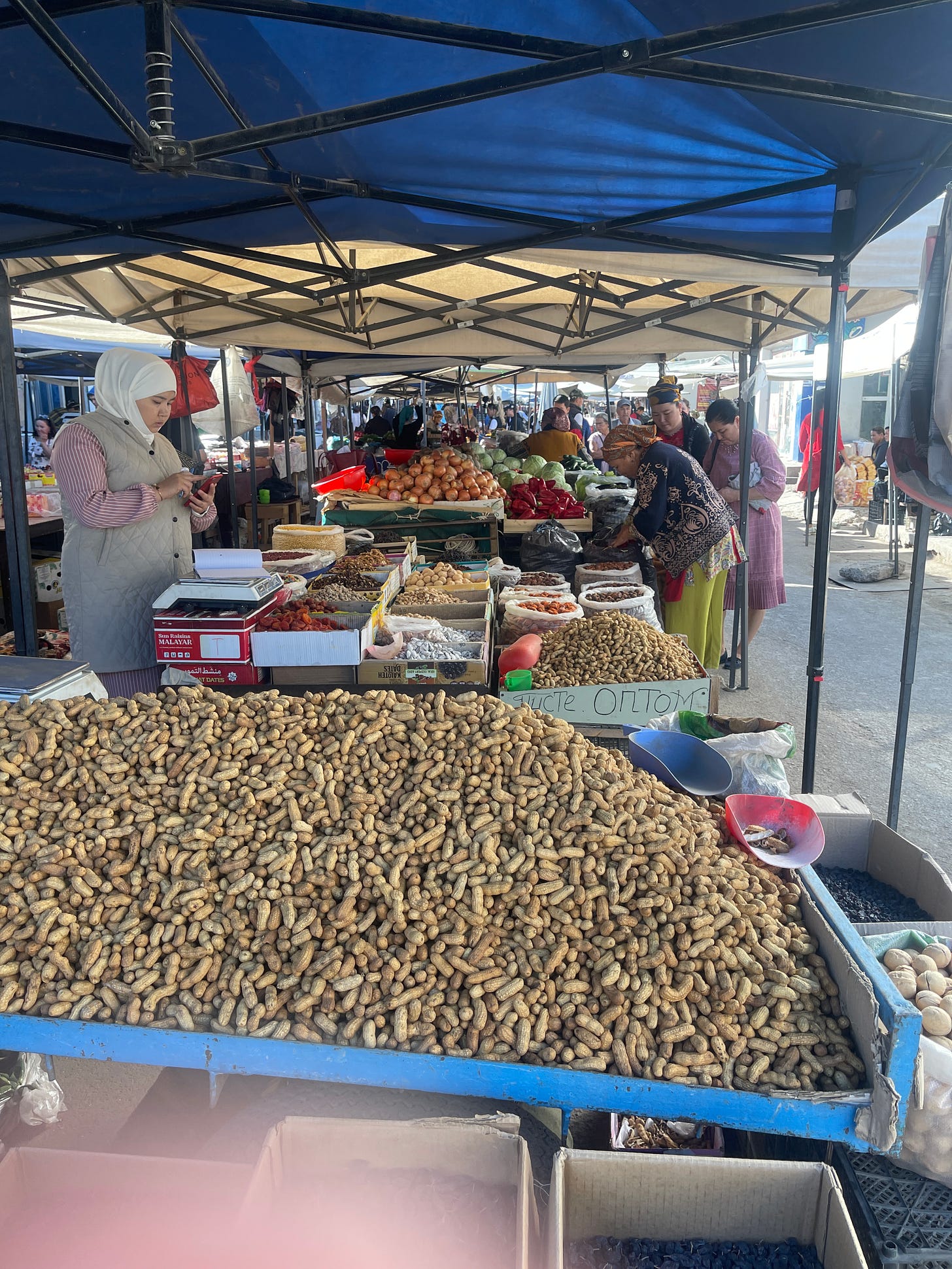
The day after the Virus Train I woke expecting to find a symptom, and there it was: the distinct sensation of a single drip making its way down the inside of one nostril. Fuck. So this is how it starts. The beginning of the end. Then the drip stopped moving, and then spontaneously evaporated, and that was it. Nothing else. Either Allah was providing personalised service again, or my immune system had been supercharged by the prison food on the Professor Gul. 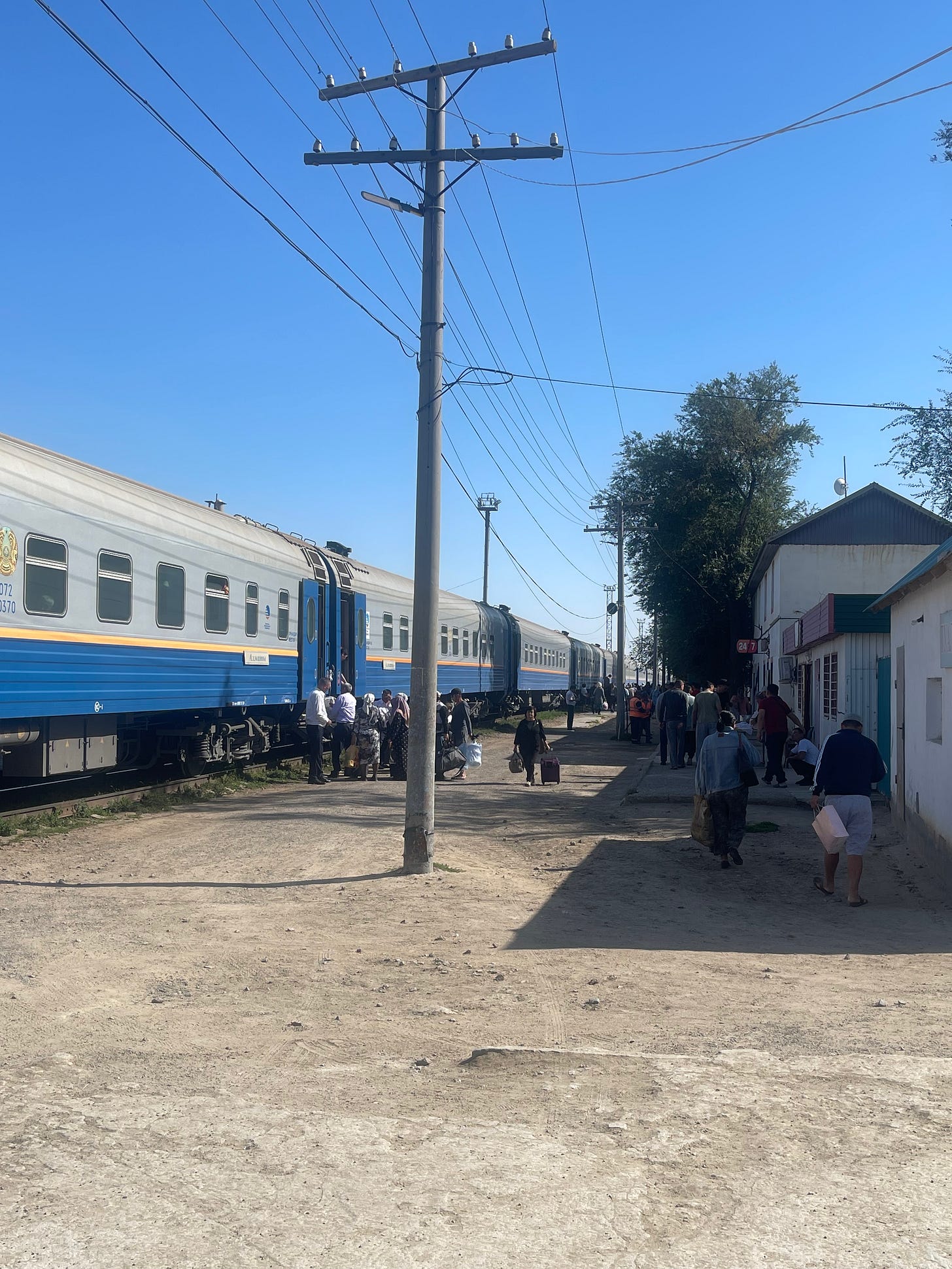
X
Nukus → TashkentNine hours from Nukus to Bukhara – not platzkart this time - a more conventional four-bunk compartment. A view of mostly sand, again. Bukhara came with a reputation. According to UNESCO, “the most complete example of a medieval city in Central Asia.” I arrived at night. Initial impressions were poor. The long drive from the train station to the hotel was via big busy urban roads. Where the fuck was this wonderful medieval city then? Suddenly we were in it. The streets became narrow and labyrinthine. By the time I was deposited at my hotel, I doubted I’d be able to find my way out again without assistance, having omitted to leave a trail of breadcrumbs. The hotel seemed OK. I went to bed. I was the only guest at breakfast. An eager-to-please young woman brought me eggs and meats and fruits and vegetables and breads and pastries and coffee. I had zero chance of eating even a quarter of it. Best breakfast experience of the year, perhaps the lifetime. 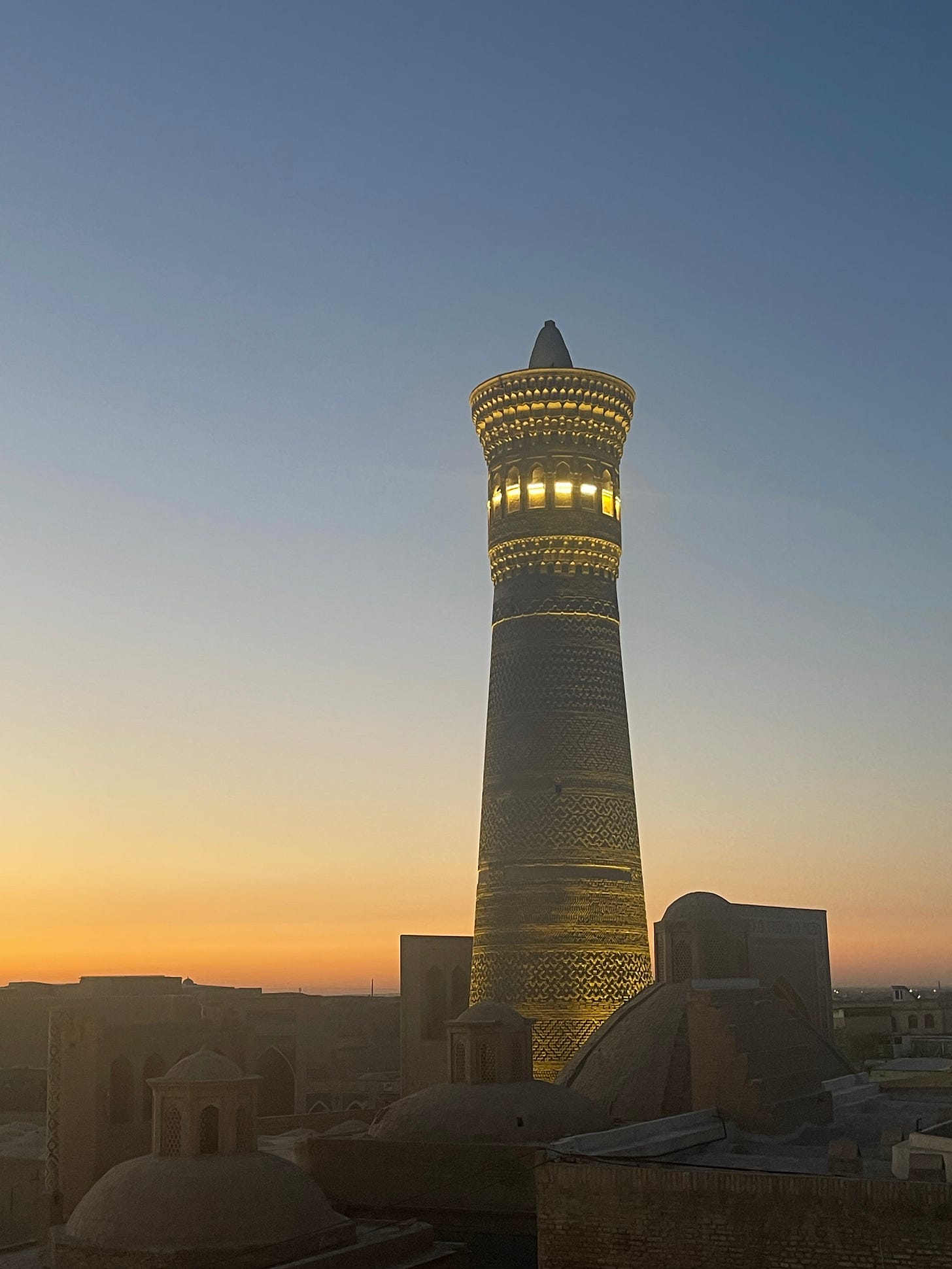
Then it was time to find out exactly where the hell I was, and how far I’d need to walk to find any of the - probably over-stated - sights of Bukhara. I went out the front door and nearly bumped into the Kalon Minaret - the tallest thing in Bukhara - a tower that was already a hundred years old before Genghis Khan laid eyes on it. How I’d failed to notice it when getting out of the taxi the night before remains a mystery. Right behind the minaret, a square separated the Mir-i-Arab Madrasa from the Kalan Mosque. I know, these names had meant nothing to me either. High, intricately tiled facades. Great turquoise domes in the sky. This was the real shit. Even this philistine could see that. I walked around the city a bit. There was real shit everywhere. There was an enormous thing called the Ark of Bukhara. Would have been a miracle had that ever floated. I went back to the hotel and Ms Eager-To-Please showed me the rooftop terrace, with a view over just about all of the Old City. She was a native Bukharan. ‘It’s not much’, she said, ‘but we like it.’ Deadpan. 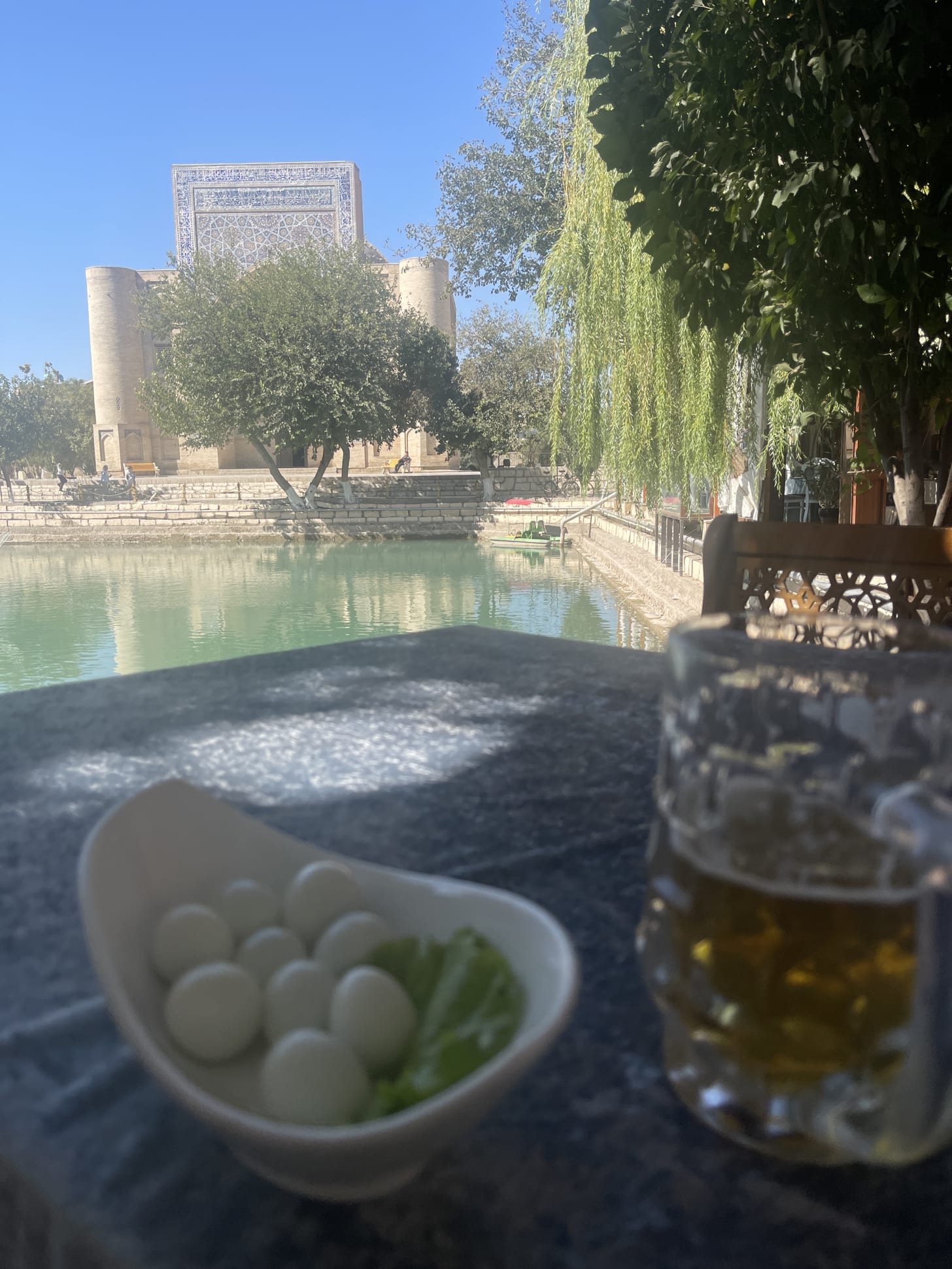
I went looking in the labyrinth for beer. Traffic was not a problem. For the locals, bikes are more practical, and tourists walked. I didn’t see any businesses in danger of insolvency due to a lack of motor vehicles or motor vehicle parking spaces. They were doing pretty well with the foot-money thank you. I found a table under an old tree beside an ancient pool, at the far end of which stood yet another tiled masterpiece. For the equivalent of NZ$1.38 I received a pint of ale and ten boiled quail eggs. It was a smidge after 11:00. Of the previous 75 hours, 31 of them I’d spent on trains, during which I’d covered 1382 kilometres of sand. The mathematically minded will deduce that average moving speed was a pinch shy of 45 km/h. The obvious - and appropriate - analogy is Christ’s time in the wilderness. Well I, for one, was out of the wilderness. Gargling my ale and quail eggs beside the ancient pool, the getting there almost seemed worthwhile. Bukhara wasn’t overrated. Neither was it perfect of course: the beer was rubbish. I ordered more of it and stayed two more days. Never got through more than a quarter of a breakfast. Next up, Samarkand. I was looking forward to Samarkand, due to a deep personal connection, in that Samarkand was my preferred starting city when playing Civilisation II, back in the 20th Century. The train arrived at night, again. The taxi driver didn’t know my hotel. I suggested he follow Google Maps on my phone. He didn’t want to take the Google route, but we came to an understanding. The understanding was that he followed Google or he didn’t get paid. We landed in a tangle of narrow streets, some of them with narrow drains running down the centre, just the right width to fit a car wheel. I know that because one of our wheels became stuck in one such drain when trying to exit a street backwards. The driver was not amused. He thought it was my fault. I thought it was his. 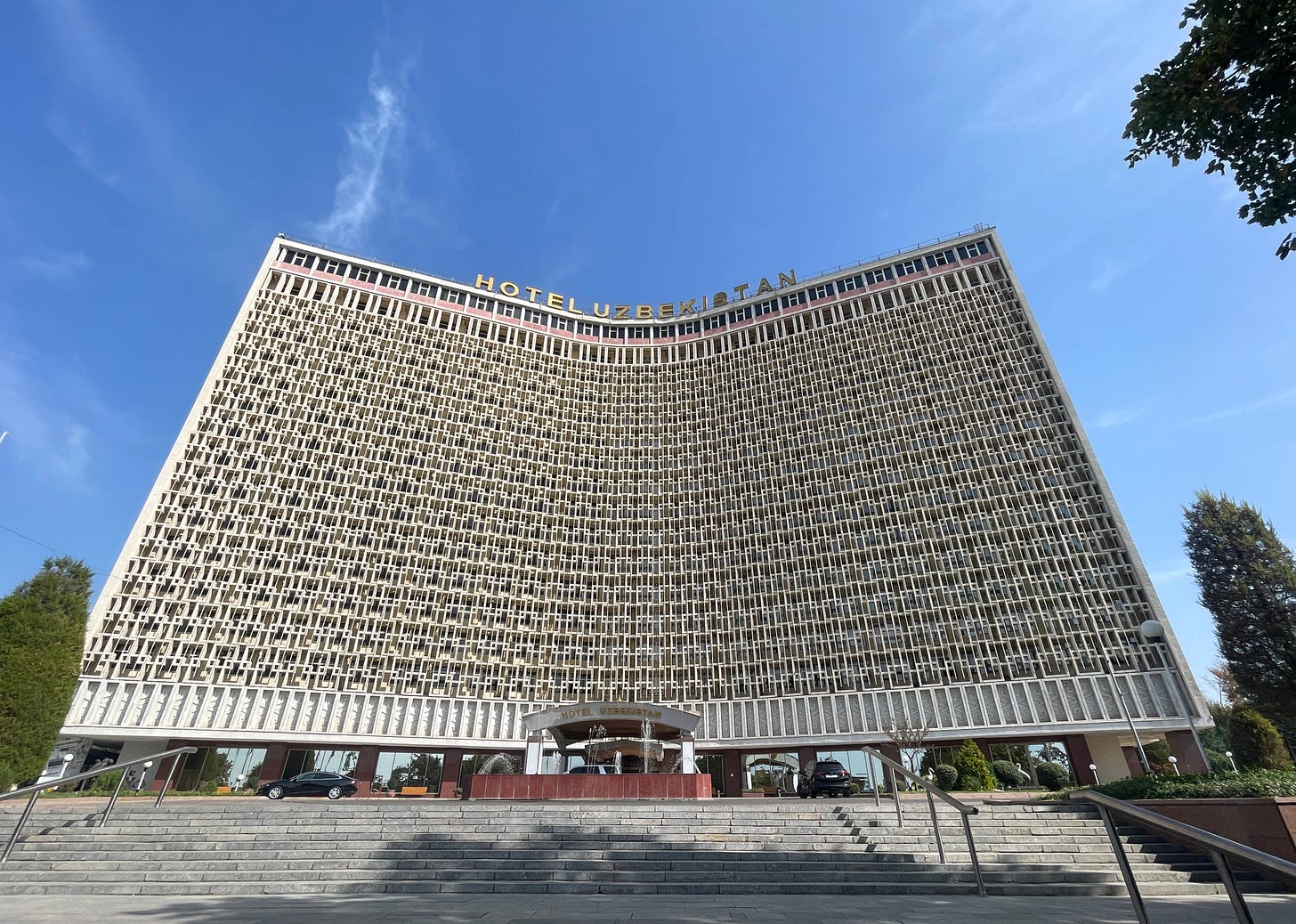
The hotel wasn’t where it was supposed to be. I got out anyway - it was a bit tense in that taxi. It was about 9 p.m. I wandered about confined streets. Some residents had their front doors open, presumably for cooling purposes. They’d say hello as I passed. In due course I came across one who knew where to find my hotel, which was handy. In the morning I discovered there was a much easier route to the hotel, though it would have helped if someone hadn’t managed to put its location in the wrong place on the world’s most commonly used navigational aid. I walked the main sights of Samarkand. It was the same but different to Bukhara. The mosques and madrasas and mausoleums were of similar architecture, but better preserved, and, on average, bigger, and definitely more effectively monetised. Entrance fees were more than nominal. The Registan – the biggest and brightest and most monetised sight of them all, prettier than anything in Bukhara - housed enough shops (selling tourist tat) to fill a fair-sized suburban mall. Even the tat shops were pretty. Deep inside one of the Registan’s giant madrasas was a place where tourists could rent clothes and dress up like a sultan and/or a sultana, and sit on a fake throne with a fake scimitar, and have a real photograph taken. To my surprise, there was some demand for this. Once upon a time in the Registan there were public executions. Now there are public embarrassments. But despite the preservation of the highlights, the rest of medieval Samarkand has largely disappeared. The impressive edifices are scattered about in a modern city, separated by six-lane roads and shops selling hair products and phone accessories and other essential crap. There are trees and parks, but it lacks the vibe of Bukhara. There was a good bazaar, where I ate plov – a traditional dish of rice and vegetables and greasy meat. Sometimes mutton, sometimes beef, sometimes horse, always greasy. I know mine wasn’t mutton. I think it was probably beef, but I couldn’t fully rule out horse. If it was horse, it turns out I like horse. But outside of the bazaar I couldn’t find a good restaurant. One day in Samarkand was enough. I headed back to the station earlier than planned. About Uzbekistan train stations. Of the four I passed through, none were old, and all were big. One could infer that their architecture was designed more to demonstrate the wealth and importance of the government that built them, and not so much to provide a usefully functional transport facility. Their insides comprised little more than large spaces with cheap chairs. The odd kiosk selling junk food was an afterthought. The Nukus station, which looked to be the newest of them, had no WCs. At all. A situation made no better by a requirement to pass through security each time one wished to enter or re-enter the grounds of the station building. A quick visit to a lavatory was not a thing. There were electronic departure and arrival boards, but some governmental genius had decreed that the displays should be ordered according to service number, rather than departure and arrival times. The full day’s business was up there, so there were more trains than could be shown on a single page, and hence the display was always changing, and the next train to leave might be anywhere on any page, depending on its number. Adding to the burden placed on an innocent tourist, the pages changed too quickly, and the information was primarily in Cyrillic alphabet. I took photos of the displays so I could examine them in my own time, but the shutter speed of my phone was too quick for the frequency of the display, with the result that photos weren’t legible. I took to videoing instead. That worked. But before actually boarding a train I’d always ask at least two Official Persons on the platform where it was going. I’m sure I sometimes looked like a fucking idiot, but I never left a station in the wrong direction. And so to Tashkent, population three million, the biggest city of Central Asia. The train was the best I’d had this side of the Caspian, and the landscape now included topography. Tashkent was quite green, and more user friendly than Samarkand. A reasonable place to kill another three days in order to time my entry to China, but I’d need to find something to do. I ventured to Chorsu Bazaar, at the top of most lists of Tashkent attractions. The outer bazaar was a mess of shops selling clothes and shoes and gold and swords. Always pays to have a good sword at hand. To protect the gold. I wound my way to the centre - a large turquoise dome that was probably once the entire bazaar. The large turquoise dome contained only animal parts. Meat, intestines, stomachs, feet, that sort of thing. It was an unpleasantly hot day, and the animal parts were reacting accordingly. Probably hadn’t seen a fridge since parting ways with the rest of their animal. For some reason I decided to head for an exit on the far side, which was a mistake. I made it there without gagging. Just. Tashkent is without a well-defined centre, but if a centre had to be defined, Amir Temur Square would be a contender for the title. There’s not a lot to see at Amir Temur Square, but what was worth seeing there was Hotel Uzbekistan, completed 1974 – a building of equal measure brutal and elegant. An exhibition, perhaps, of the dominion of the Soviet Empire at or about its zenith. And while nearly every car in Tashkent was either a Lada or a white Chevrolet, the Chevrolets at Hotel Uzbekistan were black – that’s a statement if ever there was one. I considered changing hotels, just so I could say I’d stayed there, but I was persuaded otherwise by the guest reviews. 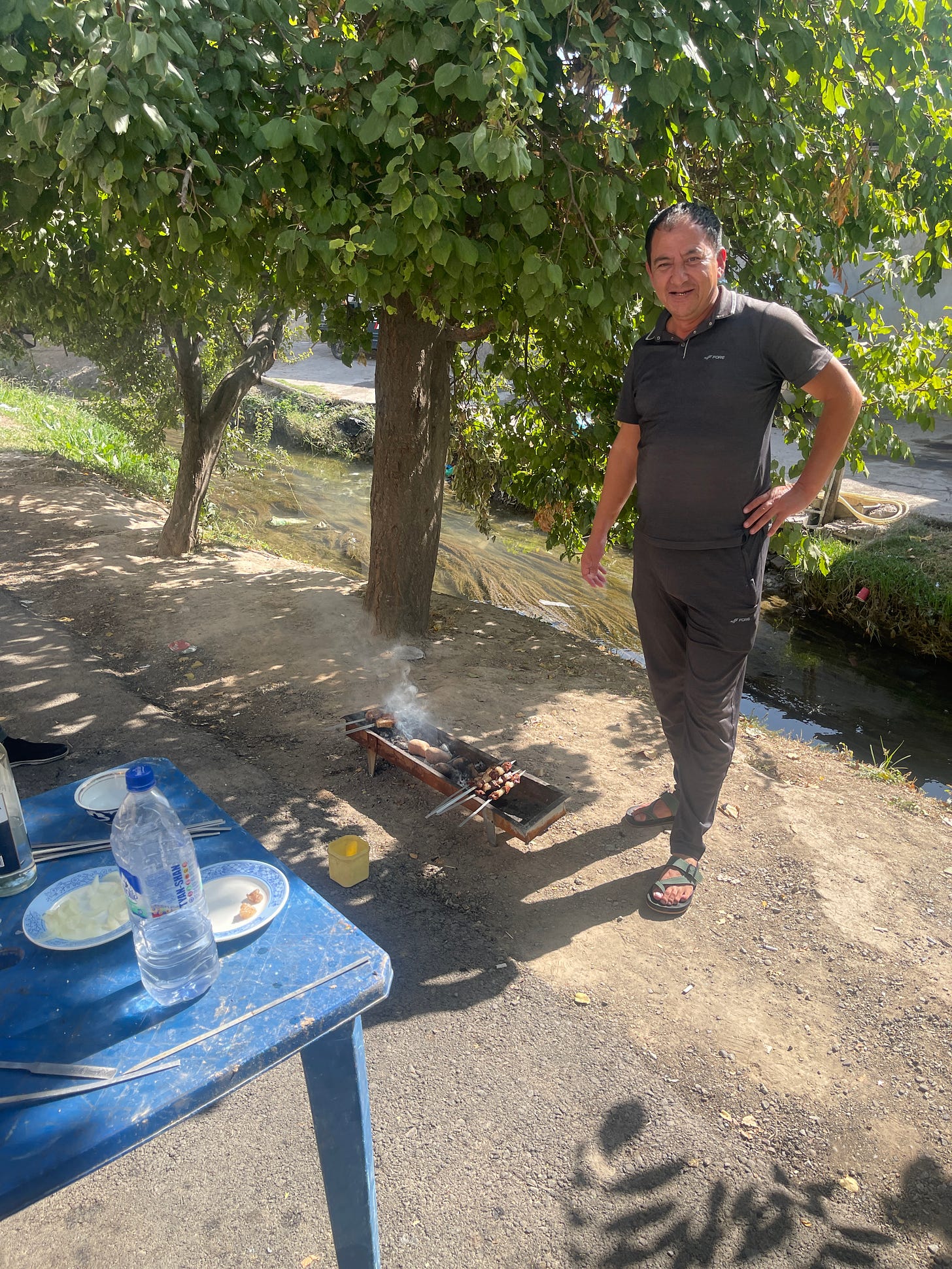
I read of a walk along a canal, reputedly interesting, so gave it a try. The “canal” was more of an outsized drain, filthy with plastic shite and god knows what else. It ran through an old, poor, and densely populated part of the city. I was well into wherever exactly I was, or was going, and negotiating my way around a donkey on the bank of the canal, when I was shouted at by a man on the other side. “Shashlik” is what he shouted. He and some friends were gathered around a small table and a tiny ground-based barbecue. I inferred that they wanted me to join them. It didn’t seem like a good idea. I demurred. He insisted. So: a little later I’d joined them, via a small nearby bridge. There wasn’t a lot of English spoken or understood by my hosts. I think they comprehended “Nouvelle Zealand”, but that was about it. The Shashlik was good, and it turned out there was vodka too. In the circumstances, it was only sensible to drink it - for its antiseptic properties. Best culinary experience of Tashkent. I don’t know whether the shashlik had been a relative of the donkey’s. XI
Tashkent → KhorgosBecause the Earth isn’t round (do your own research), I needed to return to Kazakhstan in order to get to China. I’d snared a double sleeper to myself on the overnight train from Tashkent to Almaty, which was a good start, but, for the bonus round, said train sported a restaurant car. It wasn’t a fast train, but the combo of a double sleeper and a restaurant, plus user-friendly staff, wins it the prize for Best Train Overall. Despite strong competition that was yet to come in China. Weirdly, this was the first and last restaurant car I encountered on the entire trip. Apparently they’re out of fashion. The beer in the restaurant wasn’t good, but on the other hand, neither was the food. But you don’t go to the restaurant for the cuisine. The walk to and from gives you something to do from time to time, and you can sit at a bar, or a table, and thereby give your glutes some variety from your bunk, and it’s where you find the best views out both sides. People will sometimes talk to you, so it’s not all upside. The Uzbek-Kazakh border follows a small river, on both sides of which stand Colditz-type guard towers. Whoever supplies razor wire to each country is on a good wicket. On the Uzbek side we were boarded by an all-female border force, who win the prize for Best Looking Group of Official Persons in Camo Gear. The Kazakh border force must have been forgettable, because I’ve forgotten them. Seventeen hours from Tashkent, arrived at Almaty Station early morning. It was almost, not quite, cold. Almaty is nine hundred metres above sea level, and twas early autumn, so with the effects of altitude and season, the daily temperature ranged between cool and ideal. A suddenly pleasant change. The city is half-encircled (if a thing can be half-encircled – feel free to debate) by snowy mountains that top out over 4000 metres. The sky was blue every day – actually the sky had been blue every day, everywhere - but now the sky was blue against the white of the snow. 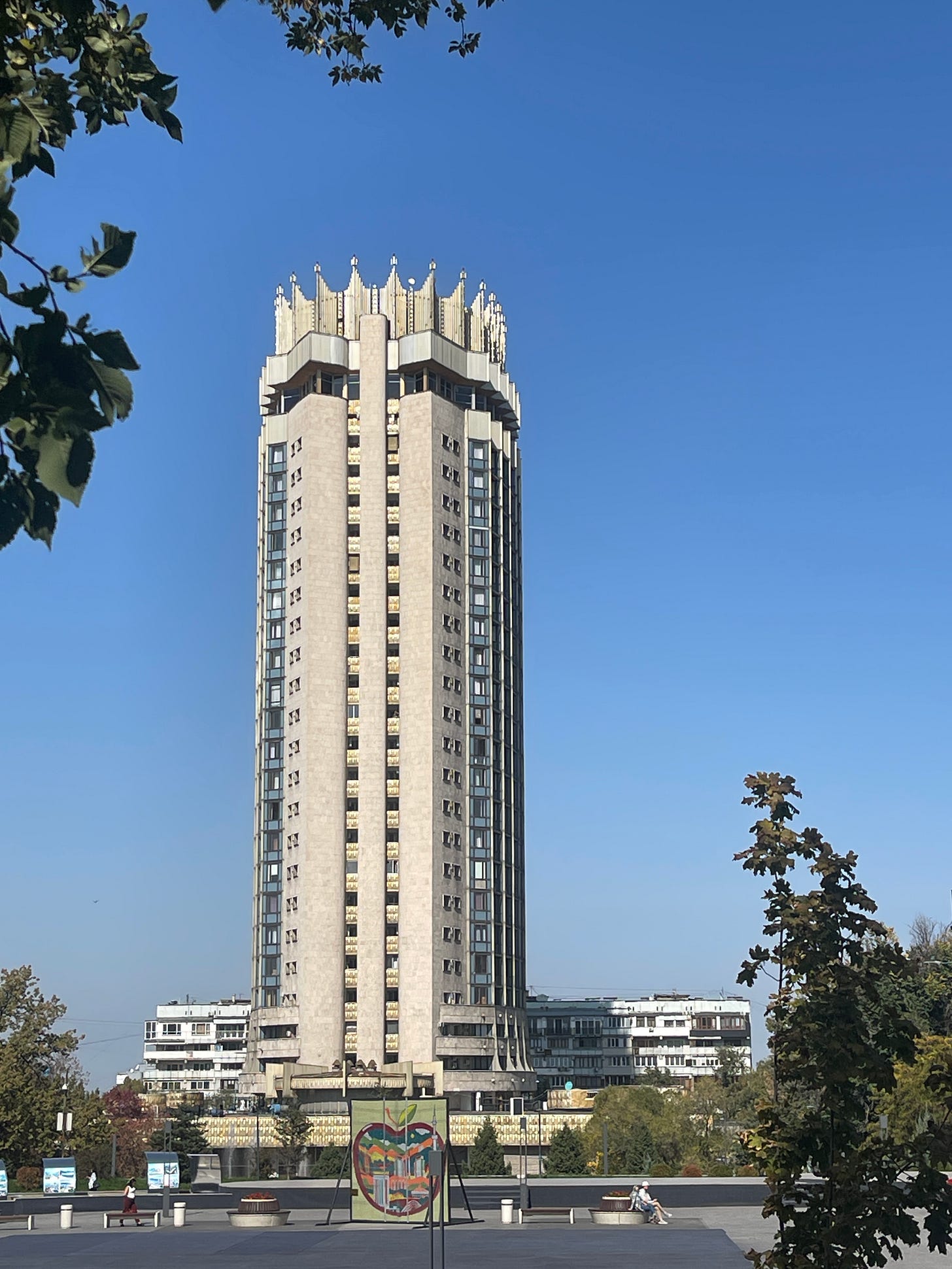
First stop Hotel Kazakhstan. Not that I’d realised when I’d booked, but it turned out to be a younger sister to Hotel Uzbekistan. Different architecture; same Cold War vibe. A vibe that says “Fuck you America. Our hotels are better.” Said to be built to withstand a magnitude 9.0 earthquake. The steel-framed windows in my room each weighed the same as a 1959 Mini. The space between the panes of the double-glazing was wide enough for a slim aquarium. The 70s Soviet architects had serious budgets. I’d expected Almaty to be grungy, probably because it’s big and because it’s in Kazakhstan. My expectations weren’t met. It was clean. It had a newish subway, access to which was gained by the mere swipe of a credit card. Still can’t do that in New Zealand, you might have noticed. The bazaar was pretty good, including intestines that weren’t actively putrefying. There was good beer and even good pizza, and - gold standard test - good flat white. If I’d been asked when starting the trip where I thought I’d find the best café, I wouldn’t have said Almaty. The best café was in Almaty. 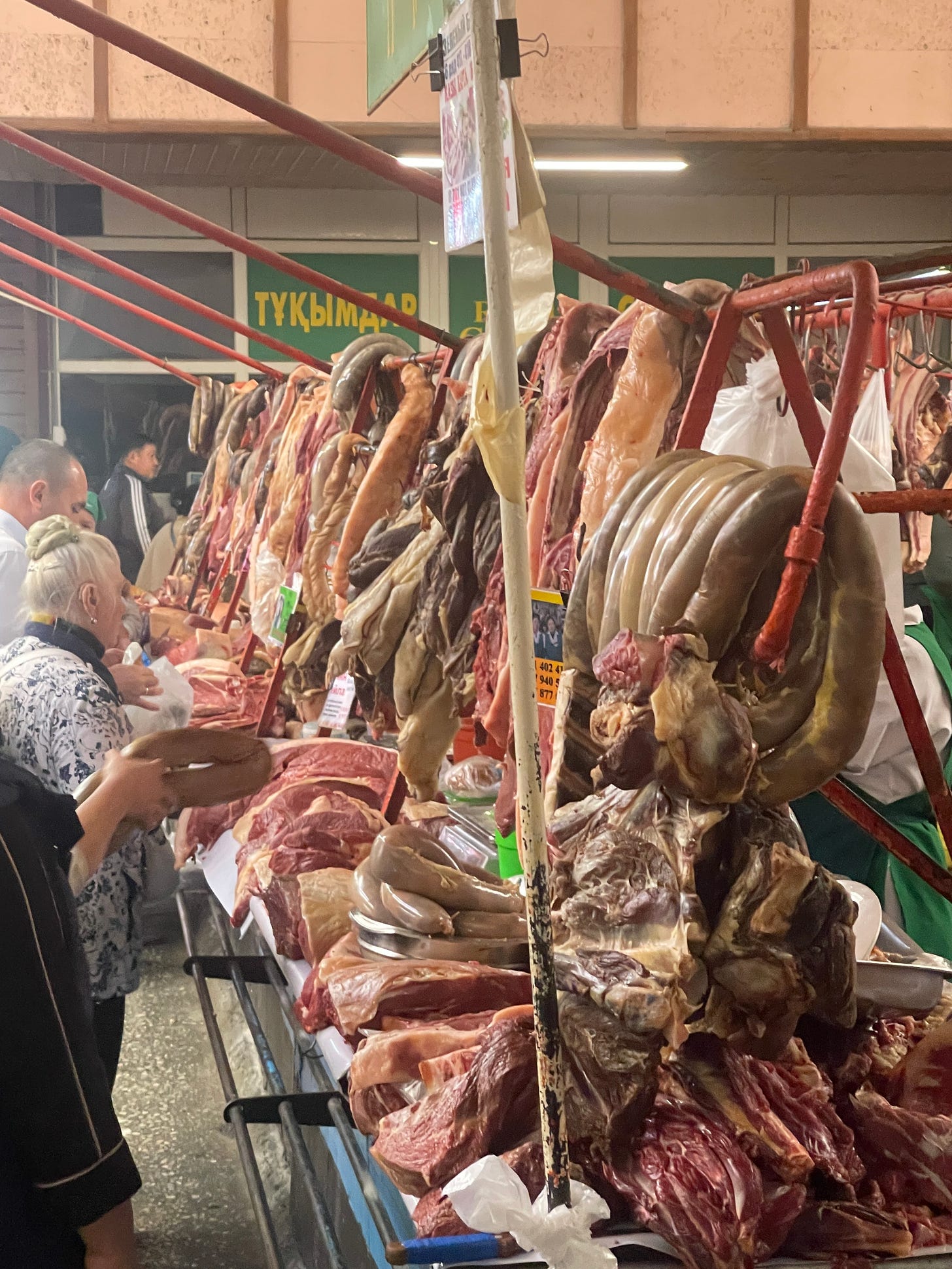
This would be the last stop before China. Transport to China needed to include transport into China, because the Chinese won’t let you walk across their line in the sand. You have to be on wheels. Because. Apparently it’s permissible to ride in on a bicycle, which would be fun, but it would also be adding another level of difficulty. Pre-Covid there had been a train to Urumqi, which was never an attractive option – journey time around thirty six hours, including eight or so at the border while the axles where changed to fit a different gauge track. Fun times. A Kazakh bus didn’t appeal, so I tried to hire a car and driver. I could get a car and driver to the border, yes, but no further. Bus it was then. Online bus booking? No chance. I went to Saryan Bus Station to establish the timetable and acquire a ticket. When I said Almaty was clean, that was before I’d been to Saryan Bus Station. While trying to avoid touching anything, I established that a bus left for Yining, about a hundred kilometres inside China, every morning at 7 am. I asked for a ticket in two days’ time. The ticket lady said I could just turn up on the day and buy a ticket. That didn’t sound like an excellent plan. I bought a ticket. Two days later I returned to Saryan, pre-dawn. When the gate to the bus opened - not dissimilar to the opening of a gate in a sheepyards - every seat filled within 1.5 seconds. Turning up on the day to buy a ticket wouldn’t have gone well. Seat numbers on tickets were ignored; first in best dressed. And away we went. Wasn’t as bad as I’d feared, except for some fucker somewhere receiving texts every fifteen seconds accompanied by a notification tune. FFS. Five hours to the border. En route we stopped at a spanking new motorway service centre. The state of the WC there should not be described. Some advice about bus stops. When getting off a bus temporarily, take a photo of the bus. When you return, it might have become surrounded by a dozen similar buses, all looking just as bussey, and none with destinations in English. Happened to me more than once. Didn’t learn the first time. Another stationary truck queue began about ten kilometres before China. This road was part of the Trans-Caspian Transport Corridor – an important chunk of the Belt and Road. As was the road with the long stationary truck queue at the Georgian border. As was the road with the long stationary truck queue at the Türkish border. I don’t think this is quite the standard of efficiency that Xi was hoping for. We were offloaded on the ragged eastern edge of Kazakhstan, herded into a building for outgoing processing, reloaded onto our bus on the other side of the building, driven across no-man’s land to China, and offloaded again. That sort of thing always takes longer than would be reasonably expected. Maybe ninety minutes from arrival to setting foot in China. Or, more particularly, Khorgos, and Khorgos is in Xinjiang. The Chinese are sensitive about Xinjiang. You might have heard. So: into Chinese processing. Being the only westerner, I was pulled out of the queue and questioned by a woman with surprisingly good English. A moderate degree of questioning. She gave my passport a flicking. Someone else came over and flicked it as well. Because. The woman seemed satisfied. But this was only an informal chat – an opening skirmish. I was still a long way from the passport windows. She gave me a form to complete. I went back to the queue. Form looked simple enough. Box ticking. Did I have accommodation booked in China? Tick. Did I have transport booked in China? Tick. Did I have transport booked out of China? Ti… Faaaark. Rewind. I’d obtained a Chinese visa in New Zealand. That’s a chapter in itself, but not an interesting one. To get the visa I needed to show proof of paid accommodation, and paid flights in and out. And it’s not a good idea to announce an intention to visit Xinjiang, and an even worse idea to announce an intention to enter Xinjiang From the Direction of Muslim Countries. I obtained the necessary proof for the visa, including flights Auckland-Shanghai-Auckland. Subsequently, plans changed. Hotels and flights were cancelled. Other hotels were booked, trains were booked (and re-booked). So now I had everything nailed down from Khorgos to Shenzhen, and from Shenzhen the exit from China is easy - twenty minutes to Hong Kong - and trains run every thirty minutes or so, so there was no need to book one in advance. Except that there was, which, with the aid of the form, had only just dawned on me. It shouldn’t have been a surprise. What a fucking muppet. I couldn’t have the wheels come off now, not having come so far, and having been forced to drink so much marginal beer. It wasn’t an immediate disaster. I could afford to lose thirty-six or so hours at the border while I got my shit more properly together, but much long than that and my first train would be at risk, and train bookings in China are precious. I considered just ticking Yes. Probably wouldn’t be asked to show a ticket to Hong Kong anyway, and even if I were, I could produce some US cash to prove I had the means to buy one. On the other hand, by ticking Yes I’d be lying to the Chinese government in order to enter Xinjiang From the Direction of Muslim Countries. That could go badly. I left the queue and sat down. Nothing was happening quickly in that queue anyway. I worked out what train I wanted and emailed my friends at China Highlights:
Fuck knows how long that will take. Fourteen minutes is how long it took. Fourteen minutes and US$18. China Highlights you widdle bewdy. Back in the queue with the Yes box ticked. The guy at the passport window had questions. Lots of questions. Then there were two questioners: Skirmish-Woman was back. Maybe because she had good English. Maybe because she was Secret Service. Which might explain why she had good English. Why was I coming into Xinjiang? What was I doing in Kazakhstan? What was I going to do in Xinjiang? Where else had I been? Why? Was I a journalist? I tried to explain what it was that I was doing, but to a border guard a million miles from the West, geographically and conceptually, I was a giant WTF. He couldn’t comprehend the point of the undertaking. Possibly the SS Woman understood, but she seemed to be present mainly in an observer role. Maybe she was waiting for me to contradict myself. Maybe she was scoring Window-Guy’s performance. The questions went on, largely in circles. The fact that I had a big fat Chinese visa in my passport didn’t appear to count for a lot. ‘Have you been taking notes?’ ‘What kind of notes?’ Sure, “No” would have been a more practical answer, but it was almost becoming entertaining. ‘Notes of your thoughts.’ ‘Thoughts about what?’ ‘Thoughts about countries.’ ‘No, but I’ve been taking photos of countries.’ I started scrolling through my phone for him. He soon found that boring. ‘Where are you going in China?’ ‘Yining, Urumqi, Xi’an, Shenzhen, then Hong Kong.’ ‘How are you travelling?’ ‘By train.’ As though I hadn’t mentioned that. I pulled my phone again and showed him screen shots of my tickets, including, with some smugness, my new one to Hong Kong. ‘But those trains will cost more than flying. Why trains?’ I attempted yet another explanation. Still wasn’t sinking in. ‘How long are you staying in China?’ ‘Six days.’ ‘What? Six days? Why only six days?’ Back on the merry-go-round. I was eventually allowed to leave the building. No one had looked at any part of the form. Was I officially in China now? Not really. Next – the final Ep (probably). XII
Yining → Xi’anLeaving the interrogation hall I was free to walk in any direction, so long as it was east, toward a border edifice that was more statement than building. Choose your own adjective. Welcome to Jyna. 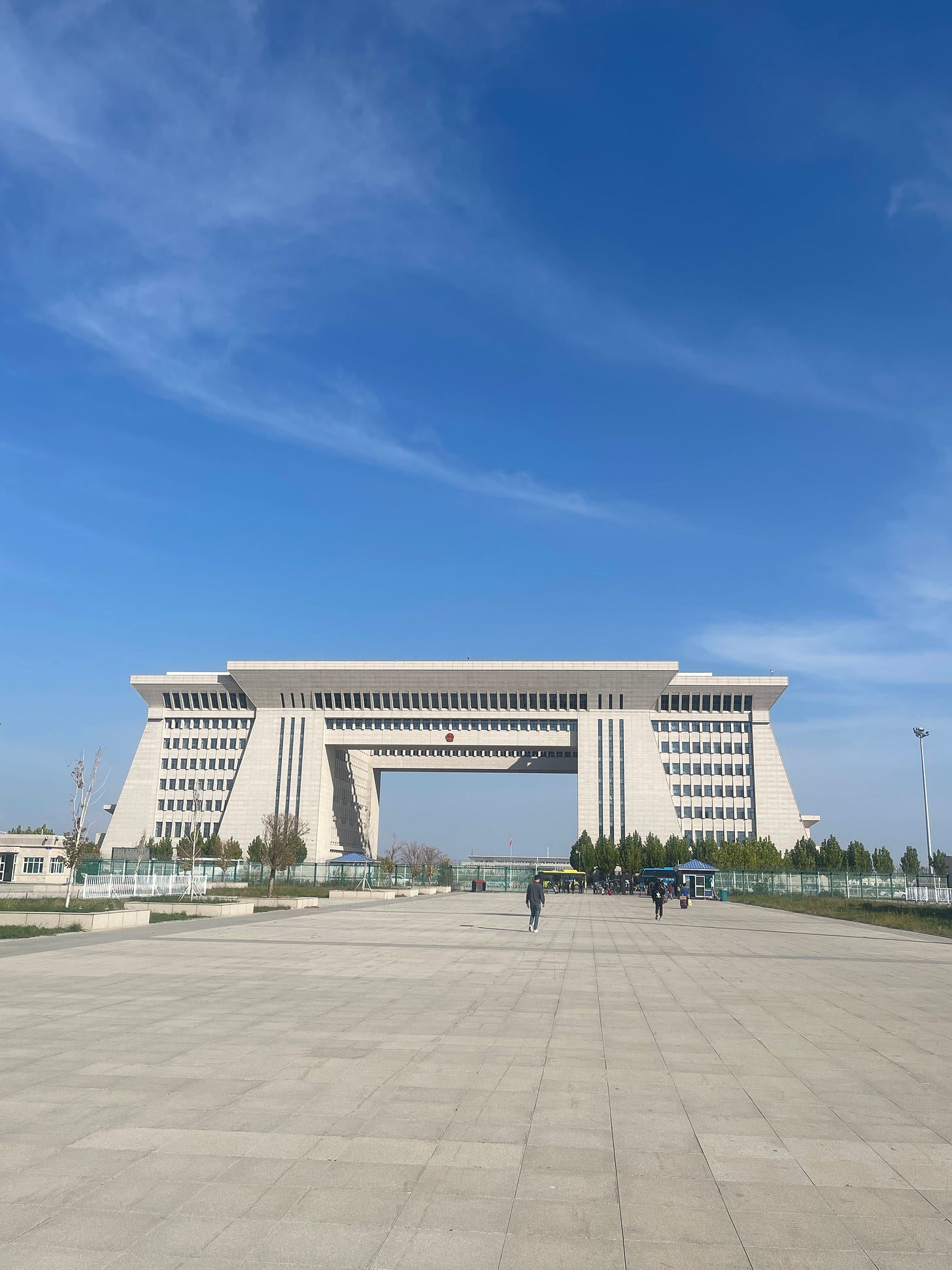
I located my fellow passengers, standing about in an open area. No shade. No seats. No bus. I stood about too – when in Rome ... It was standing about here that I met Eric - a young man who said he was from Beijing. I also met his wife, but she doesn’t have an English name. Right. Whatever appellation she went by remained a mystery. Wife spoke no English, but Eric was talkative. He informed me that we were waiting for the bus. I believed him. He helped me change some money with a lurking currency trader. He showed me how to set up Alipay and use it to pay for things – credit cards being useless in China. He showed me how to use Alipay to use Didi to get a taxi. This was well-useful intel. Eric was either a helpful citizen or a Secret Service operative sent to monitor the foreign devil. I didn’t really care. Eric insisted we have dinner together when we got to Yining. Fuck it, why not? The bus took another hour to arrive. Total time crossing border: four fun-filled hours. We re-boarded and headed for Yining – presumably about an hour away. Fifteen kilometres later we stopped at a checkpoint. A soldier climbed on and started shouting. The only word I understood was Kazakh. Cool, nothing to do with me then. I was near the back. He kept shouting. He was walking up the aisle, and getting more agitated the further he walked. Some Kazakh was definitely in trouble. Could be interesting. He stopped at my seat. Moi?, said I. He spoke no French, but it was moi alright. I was directed onto the road. Also on the road were the driver, the conductor-guy, and a woman passenger. Of the five of us, only one spoke English. We had to hurry to a building. There was jogging. I didn’t know why there was urgency now, after the leisurely four fucking hours at the border, but I have too many metal body parts for jogging. I arrived last, at walking speed, despite the hurry gesticulations from Angry Soldier. There were four or five Official Persons in the building. They were keen passport flickers. They asked questions - none of them in English. I couldn’t assist. If I’d been able to make myself understood, I would have said something like:
But as I couldn’t say any of that, I adopted my default defence to passport flickers, which is to look in a direction other than that of the flicker, with an air of boredom. I nailed it, probably because I was quite bored. After a while I was allowed into China for the second time that day, along with the driver and the conductor-guy and the passenger. Disembarking in Yining I noticed that said passenger had a friend who spoke English. I asked what the checkpoint thing was about. She said her friend wasn’t Kazakh – she was from Tajikistan – and I wasn’t Kazakh. Right. So the soldier had been shouting ‘not Kazakh’, and probably also ‘not Chinese’. But why the driver and the conductor? Apparently they were always checked. Well that makes sense – they might have changed their intentions for the worse since last arriving in China, which would have been their previous bus trip, the day before yesterday. Eric and Wife picked me up from my hotel in a taxi and, despite there being restaurants nearby, we drove what seemed an unnecessarily long way to an eatery of Eric’s choosing. ‘Do you know this restaurant?’ ‘Yes.’ ‘You’ve been there before?’ ‘No, but a taxi driver said it’s good.’ In my experience, wherever in the world you might be, following advice from taxi drivers about restaurants is not a good idea. Eric and Wife liked it. And for all I know, it was in fact the best restaurant in Yining. Eric, or the Chinese government, paid. Can’t complain. In the morning I went looking for coffee. Foolishly. I wandered around old streets with small shops. Nyet. Coffee was not a thing in Yining. Then I came across a modern mall, and according to the floor directory and Google Translate, there was a Coffee Lounge on the fifth floor. An employee was present. I managed to indicate a desire for coffee. I don’t know exactly what she said in response, but I gathered it was approximately: We’re closed. Coffee? Are you insane?. It’s only eleven o’clock. The next day, my first Chinese train, to Urumqi. Getting on a Chinese train is disconcerting. There are no tickets, either paper or electronic. Your booking is linked to your ID card, if you’re Chinese, or your passport if you’re not. If there’s been a transcription error somewhere, and your name and passport number don’t exactly match what Big Brother is expecting, you might not be getting on your train. But there’s a benefit in the system for the lucky few without ID cards. A special passport queue: a free skip-the-line. I had a first-class seat. It wasn’t spacious. I wouldn’t want to try second class. There were big hills, arguably mountains, to be seen, but it was arid out there. More sand, now with added gravel. Despite the barrenness, construction was everywhere – more roads, more railway lines, more power lines, more tunnels. It was a reasonably quick journey: 481 km in 5 hours. No one would call Urumqi pretty, but it does have a large impressive train station. Chinese railway infrastructure is pretty much all large and impressive. I made the mistake of choosing to walk from the station to my hotel. Google Maps doesn’t work well in China – the sat photos don’t line up with the street maps. Apple Maps lines up, but most enterprises aren’t shown in Apple. To be fair, not a great number are shown in Google either. Adding to the difficulty, hotel names in the train station district were not distinctive. After half an hour I arrived, sweating, at Jinquai Wanda Plaza Urumqi High Speed Railway Hotel. I should have gone to Urumqi High Speed Railway Station Jingkai Wanda Atour Hotel. Basic newbie error. 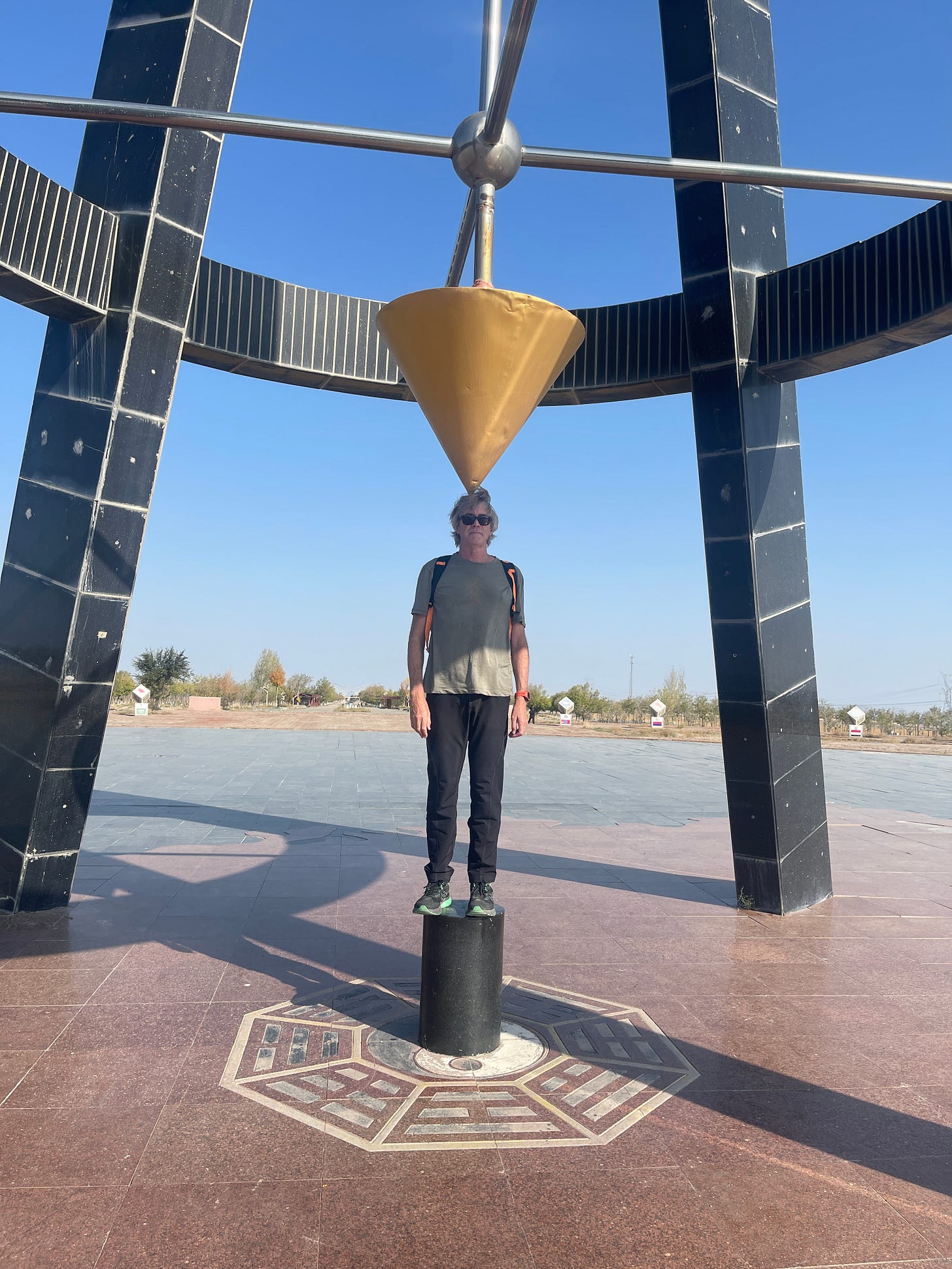
Next day I got a taxi, via Didi, via Alipay, to what is either the geographic centre of Asia, or a large chip-implanting device. It was some distance out of town. We passed a big walled thing that might have been a prison; might have been a Uighur re-education centre. If there’s a difference. The taxi driver volunteered to photograph my chip implantation. Then it was onward to the Grand Bazaar. Happy driver – many yuan earned today. Urumqi’s Grand Bazaar claims to be the biggest in the world. It might be, but at only twenty years old, it lacks cred. And it’s possible to find your way around it without getting lost, and find your way out of it, and find your way back to any particular part of it. Not a proper Grand Bazaar then. Not a realistic challenger to, frinstance, Istanbul’s medieval, unnavigable labyrinth. Onward, to Xi’an. The populations were getting bigger. Khorgos, the border village, was a mere 71,000. Yining still small at 376,000. Urumqi: 4.9 million. Xi’an: 9 million. Shenzhen, where I was aiming to get: 13 million. And Shenzhen is only a corner of the Pearl River Delta Metropolitan Region: 55 million souls. We rolled through the outskirts of Urumqi at sunrise - a hazy, industrial, damaged landscape. The aftermath of the Robot Wars. Then we gained speed. This was a respectably quick machine. Flashing past the window was sand, gravel, wind farms, power stations, and snow. Maximum elevation reached: 3607 metres. Not bad for a high-speed train. The Swiss make a fuss about having the highest railway in Europe at 2093 metres. Pffft. For six hours I had a four-bunk compartment to myself. Then a woman arrived, who showed no interest in speaking. After three hours she offered me a banana. I thought I should reciprocate, so handed over a chocolate bar. She insisted I have one of her instant noodle packs. I tried to resist, but failed. Then she brought out desert - a sealed packet, some kind of snack - but I couldn’t discern the contents from the packaging. Stupidly, I opened it anyway, and pulled out a cold pickled chicken foot. It wasn’t the only foot in there. Bit of a dilemma. Insult her by refusing the feet? Or attempt to eat one and then insult her by vomiting on her? I chose the first insult. I now discovered that she could read and write English. She wrote: ‘Why do you not eat them?’ I wrote back, not imaginatively. ‘I don’t like chicken feet.’ ‘Why not?’ (Well, maybe if they were deep fried, and if they weren’t chicken feet.) ‘I’ve never eaten them.’ My creativity was at lunch. ‘You should try them one day.’ ‘Maybe.’ Brilliant. I said this would be the final episode (probably). It’s good that I included the probably. Next: the final Ep. XIII
Xi’an → Hong KongArrived in Xi’an after 2,545 km and 13.5 hours. That’s an average of 188 km/h. Average. Including stops. Xi’an Station was even bigger than Urumqi Station. Having turned down the chicken feet, I was hungry. There were two restaurants beside my hotel. I went to the first, because it looked sort of cool. There were no menus. I had to order on my phone. In order to order on my phone I had to log in to an app, and in order to log in I needed to download it. And set up an account. FFS. I went to the next restaurant. Not cool at all. A basic affair with formica tables and linoleum and fluorescent lighting. The menu was on the wall, in big pictures: point and eat. The food was excellent. There was a fridge stacked with Tsingtao. Tsingtao isn’t a great beer in absolute terms, but one can develop a taste for it. I returned twice to the lino emporium. The fridge being beside the door, the restauratice would open it and thrust a bottle into my hand as I entered. That’s proper service. I visited the Terracotta Warriors, along with a horde of Chinese tourists; a horde that didn’t behave well in any circumstance that might call for a queue. A kerfuffle happened before I even got inside, when I insisted that one couldn’t just join the ticket queue wherever the fuck one liked. Some astonishment was expressed, but it stopped happening. Toward the end of my examination of the Warriors, I came to the prime viewing spot overlooking the biggest pit. Prospective viewers were stacked maybe six deep. I joined the scrum, expecting to gradually move forward as those at the front finished their viewings. Nope. Didn’t work that way. No matter how small the gap between me and the person in front, or even if there were no gap at all, someone would forcibly insert themselves. I was getting no closer to the front. I might have been getter further away. Either I had to start acting like the rest of these animals, or give up and never reach the viewpoint. Fuck it. I got to the front. It didn’t escape my consciousness that I was now not only an animal myself, but a herd animal to boot. I had become horde. I left the complex having taken a total of zero photographs. Perhaps my experience was tainted by the uncouth mob, but I was underwhelmed. Downtown Xi’an though, was a better affair. It has magnificent city walls, colourful street life, some cool old buildings, and ample tuk-tuks to get around on. Oh, and at night an autonomous robot patrolled my hotel. Probably sentient. Thus begins the end times. There was no bunk option to Shenzhen, so I’d booked a first-class seat. Second class was a non-starter, and the business-class fare was eye-watering. But the day before travelling I realised I wanted my eyes to water. I had now experienced Chinese first class, and I knew the label was inaccurate. Plus, it would be the last train of the trip - but for the short hop into Hong Kong - and I’d earned some luxury, Shirley. But what were the chances of a business seat being available at short notice? They were slim, but not zero. I paid my money. It was worth it. 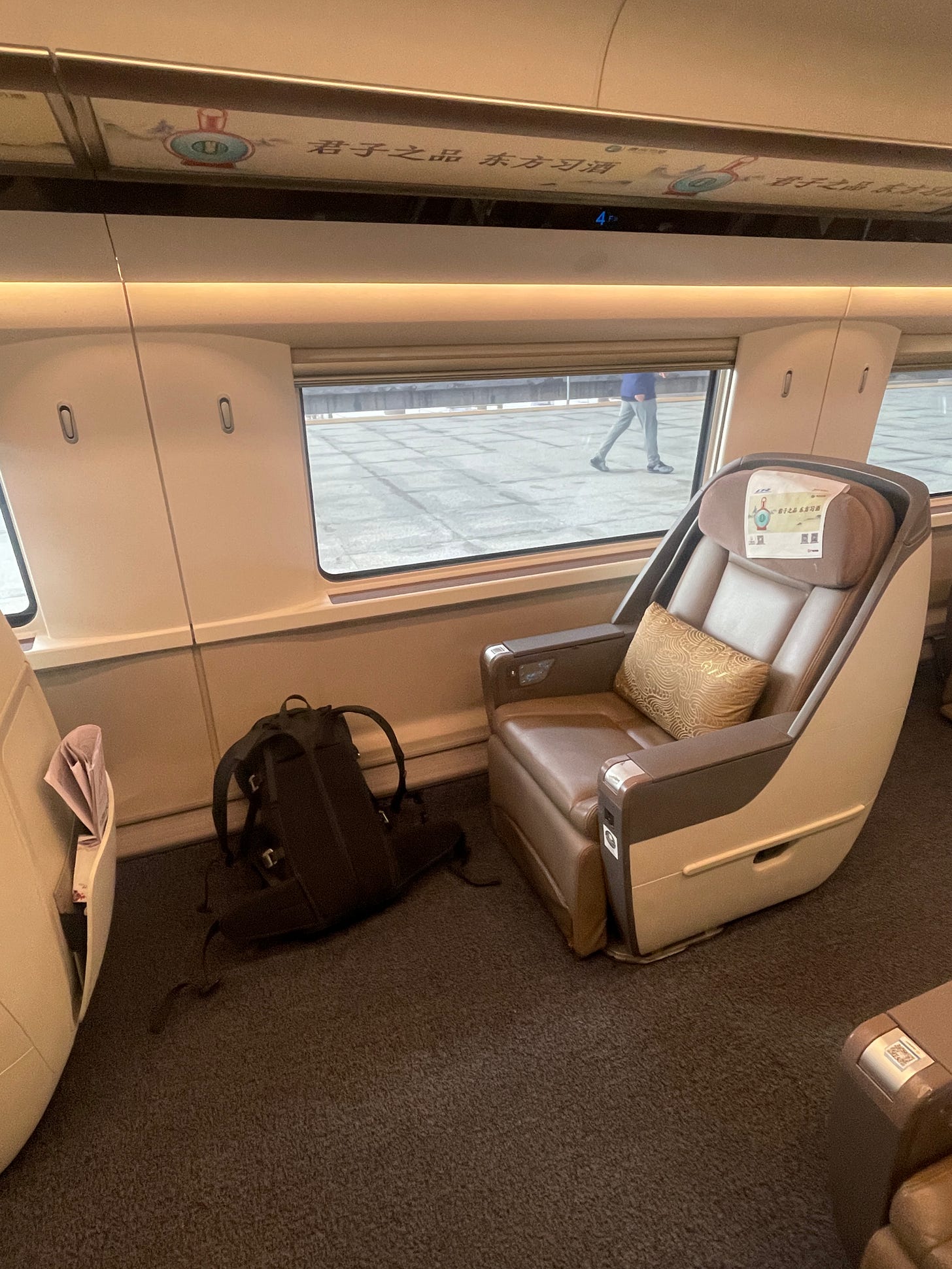
At the station, my business class reservation got me a shortcut entry, straight into a lounge. Departures weren’t announced in the lounge. Nothing so vulgar. Instead, a hostess came to my seat and politely suggested that I might now like to board my train, then escorted me all the way there. The seat came with a goodie bag and half a rugby field of legroom. The dissimilitude between first class and business class was large. This beast made the previous train look sluggish. Cruising speed 350 km/h. And that’s a literal cruising speed, not just a speed that we hit now and then: 350 was the speed we were usually moving at. 2,424 kilometres in 8 hours 15 minutes. An average of 293 km/h. Including stops. Despite the unnatural speed and the vast legroom, trophy for Best Train Overall remained with the Tashkent – Almaty overnighter, with its private cabins and restaurant car. The advantage of privacy was well demonstrated en route to Shenzhen when the guy on the other side of the carriage decided to eat. He extended his electric leg rest until it was horizontal, then sat on it, a leg each side, facing backwards, with his seat now in front of him. He put a large container of something on his tray table and began eating like an unmannered Labrador Retriever. Noodles were slurped. Bones were spat out. Other things were loudly chewed, mouth open. Lips were smacked. Nostrils were sniffed. Jesus. We went through Wuhan; by my reckoning within 15 kilometres of Wuhan Wet Market, and within 9 of the Wuhan Institute of Virology. Nothing to see here. The countryside became increasingly lush as we neared and then crossed the Tropic of Cancer. We pulled into Shenzhen Station at dusk. I could see about ten platforms as we entered, at each of which crouched a high-speed train. The scale of infrastructure is ridiculous. Nearly Hong Kong, but the last stage now wasn’t looking totally straightforward. I’d been plagued all day by a runny nose – a really, really runny nose - one that couldn’t be concealed for more than a few minutes. I suspected Hong Kong might still be sensitive about viruses, and symptoms thereof. I worried that a runny nose might not be allowed in. I’d been told that if I didn’t speak Chinese, I should allow an hour at Shenzhen Station to find and board my train to Hong Kong. That seemed about 45 minutes too conservative, even for a white man, so I’d booked another, earlier train. I’d lose US$18 on whichever train I didn’t take, but I’d avoid an hour of boredom. Finding the earlier one was easy, with time remaining for a self-congratulatory beer. Immediately after the beer my nose stopped running. Either the air-con on the Xi’an train had been the cause of the running, or the beer had killed the virus. I chose to believe the latter. I was soon on the train to Hong Kong, and twenty minutes later at Hong Kong West Kowloon Station. Fun fact – Hong Kong West Kowloon Station is not sovereign territory of Hong Kong. It’s designated a Chinese Mainland Port Area and subject to Chinese law. Many Hong Kongers are not ecstatic about that. HKWKS is also, by the way, a resplendent piece of architecture. Anyhoo, there was customs to navigate, and part of the navigation included answering questions on an iPad, and some of the questions, unsurprisingly, were about viral symptoms. I changed my mind about the beer killing a virus, and chose to believe that the runny nose had always been an air-con issue. So by answering No, re symptoms, I wouldn’t really be lying, would I? As it happened, I was incapable of operating the iPad. A customs guy came to help. He commandeered the ‘pad, and ticked No to every question on my behalf, without bothering to ask my opinion. When he got to the question about occupation, he ticked Other, and sent me on my way. Right then. But a few turns of a corridor later I was facing an array of body-temperature sensors, and Hong Kong was on the far side of said array. No one told me this was going to happen. I didn’t feel now that I had either a cold, or a high temperature, but if these sensors said I did, telling the customs people that I felt OK was unlikely to be enough to stop me being quarantined, or sent back to China, or maybe sent back to China and quarantined. I attempted to walk the gauntlet calmly. I made it. Continuing my patchy planning form, which first started going downhill in Turkey, I’d left my run to book a hotel in Kowloon too late – apparently my brain had never considered it important. Remaining available options in Tsim Sha Tsui were all cheap shitholes, except that, for shitholes, they weren’t cheap. The receptionist in my chosen shithole looked at me, picked up the phone, and told someone: We’ll have to give him a different room, he won’t fit in a single. I fat in the so-called double, but it was fortunate I had minimal luggage. But Tsim Sha Tsui is a good place to stay, no matter how shitty the hole. Just around the corner from my shithole was the Kowloon Taproom, which was the best craft beer bar I’d seen since, well, since well before Amsterdam. It had been a good day. I’d felt pretty happy about getting on the train in Xi’an that morning, because it was the last crucial transport connection, and therefore marked the point at which I’d managed to not miss any crucial transport connections. So that was a significant achievement. And although Shenzhen to Hong Kong had always looked like a gimmee, nothing’s done until it’s done, so my mood had improved another notch when I managed to board that train. But in the Kowloon Taproom, inhaling a New England IPA, with the whole adventure-ordeal behind me, happiness would not be an accurate description. I was beyond that. I was at Maximum Fucking Relief. I thanked Christ, and assured him I would NOT be doing that again. 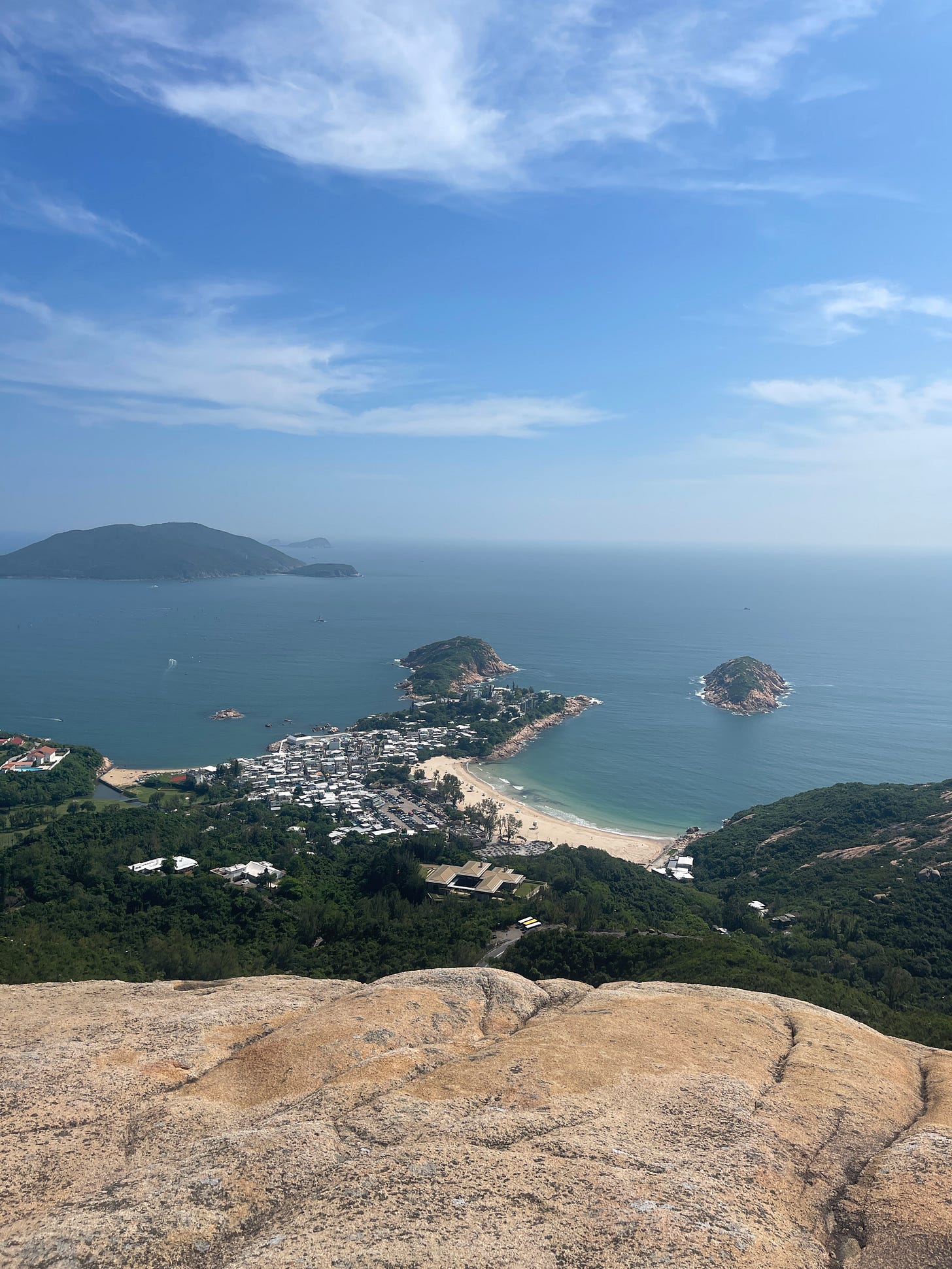
There was one thing left – to immerse myself, the next day, in the South China Sea. I decided to walk the Dragon’s Back, on the south side of Hong Kong Island, which would eventually deposit me at Big Wave Bay, which looked a good place to immerse. The last six kilometres from Chai Wan metro station to the Dragon was via classic Hong Kong taxi – the long wheel-based Toyota Comfort. There are plenty of original Comforts still running, but they’re getting old and they’re suffering replacement by a new Comfort Hybrid, which is a better vehicle in every respect, except vibe. 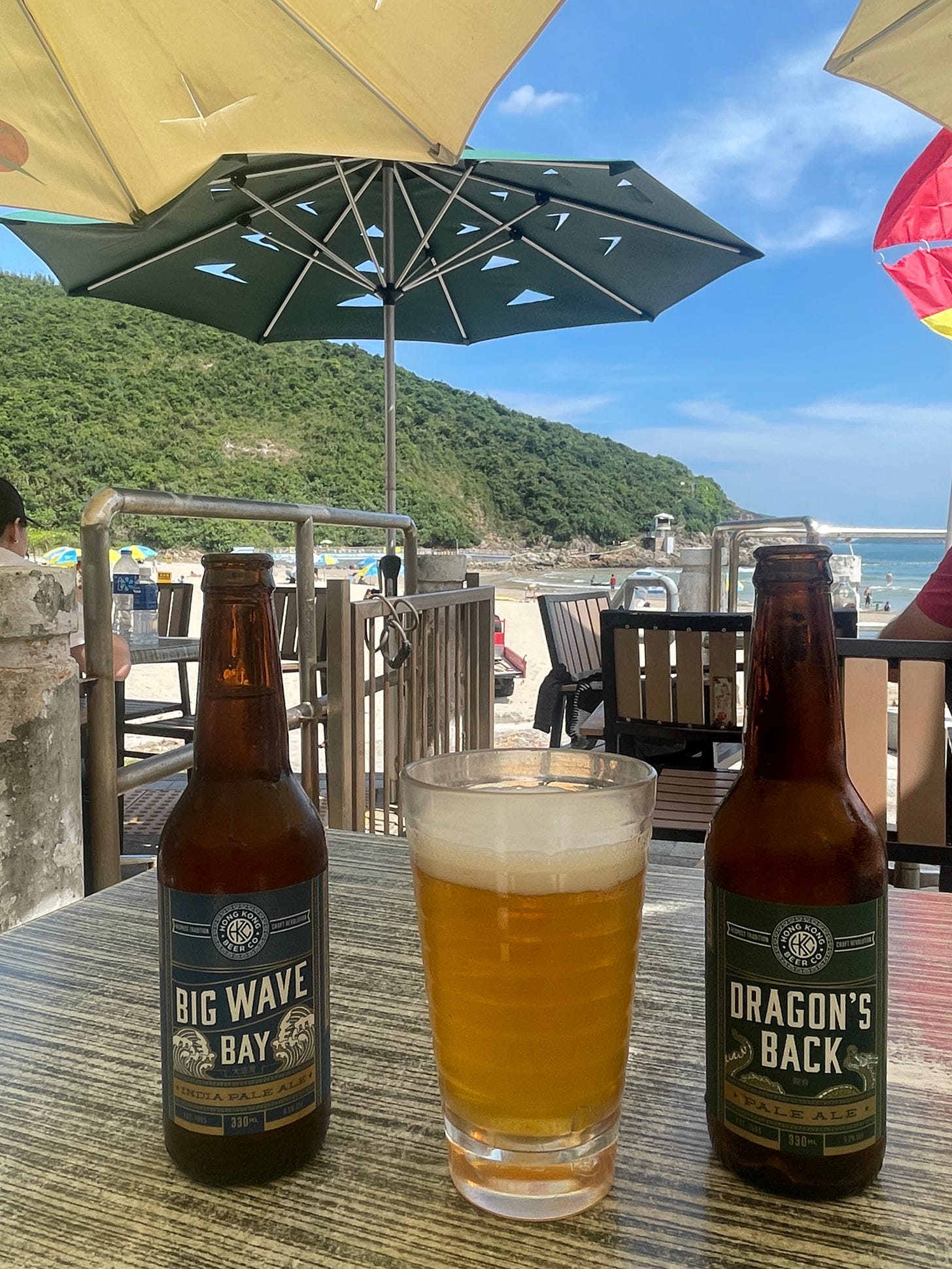
It’s recommended that walkers of the Dragon’s Back take water with them, because it’s moderately steep, and usually hot. Continuing my patchy planning form, I forgot to take water, something I realised only as I was slogging up the Back. Funnily enough, it was hot. I reached Big Wave Bay 2.5 hours later, quite thirsty. Fortunately a small operation on the edge of the beach, by the name of Eric’s Kitchen, was able to supply water, pizza, fried chicken, two excellent local beers with excellently local names, and a table with a view. I could fault nothing about any part of the Big Wave Bay experience. It is not impossible that I felt better than I had in the Kowloon Taproom. In due course, full immersion occurred. More than three times. Fin. |